Quick Answer:
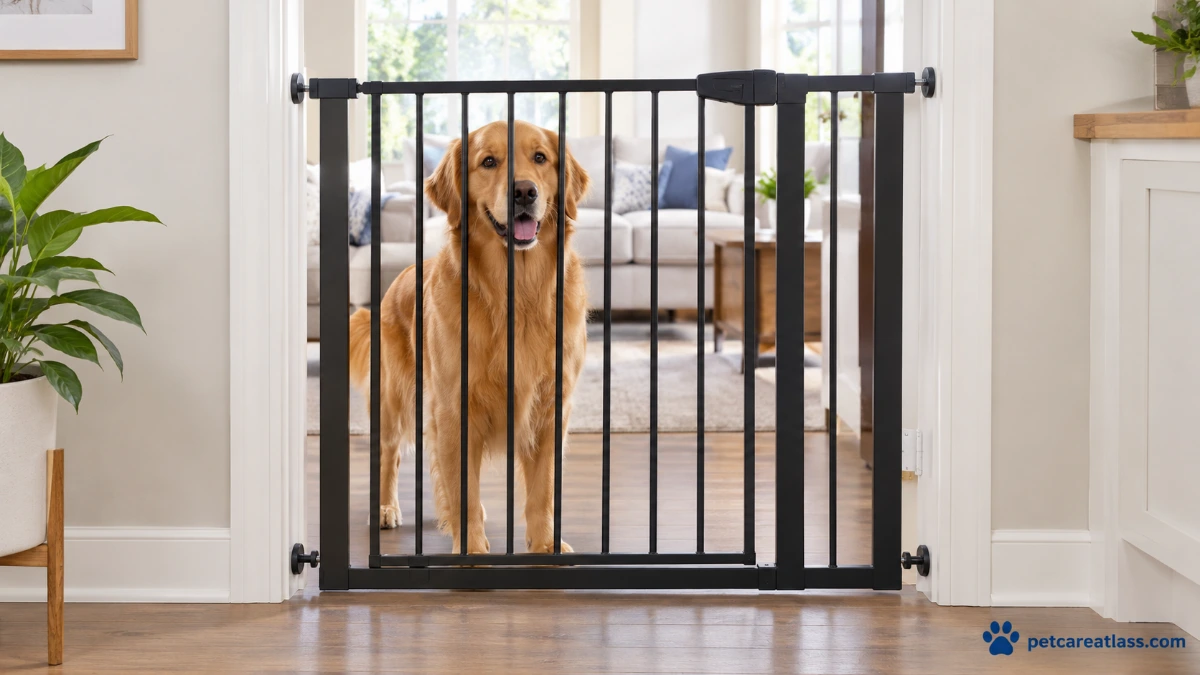
Pet gates for dogs help create safe boundaries inside your home by restricting access to stairs, kitchens, bedrooms, and other areas. The best gate depends on your dog’s size, jumping ability, chewing habits, and the space where you plan to install it. Choose a sturdy, properly fitted gate with a secure locking mechanism and no dangerous gaps.
Introduction
Choosing the right gate for your dog can make everyday life at home safer and easier. Whether you want to keep a curious puppy out of the kitchen, prevent your dog from accessing stairs, or create boundaries between rooms, the right barrier can help manage your pet’s movement without disrupting your household routine.
However, not all pet gates are suitable for every dog. Differences in height, strength, jumping ability, materials, and installation methods can affect safety and effectiveness. Understanding these factors before purchasing will help you find pet gates for dogs that fit your home, match your dog’s needs, and provide reliable everyday protection.
Key Takeaways
- Choose a gate based on your dog’s height, weight, jumping ability, and behavior.
- Pressure-mounted gates are convenient for ordinary doorways, while hardware-mounted gates provide a more secure installation.
- Use a properly installed hardware-mounted gate at the top of stairs.
- Metal gates are worth considering for strong dogs and persistent chewers.
- Measure the opening before purchasing and check the gate regularly for loose fittings or damage.
Why Do You Need a Pet Gate for Your Dog?
A dog gate is a practical way to manage your dog’s access to different parts of your home. Instead of constantly following your pet or closing every door, you can create clear boundaries while allowing your dog to remain part of household activities.
Here are some common situations where a dog gate can help:
- Keeping puppies away from hazards: Restrict access to electrical cords, cleaning products, kitchen appliances, and other household dangers.
- Protecting certain rooms: Prevent dogs from entering bedrooms, offices, kitchens, or rooms containing valuable belongings.
- Managing multiple pets: Create separate areas when dogs need space from each other or when introducing a new pet.
- Protecting stairs: Prevent dogs from accessing stairways when they are recovering from an injury or have difficulty navigating steps.
- Creating a comfortable resting area: Give your dog access to a quiet, puppy-proofed room where they can relax without unnecessary interruptions.
- Managing visitors: Keep dogs safely separated when guests, maintenance workers, or delivery personnel enter your home.
A gate should support safe household management, not replace exercise, supervision, training, or social interaction.
Types of Pet Gates for Dogs
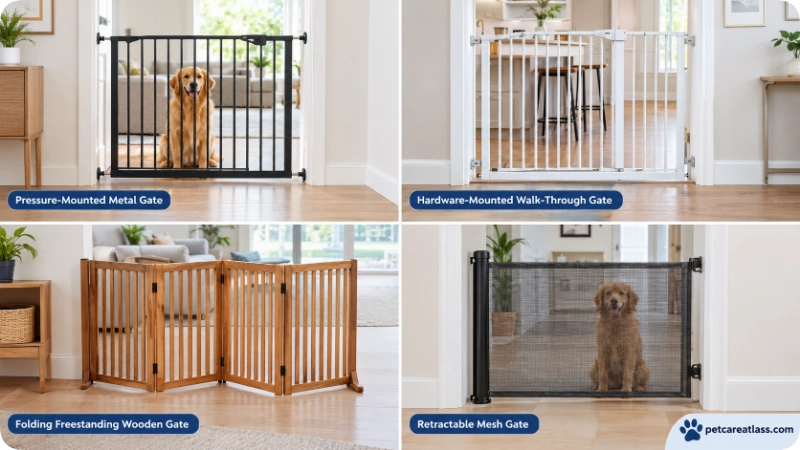
Dog gates come in several designs, each suited to different spaces and household needs. Understanding how they work will help you avoid buying a gate that is difficult to install or unsuitable for your dog.
1. Pressure-Mounted Dog Gates
Pressure-mounted gates use adjustable tension rods or pressure fittings to hold the gate between two walls or inside a doorframe. They generally do not require drilling into the surrounding structure.
Best for: Small to medium-sized dogs, puppies, and ordinary doorways.
Advantages:
- Usually easy to install and remove.
- Convenient for temporary room separation.
- Available in adjustable widths.
- Suitable for homes where permanent installation is undesirable.
Limitations:
- Can become loose if a dog repeatedly pushes against them.
- May not withstand strong dogs that lean, jump, or paw at the barrier.
- Not appropriate for the top of a staircase.
Check the manufacturer’s installation instructions and inspect the fittings regularly. Pressure-mounted gates are best reserved for locations where a dislodged gate would not create a serious fall hazard.
2. Hardware-Mounted Dog Gates
Hardware-mounted gates attach to a solid doorframe, wall, or suitable supporting structure using screws and mounting brackets.
Best for: Large dogs, energetic dogs, stairways, and frequently used barriers.
Advantages:
- More secure attachment than ordinary pressure mounting.
- Suitable for locations where a stronger barrier is needed.
- Available in different heights and widths.
- Often available with convenient walk-through doors.
Limitations:
- Require drilling and installation.
- Less convenient to move between rooms.
- Incorrect installation can compromise stability.
For the top of a staircase, choose a hardware-mounted model specifically suitable for that location. Follow its installation instructions, including the permitted mounting surfaces and opening direction.
3. Freestanding Dog Gates
Freestanding gates stand independently without attaching to walls or doorframes. Some have folding panels that create a zigzag arrangement, while others have wider feet for stability.
Best for: Small, calm dogs and temporary room separation.
Advantages:
- No drilling or permanent installation.
- Easy to reposition.
- Convenient for open spaces and wide entrances.
- Some models fold away for storage.
Limitations:
- Can tip over if pushed.
- May not contain large or determined dogs.
- Not suitable for protecting the top of stairs.
Before choosing this style, consider whether your dog can jump over it, push it aside, or knock it down.
4. Retractable Dog Gates
Retractable gates use a mesh barrier that extends across an opening and rolls back into a housing when not needed.
Best for: Homes where saving space and maintaining a clear walkway are priorities.
Advantages:
- Retracts when the opening is not in use.
- Takes up relatively little space.
- Can accommodate some wider openings.
- Provides a less visually bulky barrier.
Limitations:
- Mesh may be damaged by chewing or scratching.
- Installation quality affects stability.
- Some dogs may push against or climb the material.
Check the manufacturer’s instructions for approved locations and make sure the mesh remains properly tensioned. Do not assume a retractable model is suitable for stairs.
5. Extra-Wide and Extra-Tall Dog Gates
These gates are designed for larger openings or dogs that can easily jump over standard barriers. Some models use extension panels, while others feature taller metal frames.
Best for: Large breeds, athletic dogs, and homes with wide doorways.
Advantages:
- Cover wider entrances.
- Provide additional height for jump-prone dogs.
- Reduce the need for improvised barriers.
- Available in different mounting styles.
Limitations:
- May require additional support or extension components.
- Larger models can be heavier and harder to move.
- Incorrect sizing can leave dangerous gaps.
Always check the maximum supported opening width and the manufacturer’s approved extension combinations.
Pressure-Mounted vs. Hardware-Mounted Dog Gates
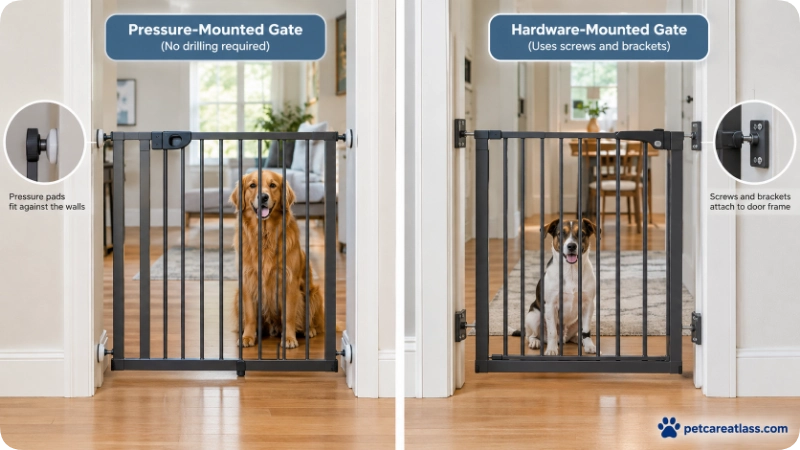
These two installation styles are among the most common options. The main difference is how they attach to your home and how securely they stay in position.
| Feature | Pressure-Mounted Gate | Hardware-Mounted Gate |
|---|---|---|
| Installation | Adjustable pressure fittings | Screws and brackets |
| Drilling | Usually not needed | Required |
| Stability | Depends on tension and surface | Generally more secure |
| Portability | Easy to remove and move | Usually fixed in place |
| Best location | Standard doorways | Stairways and secure barriers |
| Suitable dogs | Calm, less forceful dogs | Large, active, or persistent dogs |
| Main limitation | May loosen or shift | Requires permanent installation |
Which one should you choose?
For an ordinary doorway between two rooms, a properly installed pressure-mounted gate may be sufficient for a dog that does not push or climb barriers.
For the top of a staircase, choose a suitable hardware-mounted gate. If your dog regularly pushes against barriers or has already knocked one over, consider a more secure installation rather than relying on pressure fittings.
How to Choose the Right Pet Gate for Your Dog
The right gate should match your dog’s physical abilities, behavior, and the location where you intend to use it. Consider these factors before purchasing.
1. Measure Your Doorway or Opening
Start by measuring the exact width of the opening where you plan to install the gate.
Measure between the actual mounting surfaces, following the manufacturer’s measurement instructions. If the opening is uneven, check its width at multiple points.
Also consider:
- The height available for installation.
- Whether the opening has baseboards or decorative trim.
- Whether the walls can support mounting hardware.
- Whether extension panels are needed.
- Whether the gate will obstruct nearby furniture or doors.
Do not assume that a standard doorway measurement will fit every gate.
2. Choose the Correct Gate Height
Your dog’s height and jumping ability matter more than breed name alone.
A small dog may be contained by a relatively short gate, while an athletic medium-sized dog might jump over a barrier that appears tall enough.
Consider your dog’s:
- Standing height.
- Jumping ability.
- Climbing behavior.
- Previous attempts to escape barriers.
For dogs that jump, select an appropriately taller model with a design that does not provide convenient footholds. No particular height guarantees containment for every dog.
3. Consider Your Dog’s Weight and Strength
A gate designed for a small puppy may not withstand a large, powerful adult dog.
If your dog leans against barriers, paws at them, or repeatedly attempts to push through, prioritize sturdy construction and secure mounting.
For stronger dogs, metal frames are often a sensible option because they generally withstand chewing and physical pressure better than lightweight alternatives.
4. Select a Suitable Material
Different materials offer different advantages in terms of durability, appearance, weight, and maintenance.
| Material | Advantages | Things to Consider |
|---|---|---|
| Metal | Strong and suitable for active dogs | Check sharp edges, coating, and bar spacing |
| Wood | Attractive decorative designs | Can be chewed or damaged by moisture |
| Plastic | Lightweight and easy to clean | May not suit strong chewers |
| Mesh | Lightweight and convenient for retractable gates | Can tear from scratching or chewing |
If your dog chews barriers, look for a durable metal model with a smooth finish and no accessible sharp edges.
5. Check the Bar Spacing and Design
The openings between bars should be small enough to prevent your dog from squeezing through or getting its head, paws, or other body parts trapped.
Pay particular attention if you have:
- Very small puppies.
- Toy breeds.
- Dogs with narrow heads.
- Dogs that repeatedly try to push through openings.
Vertical bars can also be preferable to designs with horizontal crosspieces that might provide footholds for climbing.
6. Look for a Secure Locking Mechanism
A gate is only useful if it stays closed when you need it to.
Look for:
- A reliable locking mechanism.
- A latch that cannot easily be operated by your dog.
- A clearly secured closing position.
- Smooth opening and closing.
- A design that adults can operate conveniently.
If multiple family members use the gate, make sure everyone understands how to close and lock it properly.
7. Consider Daily Convenience
Think about how frequently you will walk through the opening.
A walk-through gate can be more practical than a barrier that must be removed every time you enter or leave a room.
For busy household areas, consider:
- One-handed operation.
- An automatic closing feature, if available.
- A secure latch indicator.
- A low or absent threshold where appropriate.
- A design that does not obstruct mobility.
Convenience matters because a gate that is difficult to operate may not be closed consistently.
Best Places to Install Dog Gates Around Your Home
The ideal installation location depends on your dog’s needs and the hazards you want to prevent.
Kitchen
A kitchen gate can prevent your dog from accessing hot appliances, food preparation areas, trash cans, and potentially harmful foods.
A pressure-mounted gate may work for a suitable doorway if your dog cannot easily dislodge it.
Living Room
A dog gate can separate the living room from other areas while allowing your pet to remain close to the family.
Freestanding or mounted models may work, depending on the room layout and your dog’s behavior.
Bedroom
Use a gate to control access to bedrooms when you want to protect bedding, manage nighttime routines, or keep your dog away from certain belongings.
Hallways
Hallways are useful locations for creating temporary boundaries between rooms. Measure the full opening and consider whether an extra-wide model is necessary.
Stairways
Stairways require additional attention because a failed barrier can expose your dog to a serious fall.
Use a hardware-mounted gate designed for the specific stairway location. At the top of stairs, choose an installation that does not create a dangerous trip hazard and opens in the direction specified by the manufacturer.
Never rely on a freestanding or ordinary pressure-mounted gate as protection at the top of a staircase.
How to Install a Dog Gate Safely
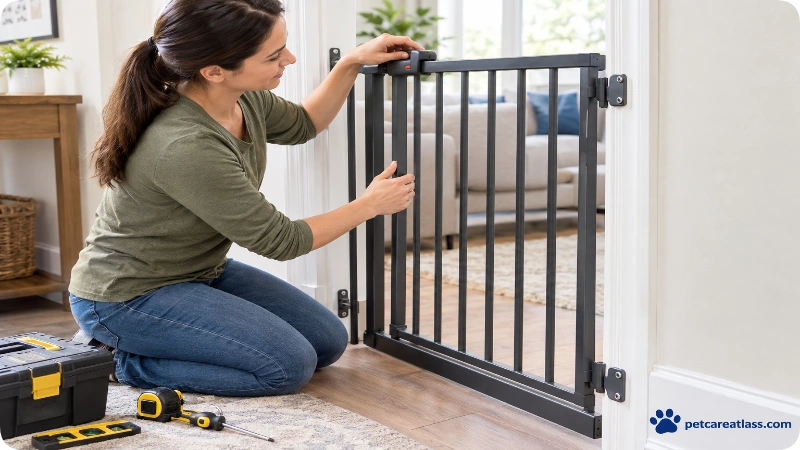
Correct installation is essential for preventing the gate from shifting, falling, or leaving openings your dog can escape through.
Follow these general steps:
- Measure the opening: Confirm the width and available height before unpacking the gate.
- Read the instructions: Check the manufacturer’s mounting requirements, hardware, and approved locations.
- Prepare the installation area: Make sure the mounting surfaces are suitable and free from loose or damaged material.
- Attach the gate: Install the pressure fittings or mounting brackets according to the supplied instructions.
- Check the alignment: Make sure the gate sits correctly and does not leave gaps along the sides or bottom.
- Test the latch: Open and close the gate several times to confirm that the locking mechanism works.
- Inspect its stability: Check that the gate does not shift, wobble, or come loose under ordinary use.
For hardware-mounted gates, use suitable structural supports and the specified fasteners. If you are unsure whether the wall or doorframe can support the installation, consult a qualified installer.
Important: Never modify a gate, remove required components, or use extensions that the manufacturer has not approved.
Common Mistakes to Avoid When Buying Dog Gates
Choosing the wrong gate can create new problems instead of solving existing ones.
| Common Mistake | Why It’s a Problem | Better Approach |
|---|---|---|
| Choosing a short gate | Dogs may jump over it | Select a height suited to your dog |
| Ignoring measurements | Gate may not fit securely | Measure the opening first |
| Pressure-mounting at stairs | Gate may become dislodged | Choose a suitable hardware-mounted gate |
| Buying a lightweight gate | Strong dogs may push it over | Choose sturdy construction and secure mounting |
| Ignoring bar spacing | Small dogs may squeeze through | Check spacing against your dog’s size |
| Choosing a difficult latch | Gate may be left unsecured | Choose an easy, reliable locking system |
| Ignoring damage | Broken parts can cause injuries | Inspect the gate regularly |
How to Help Your Dog Get Used to a Pet Gate
Some dogs accept a new barrier quickly, while others may bark, scratch, or become frustrated when access to a familiar area is restricted.
Introduce the gate gradually rather than forcing your dog to accept it immediately.
Try these steps:
- Let your dog investigate the installed gate while you supervise.
- Reward calm behavior around the barrier with praise or suitable treats.
- Begin with short periods of separation while remaining nearby.
- Gradually increase the time as your dog becomes comfortable.
- Provide toys, enrichment activities, and a comfortable resting area on the other side.
- Reward your dog for settling rather than scratching or jumping at the gate.
If your dog becomes distressed, reduce the difficulty and work at a slower pace.
Persistent panic, destructive escape attempts, or separation-related distress may require help from a qualified reward-based dog trainer or veterinary behavior professional.
Dog Gate Safety and Maintenance
A dog gate should be checked regularly, especially when it is used every day.
Follow these precautions:
- Inspect mounting points, screws, brackets, and pressure fittings.
- Check for broken bars, loose mesh, sharp edges, and damaged coatings.
- Make sure the locking mechanism works correctly.
- Keep the area around the gate free from objects your dog could use to climb over it.
- Never leave a dog unattended behind a damaged or unstable barrier.
- Supervise puppies and dogs that are still learning how to behave around gates.
- Do not use a gate as a substitute for appropriate supervision or extended confinement.
Dogs should still have sufficient opportunities for exercise, social contact, play, and rest. A gate is a household management tool, not a way to isolate a dog for long periods.
Frequently Asked Questions
What is the best type of pet gate for dogs?
The best type depends on your dog’s size, strength, and the installation location. Hardware-mounted metal gates are a strong option for large or active dogs, while pressure-mounted gates can work well for ordinary doorways when correctly installed and used with suitable dogs.
Are pressure-mounted dog gates safe?
Pressure-mounted gates can be suitable for separating rooms on level floors when installed correctly. However, they can loosen if a dog pushes against them repeatedly. They should not be used at the top of stairs, where a dislodged gate could cause a serious fall.
What height should a dog gate be?
There is no single height that works for every dog. Choose a gate based on your dog’s standing height, jumping ability, and tendency to climb. An athletic dog may need a much taller barrier than a calm dog of similar weight.
Are metal dog gates better than wooden gates?
Metal gates are often a better choice for dogs that chew, scratch, or push against barriers because they generally offer greater durability. Wooden gates can be attractive and suitable for calmer dogs, but their resistance to chewing depends on the construction and finish.
Can I use a baby gate for my dog?
Some baby gates can work as dog barriers, provided their construction, dimensions, mounting system, and openings are suitable for your dog. However, not every baby gate is designed to withstand a dog’s pushing, chewing, or climbing. Check the manufacturer’s instructions before using one.
Are freestanding dog gates effective?
Freestanding gates can work for small, calm dogs that do not jump, push, or climb barriers. They are convenient because they require no permanent installation. However, they are not a reliable choice for powerful dogs or locations where a fallen gate could cause injury.
How do I stop my dog from jumping over a gate?
Choose a taller gate that does not provide convenient footholds, remove nearby furniture or objects that could help your dog climb, and reward calm behavior around the barrier. If jumping continues, consider a more secure enclosure and seek help from a qualified trainer.
Conclusion
Pet gates for dogs can make your home safer and easier to manage when you choose the right design for your pet and living space. Consider your dog’s size, jumping ability, chewing habits, and the location where the gate will be installed.
Prioritize secure mounting, appropriate height, reliable locks, and durable materials. Most importantly, use gates as part of responsible supervision and training so your dog can remain comfortable, active, and included in family life.

Daniel Brooks is a pet care and animal behavior writer at petcareatlass.com focused on helping owners better understand their pets’ behavior and everyday needs. He creates practical, easy-to-follow content on pet communication, training, welfare, and responsible care.