Quick Answer:
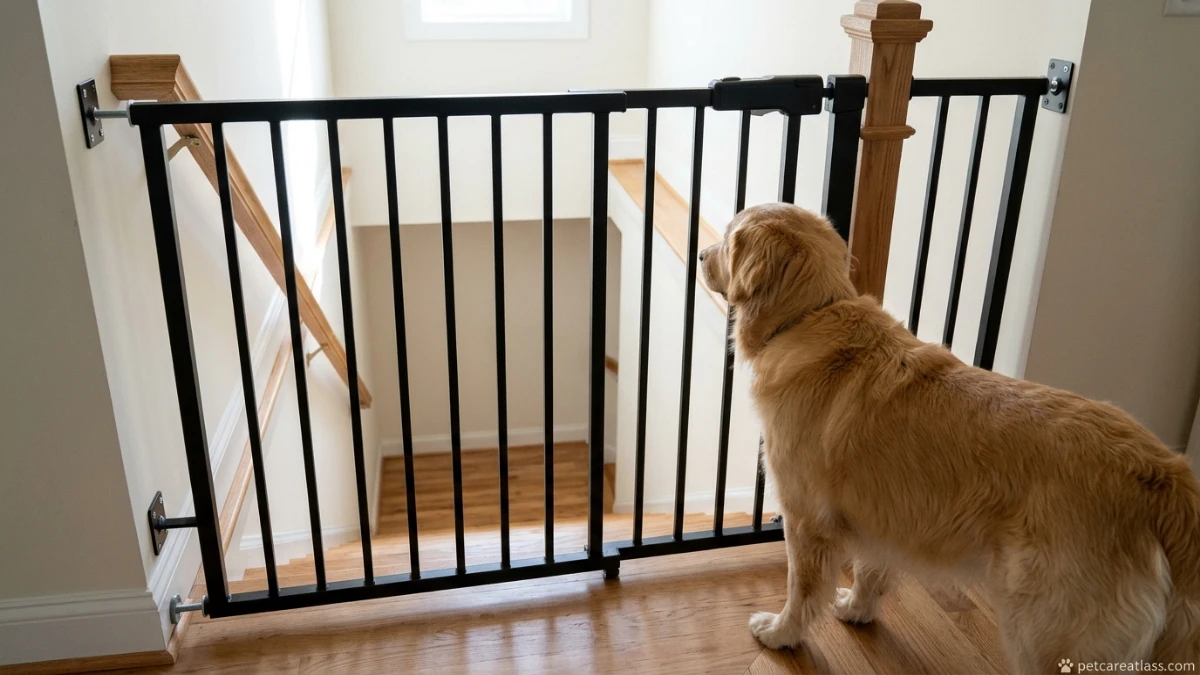
A hardware-mounted pet gate for stairs is usually the best choice for preventing pets from accessing dangerous stairways, particularly at the top of stairs. Choose a sturdy gate with secure mounting hardware, an effective locking mechanism, appropriate height, and a design specifically approved for stair installation.
Staircases can be challenging for pets, especially puppies, small dogs, senior animals, and pets with limited mobility. An unexpected fall or an attempt to climb stairs without supervision can create unnecessary safety risks.
Installing the right pet gate for stairs helps restrict access while giving you better control over your pet’s movement around the home. However, choosing a suitable gate involves more than finding the correct width.
Mounting style, gate height, locking mechanisms, material, and staircase design all matter. Understanding these features will help you select a secure, practical barrier that fits your home and your pet’s needs.
Key Takeaways
- Hardware-mounted gates are generally preferred for the top of staircases.
- Not every pressure-mounted or retractable gate is approved for stair use.
- Measure the staircase opening carefully before purchasing.
- Consider your pet’s height, weight, jumping ability, and climbing behavior.
- Check mounting hardware, locks, hinges, and frame condition regularly.
- Introduce the barrier gradually so your pet becomes comfortable with the new boundary.
Why Stairways Can Be Risky for Household Pets
Stairs are a normal part of many homes, but they can present challenges for animals with different sizes, ages, and physical abilities. A pet that confidently walks across a flat floor may struggle with steep steps, slippery surfaces, or unfamiliar staircases.
Several situations make stair access particularly concerning.
Puppies and young dogs: Puppies are still developing coordination and learning how to navigate their surroundings. Their curiosity may also encourage them to explore stairs before they are ready.
Small dogs: Short-legged breeds may have difficulty managing tall steps. Repeated stair climbing can also be uncomfortable for some dogs.
Senior pets: Older animals may experience reduced strength, balance, or mobility, making staircases more difficult to navigate.
Cats: Although many cats are agile climbers, kittens, senior cats, and cats with mobility limitations may benefit from restricted stair access.
Recovering pets: Animals recovering from surgery or injuries may need to avoid stairs until their veterinarian approves normal activity.
A properly installed barrier helps manage these situations by restricting unsupervised access. However, a gate does not replace supervision or veterinary advice when an animal has mobility problems.
Comparing Different Types of Stair Gates
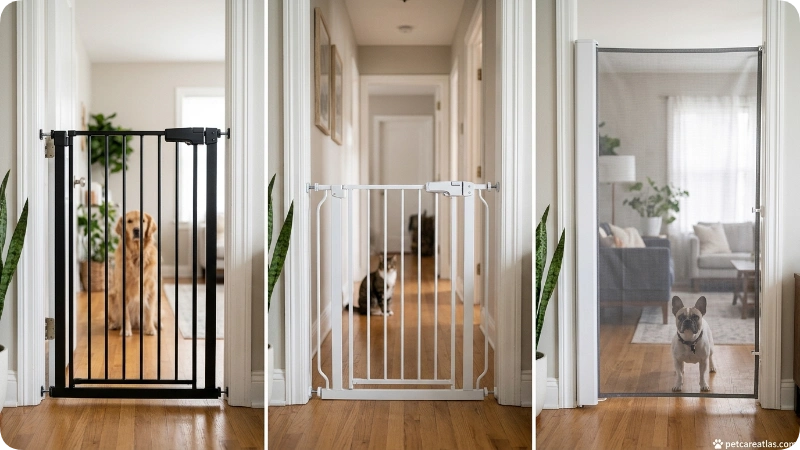
Pet gates come in several designs, and each has different installation requirements and limitations. Understanding these differences will help you choose a suitable option.
Hardware-Mounted Pet Gates
Hardware-mounted gates attach to walls or suitable structural surfaces using screws and mounting brackets. Their secure attachment makes them generally preferable for the top of a staircase.
Advantages:
- Secure attachment to suitable mounting surfaces.
- Less likely to shift when properly installed.
- Available in different heights, widths, and materials.
- Walk-through designs provide convenient access.
- Some models include mechanisms that prevent opening toward the stairs.
Limitations:
- Usually require drilling.
- Installation takes more time than pressure-mounted alternatives.
- Incorrect mounting can compromise stability.
- Some models are not approved for stair installations.
Best for: Households that need a more permanent barrier at the top of a staircase.
Pressure-Mounted Pet Gates
Pressure-mounted gates use adjustable tension to hold the frame between two opposing surfaces. They are popular because many models can be installed without drilling.
However, ordinary pressure-mounted gates should not automatically be used at the top of stairs. They can shift or become dislodged if an animal pushes against them.
Only consider a particular model for stair use when its manufacturer explicitly approves that installation and provides the necessary instructions.
Advantages:
- Generally easy to install.
- Convenient for temporary barriers.
- Usually removable without permanent wall modifications.
- Available in different widths and materials.
Limitations:
- May lose tension over time.
- Can move under repeated pressure.
- Some designs have bottom bars that create tripping hazards.
- Not universally suitable for stairways.
Best for: Appropriate doorways and room entrances away from dangerous drops.
Retractable Pet Gates
Retractable gates use a flexible mesh panel that rolls into a housing when the barrier is not needed. They can be useful in homes where a conventional swinging gate would take up too much space.
However, their suitability for stairs depends on the individual model. Check the manufacturer’s instructions before using one at the top or bottom of a staircase.
Advantages:
- Retracts when not in use.
- Takes up relatively little space.
- Convenient for certain wide openings.
- Does not require a conventional swinging door.
Limitations:
- Mesh can be damaged by chewing or scratching.
- Requires secure mounting.
- Some pets may push or climb against the material.
- May need more frequent inspection for damage.
Best for: Homes with limited space where a particular retractable model is explicitly approved for stair use.
Freestanding Pet Gates
Freestanding gates use a self-supporting frame rather than permanent wall attachments. They are convenient for temporarily dividing rooms or creating boundaries in suitable locations.
However, they can tip over or move when pushed. For this reason, they should not be placed at the edge of a staircase where a failed barrier could cause a fall.
Best for: Temporary room separation on stable, level flooring away from stairs.
Pet Gate Types Compared
| Gate Type | Installation | Stair Suitability | Main Limitation |
|---|---|---|---|
| Hardware-mounted | Screws and brackets | Generally preferred at the top | Requires drilling |
| Pressure-mounted | Adjustable tension | Only approved models | May become dislodged |
| Retractable | Mounted brackets | Depends on model | Mesh can be damaged |
| Freestanding | No permanent mounting | Not suitable for stair edges | Can tip or move |
Essential Features of a Safe Stair Gate
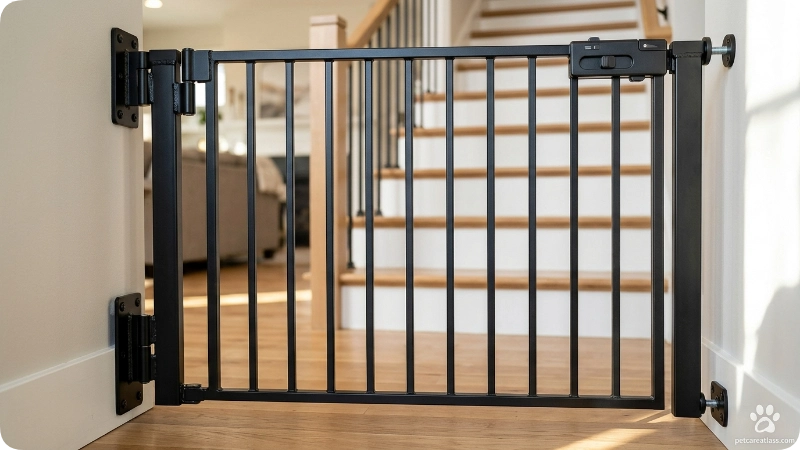
A suitable gate should provide a secure barrier without creating additional hazards for your pet or household members.
Secure Mounting Hardware
For a gate at the top of stairs, prioritize a model designed for hardware mounting.
Check whether the mounting brackets attach to suitable structural surfaces, such as wall studs or approved solid mounting points. Drywall or plaster alone may not provide sufficient support.
If your staircase has wooden or metal railings, check whether the manufacturer offers compatible banister adapters.
A Reliable Locking Mechanism
A secure latch helps prevent pets from pushing the gate open.
Look for:
- A locking mechanism that engages fully.
- A latch that is difficult for pets to manipulate.
- An opening mechanism adults can operate conveniently.
- A design that allows you to confirm the gate is properly closed.
Test the locking mechanism after installation and whenever you notice unusual movement.
Controlled Opening Direction
Opening direction is particularly important at the top of a staircase.
Choose a gate with a design that prevents it from swinging outward over the steps. Some models include a directional stop that allows the gate to open toward the landing only.
This feature helps reduce the risk of accidentally opening the gate over the staircase.
Appropriate Gate Height
The gate should be tall enough to discourage your pet from jumping over it.
Consider your animal’s:
- Standing height.
- Jumping ability.
- Climbing behavior.
- Age and physical condition.
- Previous attempts to escape barriers.
A gate that works for a small, calm dog may not contain a large, athletic breed.
Safe Bar Spacing
The distance between vertical bars should be appropriate for your pet’s size.
Openings that are too wide may allow small animals to squeeze through or become trapped. Check the actual measurements rather than relying on product photographs.
For cats and very small dogs, consider whether the animal can climb through, over, or around the structure.
A Threshold-Free Design
Some traditional gates have a raised bottom bar across the opening. This can create a tripping obstacle for people walking through the gate.
At the top of stairs, consider a threshold-free design specifically approved for that installation. A properly selected model can make everyday access more convenient while reducing the number of obstacles on the landing.
Measuring Your Staircase Before Buying
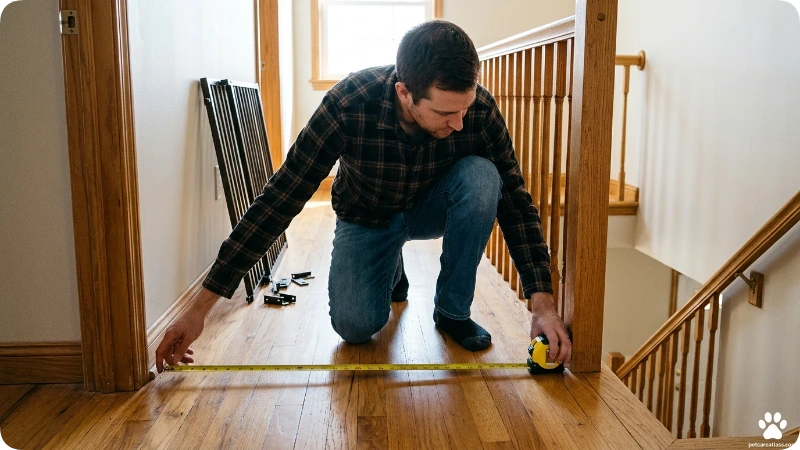
Accurate measurements help prevent installation problems and ensure that the selected gate fits the available opening.
Follow these steps before ordering:
Step 1: Measure the opening width.
Use a tape measure to determine the distance between the two intended mounting surfaces. Do not assume the opening is perfectly square.
Step 2: Measure at multiple heights.
Check the width near the floor, around the middle, and near the intended mounting position. This helps identify walls or railings that are not parallel.
Step 3: Identify the mounting surfaces.
Determine whether your installation involves:
- Two solid walls.
- A wall and a wooden banister.
- Two banisters.
- A wall and an irregular railing.
The mounting arrangement affects which gate and accessories will work.
Step 4: Check the available landing space.
Make sure the gate can open in the permitted direction without hitting furniture, walls, or other obstacles.
Step 5: Compare measurements with product specifications.
Check the manufacturer’s minimum and maximum opening widths. Include any required extensions when calculating the finished dimensions.
Never force a gate into an opening outside its approved measurement range.
Installing a Gate at the Top or Bottom of Stairs
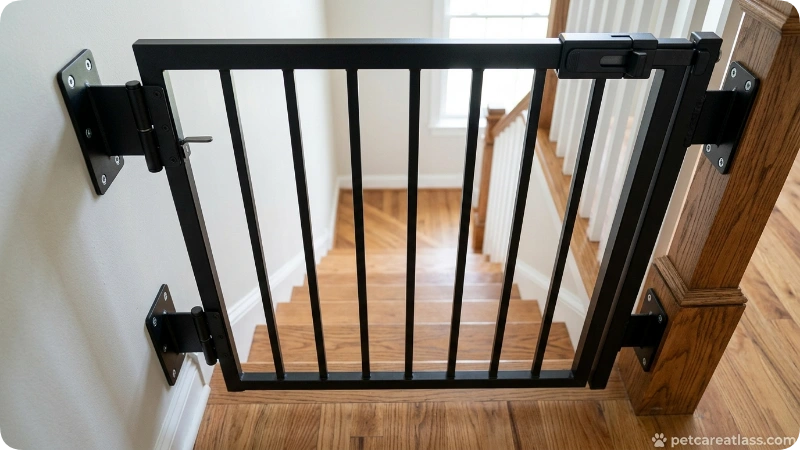
Installation requirements vary by model, so always use the manufacturer’s instruction manual as your primary guide.
Installing a Gate at the Top of Stairs
The top of a staircase requires particular attention because a failed barrier could allow an animal to fall down the steps.
- Select a gate explicitly approved for top-of-stair installation.
- Identify suitable mounting surfaces and structural supports.
- Measure the opening according to the manufacturer’s instructions.
- Position the mounting brackets at the specified locations.
- Attach the brackets using the supplied or manufacturer-approved hardware.
- Install the gate frame and check that all connections are secure.
- Confirm that the gate opens toward the landing, not over the stairs.
- Test the locking mechanism and opening direction.
- Check for dangerous gaps around the frame.
Avoid installing a gate directly onto unsupported drywall, weak trim, or an unstable railing. If the mounting arrangement is uncertain, consult a qualified installer.
Installing a Gate at the Bottom of Stairs
A gate at the bottom can help prevent pets from climbing upstairs without supervision.
Depending on the staircase design and manufacturer’s instructions, you may have more installation options than at the top.
Before installation:
- Position the gate where it does not obstruct a doorway or walkway.
- Check that the frame is stable.
- Avoid gaps that allow pets to squeeze underneath.
- Make sure the latch closes properly.
- Keep nearby furniture and objects from becoming climbing aids.
Do not assume that a gate suitable for a doorway is automatically suitable for a stairway.
Choosing the Right Material for Your Home
Pet gates commonly use metal, wood, plastic, or mesh. Each material has different strengths and limitations.
| Material | Main Advantages | Possible Limitations | Suitable For |
|---|---|---|---|
| Metal | Strong and chew-resistant | Can be heavy | Active dogs and persistent chewers |
| Wood | Traditional look and solid build | May scratch or be chewed | Calm pets |
| Plastic | Lightweight and easy to clean | May be less durable | Smaller, less forceful pets |
| Mesh | Lightweight and retractable | Can tear or get damaged | Pets that do not chew or claw barriers |
Metal is often a practical choice for active dogs, particularly when durability is a priority. However, material alone does not determine safety. Mounting quality, frame construction, locking hardware, and correct installation are equally important.
Selecting a Gate for Different Pets
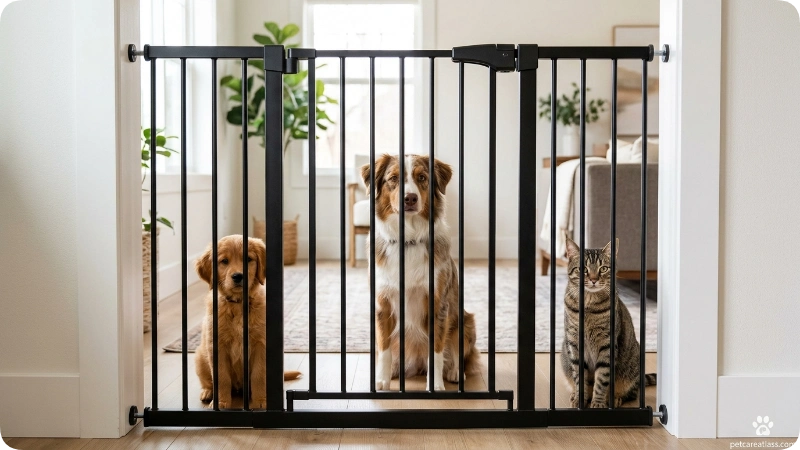
A gate that works for one pet may not contain another. Consider your animal’s behavior, physical abilities, and size before choosing a design.
For Puppies
Puppies are naturally curious and may investigate unfamiliar barriers by pushing, chewing, or squeezing through openings.
Choose a sturdy gate with appropriately spaced bars and a secure latch. Avoid designs with gaps large enough for a puppy to become trapped.
Introduce the gate gradually and reward calm behavior around it.
For Large Dogs
Large dogs can put considerable force against a barrier.
Look for a strong hardware-mounted design with suitable height and durable construction.
A gate that is technically wide enough may still be unsuitable if your dog can jump over it or force its way through.
For Small Dogs
Small dogs may squeeze through openings that larger breeds cannot use.
Check the distance between bars and the clearance underneath the gate. Also consider your dog’s jumping ability rather than assuming a small animal cannot overcome a tall barrier.
For Cats
Cats can climb and jump over many conventional pet gates.
If your goal is to restrict a cat’s access to stairs, consider a taller, more difficult-to-climb barrier or a properly enclosed alternative.
Check for gaps that could allow a kitten or small cat to squeeze through. Never assume that a gate designed for dogs will contain a determined cat.
For Senior or Mobility-Impaired Pets
Older pets and animals with mobility limitations may need restricted stair access.
Choose a stable barrier that does not require your pet to step over a raised threshold. Keep the gate closed whenever access is restricted.
If your pet has recently developed difficulty using stairs, ask your veterinarian whether a mobility assessment or additional environmental changes are appropriate.
Common Buying and Installation Mistakes
A poorly selected gate can create problems even when its dimensions appear correct.
| Common Mistake | Why It Matters | Better Approach |
|---|---|---|
| Choosing by appearance | May not suit your pet | Check materials and mounting |
| Using an ordinary pressure gate at stairs | May become dislodged | Choose a model approved for stair use |
| Buying the wrong width | May not fit securely | Measure the opening first |
| Ignoring gate height | Pets may jump over it | Consider your pet’s jumping ability |
| Overlooking bar spacing | Small pets may squeeze through | Check measurements |
| Choosing a difficult latch | Gate may be left unsecured | Test the locking mechanism |
| Ignoring maintenance | Loose hardware reduces stability | Inspect regularly |
| Installing on weak surfaces | Mounting points may fail | Use suitable structural supports |
Helping Your Pet Adjust to a New Barrier
Some animals accept a new barrier quickly, while others may bark, scratch, or become frustrated when access to a familiar area is restricted.
A gradual introduction can make the transition easier.
- Allow your pet to investigate the closed gate while you supervise.
- Reward calm behavior near the barrier.
- Avoid encouraging jumping, scratching, or pushing.
- Keep food, water, resting areas, and toys accessible.
- Maintain a consistent household routine.
- Redirect unwanted behavior instead of punishing your pet.
Never encourage an animal to test the gate by jumping against it. The barrier should remain a management tool rather than something your pet has to challenge.
Maintaining Your Gate for Long-Term Safety
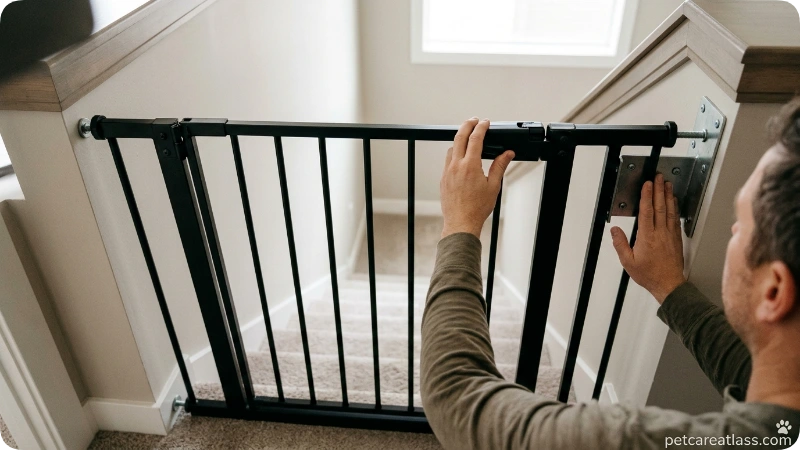
Regular inspection helps identify problems before they affect the gate’s stability.
Check the following:
- Mounting brackets: Look for loose screws, damaged fittings, or movement.
- Frame: Inspect for bending, cracks, or broken sections.
- Latch: Confirm that the locking mechanism engages correctly.
- Hinges: Check for unusual movement or damage.
- Mesh panels: Look for tears, fraying, or stretched sections.
- Bar spacing: Make sure the frame has not become distorted.
Follow the manufacturer’s cleaning and maintenance instructions. Replace damaged components with compatible parts rather than attempting improvised repairs.
If the gate moves, becomes loose, or no longer locks properly, stop using it until the problem has been corrected.
Frequently Asked Questions
What is the safest pet gate for the top of stairs?
A properly installed hardware-mounted gate specifically approved for top-of-stair use is generally the preferred option. Choose a sturdy frame, secure mounting brackets, and a one-direction opening mechanism that prevents the door from swinging over the stairs.
Can I use a pressure-mounted pet gate at the top of stairs?
An ordinary pressure-mounted gate should not be your default choice for the top of stairs. Some manufacturers approve particular models or configurations for this location, but you should only consider those when the exact product instructions explicitly permit it. A hardware-mounted model is generally the more conservative choice.
Are retractable pet gates safe for stairs?
Some manufacturers design retractable gates for specific stair installations, while others do not approve them for this location. Check the exact model’s mounting requirements, approved installation positions, and safety instructions. Do not assume that a retractable gate is suitable simply because it fits the opening.
How tall should a pet gate be?
The appropriate height depends on your pet’s size, jumping ability, and climbing behavior. A small puppy may need a different height from a large athletic dog. Consider your individual pet rather than relying only on breed size.
Can I install a pet gate without drilling?
Some pressure-mounted gates do not require drilling, making them convenient for suitable doorways. However, a top-of-stair installation generally calls for a securely hardware-mounted design. Certain manufacturers offer banister adapters that provide approved mounting options without drilling directly into the railing.
Are baby gates suitable for pets?
Some baby gates can work for pets, but not every model is designed to withstand chewing, scratching, jumping, or repeated pushing. Check the manufacturer’s intended use and stair-installation instructions before using one as a pet barrier.
Should I keep my pet gate closed all the time?
Keep the gate closed whenever your pet needs to be prevented from accessing the staircase. Make sure household members consistently secure the latch after passing through. A gate left open cannot provide a reliable barrier.
Conclusion
A suitable pet gate for stairs can help make a multi-level home safer by restricting access to potentially hazardous areas. For most top-of-stair installations, a properly secured hardware-mounted gate designed for that location is the preferred option.
Before buying, measure the opening, consider your pet’s behavior, and check the manufacturer’s installation requirements. Regular inspections and consistent use will help keep the barrier working as intended.

Dr. Emily Carter is a pet-care writer with a focus on animal health, nutrition, and everyday pet wellness. She creates practical, easy-to-understand guides that help pet owners make informed and responsible care decisions.