Quick Answer:
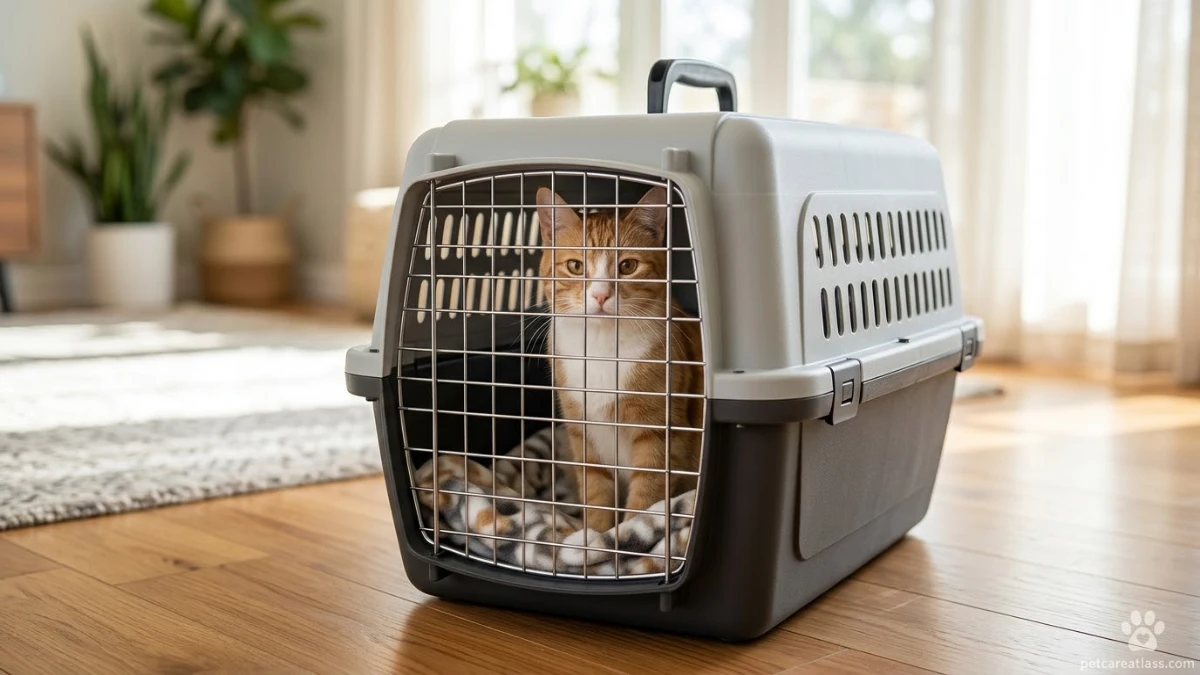
The best pet carriers for cats provide enough room to stand, turn around, and lie down comfortably while keeping the cat secure during transportation. Look for sturdy construction, reliable door closures, good ventilation, and an easy-to-clean interior. For most cats, a hard-sided carrier with a removable top is a practical choice for veterinary visits and everyday travel.
Finding the right carrier can make a significant difference in how safely and comfortably your cat travels.
Whether you are preparing for a veterinary appointment, planning a road trip, or looking for a convenient way to transport your pet, choosing the wrong design can create unnecessary difficulties.
Some cats feel more secure in enclosed hard-sided carriers, while others may benefit from familiar bedding, multiple entry points, or a lightweight design. Understanding the differences between available options helps you make a better decision.
This guide explains cat carrier types, essential safety features, sizing, travel requirements, and practical ways to help your cat feel more comfortable.
Key Takeaways
- Choose a carrier that allows your cat to stand, turn around, and lie down naturally.
- Hard-sided carriers are practical for routine veterinary visits and everyday transportation.
- Check ventilation, door locks, handles, and structural strength before purchasing.
- Soft-sided carriers can be useful for specific travel situations when properly constructed.
- Introduce the carrier gradually to help your cat become familiar with it.
- Always verify airline and vehicle transportation requirements before traveling.
Why the Right Cat Carrier Matters
A cat carrier is an essential part of responsible pet ownership. It provides a secure space for transportation and helps prevent your cat from escaping in unfamiliar environments.
Cats can become unsettled by vehicle movement, unfamiliar sounds, new surroundings, and contact with unfamiliar animals. A suitable carrier gives them a familiar place to remain during these experiences.
Carrier design also matters during veterinary appointments. A model with a removable top allows a veterinarian to examine a cat while it remains in the bottom section, reducing the need to pull a frightened animal through a small door. Veterinary guidelines recommend making carriers familiar, comfortable, and easy to access.
Different Types of Pet Carriers for Cats
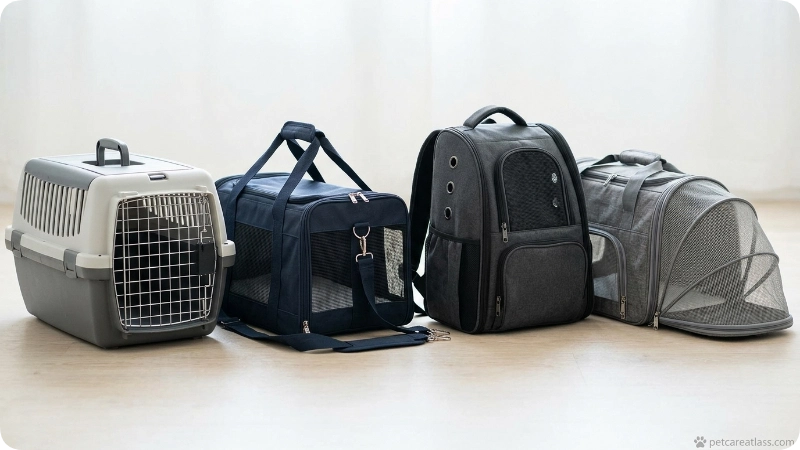
Cat carriers are available in several designs. Each has different advantages, and the most suitable option depends on your cat’s size, temperament, and transportation needs.
1. Hard-Sided Plastic Cat Carriers
Hard-sided carriers are among the most practical options for everyday transportation. They typically feature a rigid plastic body, ventilation openings, and a front door.
Some models also include a top opening or removable upper section, making it easier to place a cat inside and access it during veterinary examinations.
Advantages:
- Maintain their shape during transportation.
- Provide a firm and supportive base.
- Are generally easier to clean.
- Resist crushing better than flexible fabric carriers.
- Removable tops can simplify veterinary examinations.
Limitations:
- Can be heavier than fabric alternatives.
- Require more storage space.
- Some designs have narrow entrances.
Best suited for: Routine veterinary visits, everyday transportation, and car journeys.
2. Soft-Sided Cat Carriers
Soft-sided carriers are generally made from fabric with mesh ventilation panels, zipper closures, and reinforced bases.
Their flexible construction makes them convenient to store and can help them fit beneath certain airplane seats.
However, construction quality varies. Look for reinforced seams, a stable floor, secure zippers, and enough internal space for your cat to move naturally.
Advantages:
- Usually lightweight.
- Often easier to store.
- Convenient for certain airline journeys.
- Frequently include multiple access points.
Limitations:
- May provide less protection against crushing.
- Can be harder to clean thoroughly.
- Weak zippers or seams can create escape risks.
- Some models lose their shape under pressure.
Best suited for: Owners who need a lightweight carrier and have confirmed that its construction meets their travel requirements.
3. Cat Backpack Carriers
Backpack carriers allow owners to transport cats while keeping their hands free. Some designs include mesh windows, structured compartments, and padded shoulder straps.
However, convenience for the owner does not necessarily mean comfort for the cat. Some backpacks provide limited space or move excessively while the owner walks.
A suitable design should allow the cat to stand, turn around, and lie down comfortably. It should also have a stable base and adequate ventilation.
Advantages:
- Allow hands-free carrying.
- Can be convenient for short transportation.
- Some models distribute weight across both shoulders.
Limitations:
- Interior space can be restricted.
- Walking movement may make the compartment unstable.
- Some transparent designs offer limited privacy.
- Ventilation and structural support vary.
Best suited for: Short journeys when the specific backpack provides sufficient space and stability.
4. Expandable Cat Carriers
Expandable carriers have flexible side compartments that unfold to provide additional interior space.
They can be useful when a cat needs extra room during stationary waiting periods. However, the expanded section should not compromise the carrier’s stability or allow escape through weak fabric or seams.
Advantages:
- Offer additional room when expanded.
- Some models fold for easier storage.
- Can provide flexibility during longer trips.
Limitations:
- Fabric sections may offer less structural support.
- Cleaning can be more difficult.
- Expanded dimensions may not meet airline requirements.
- Some designs have unstable bases.
Best suited for: Owners who want additional resting space and can verify the carrier’s construction and dimensions.
Hard-Sided vs. Soft-Sided Cat Carriers
The following comparison can help you decide which design better suits your circumstances.
| Feature | Hard-Sided Carrier | Soft-Sided Carrier |
|---|---|---|
| Construction | Rigid plastic or similar material | Flexible fabric |
| Weight | Often heavier | Usually lighter |
| Cleaning | Generally easier | Needs more care |
| Storage | Takes up more space | Often folds |
| Structural Support | Firm body and base | Depends on reinforcement |
| Veterinary Access | Some have removable tops | Depends on design |
| Air Travel | Depends on airline rules | Often easier to fit under seats |
Which one should you choose?
For most everyday situations, a sturdy hard-sided plastic carrier with a removable top is a practical starting point. A well-constructed soft-sided carrier may be more convenient when portability or particular airline requirements are important.
Neither option is automatically best for every cat. Prioritize internal space, stability, secure closures, and ventilation over appearance.
How to Choose the Right Cat Carrier Size
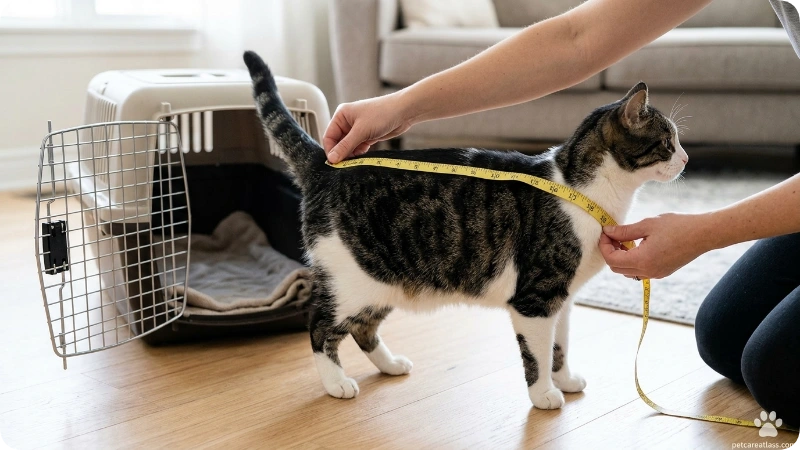
Choosing the correct size is essential for your cat’s comfort and safety.
A carrier that is too small can restrict movement, while one that is excessively large may allow your cat to slide around during transportation.
Your cat should have enough room to:
- Stand naturally.
- Turn around without difficulty.
- Sit comfortably.
- Lie down in a natural position.
Measure your cat before purchasing instead of relying only on product labels such as small, medium, or large.
How to Measure Your Cat
Use a flexible measuring tape to assess your cat’s body dimensions.
- Body length: Measure from the chest to the base of the tail.
- Standing height: Measure from the floor to the top of the head while your cat stands naturally.
- Body width: Check the widest part of the body to estimate the necessary interior width.
Compare these measurements with the manufacturer’s internal carrier dimensions. Exterior dimensions do not tell you how much usable space your cat actually has.
What Size Carrier Does Your Cat Need?
| Cat Type | Sizing Consideration |
|---|---|
| Small kitten | Room to move with supportive bedding |
| Average adult cat | Space to stand, turn, sit, and lie down |
| Large adult cat | Wider interior and stronger base |
| Senior cat | Easy entry and stable flooring |
| Long-bodied cat | Extra interior length |
| Two cats | Generally use separate carriers |
Large breeds such as Maine Coons may require carriers with considerably more interior space than those suitable for smaller adult cats.
For growing kittens, reassess carrier suitability as they develop. Do not sacrifice comfortable movement simply because a carrier is advertised for a particular weight range.
Essential Safety Features to Check Before Buying
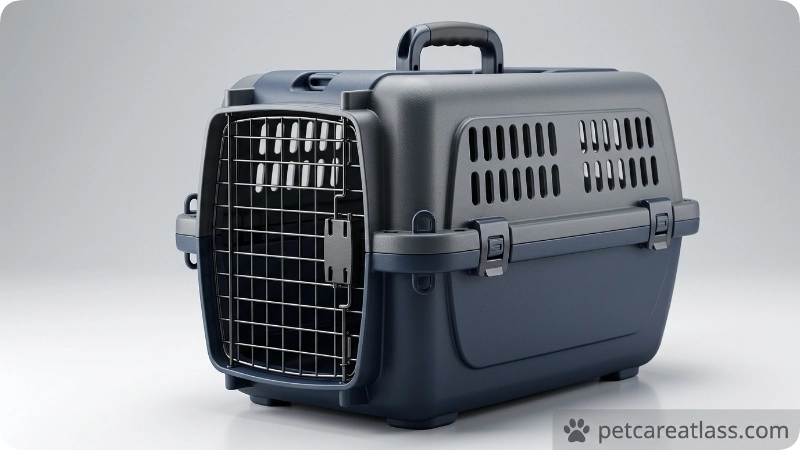
A carrier may look attractive but still lack important safety features. Inspect its construction carefully before making a purchase.
1. Proper Ventilation
Airflow is essential during transportation. Look for openings on multiple sides so air can circulate throughout the compartment.
Avoid designs with obstructed ventilation panels or covers that completely block airflow.
2. Secure Doors and Closures
A frightened cat may push against a door or attempt to escape.
Check that:
- Door locks close securely.
- Zippers do not separate easily.
- Hinges and attachment points are strong.
- Mesh panels are securely attached.
- There are no sharp edges or gaps that could trap paws.
Test the closures before placing your cat inside.
3. A Stable Bottom
The carrier should have a firm base that supports your cat without excessive bending or sagging.
A nonslip blanket or familiar bedding can provide additional comfort, provided it does not reduce the usable interior space too much.
4. Comfortable Interior
Look for a smooth interior without sharp edges or exposed hardware.
Washable bedding can make the carrier more comfortable and familiar. Avoid bulky cushions that prevent your cat from changing positions naturally.
5. Easy Cleaning
Cats may experience nausea or have toileting accidents during travel.
Removable sections, wipeable surfaces, and washable bedding make maintenance easier. Check the manufacturer’s cleaning instructions before using disinfectants or other cleaning products.
6. Strong Handles and Attachment Points
Handles should remain securely attached when the carrier is lifted.
A strong handle is useful, but carrying a loaded carrier only by its handle may cause unnecessary swinging. Support the bottom with your other hand or both arms to keep the carrier level.
How to Make Your Cat Comfortable in a Carrier
Even a well-designed carrier may become frightening if your cat only encounters it immediately before a veterinary appointment.
Gradual introduction can help your cat become familiar with the carrier before an actual journey.
Step 1: Keep the Carrier Accessible
Place the carrier in a quiet area where your cat spends time. Leave the door open and allow your cat to investigate it voluntarily.
Keeping it available at home helps make it a familiar part of the environment rather than something that only appears before an unpleasant experience.
Step 2: Add Familiar Bedding
Place a favorite blanket or towel inside the carrier.
Familiar smells can help make the space less unfamiliar. Choose bedding that provides a comfortable surface without blocking ventilation.
Step 3: Introduce Treats and Toys
Place a few favorite treats near the entrance and gradually move them farther inside.
You can also use a familiar toy if your cat responds better to play than food.
Step 4: Practice Closing the Door
Once your cat enters voluntarily, briefly close the door while offering a reward.
Begin with a few seconds and gradually increase the duration if your cat remains comfortable.
Step 5: Practice Lifting the Carrier
After your cat becomes comfortable with the closed door, gently lift the carrier for a short period.
Keep it level and avoid sudden movements. Gradually introduce brief trips around the home before attempting longer journeys.
Important: Never chase, punish, or force your cat through training steps. If your cat becomes frightened, return to an easier stage and progress more slowly.
How to Transport a Cat Safely in a Car
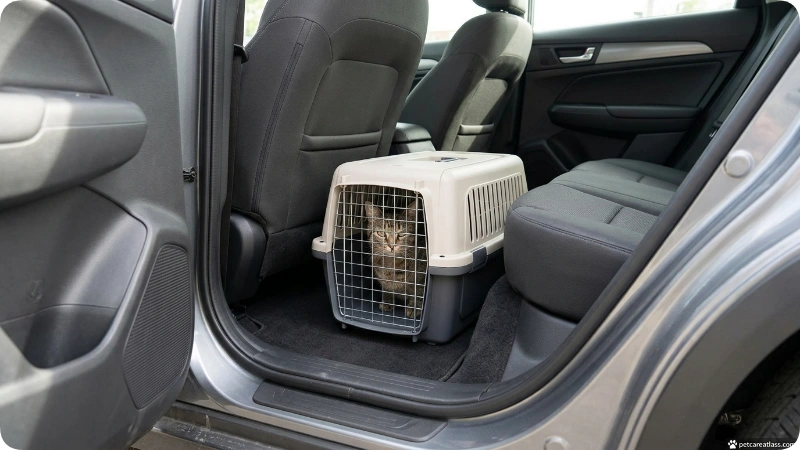
A cat should remain inside a secure carrier throughout a car journey. Allowing a cat to move freely around a vehicle can create distractions and increase the risk of injury.
Follow these precautions:
- Place your cat inside the carrier before starting the journey.
- Position the carrier on the vehicle floor behind the driver or passenger seat, following current veterinary guidance.
- Keep the carrier stable and level.
- Avoid placing it where it could interfere with vehicle controls.
- Maintain a comfortable temperature and adequate ventilation.
- Drive smoothly and avoid sudden movements.
- Never leave your cat unattended in a hot or cold vehicle.
The Feline Veterinary Medical Association’s 2025 transportation position statement recommends placing cat carriers on the vehicle floor behind the driver or passenger seat. It also advises using a seat belt only with a carrier that has been crash-test certified.[2]
Are All Cat Carriers Crash-Tested?
No. A carrier advertised as strong, durable, or suitable for car travel has not necessarily passed independent crash testing.
If you frequently travel by car, look for independently certified products. The Center for Pet Safety provides information about certified pet travel products.
Do not assume that an ordinary plastic or fabric carrier is designed to protect a cat during a vehicle collision.
Choosing Pet Carriers for Cats for Air Travel
Air travel requires additional planning because airlines have specific requirements for pet carriers.
A carrier marketed as airline-approved is not automatically accepted by every airline. Requirements can vary depending on the airline, aircraft, route, and cabin.
What Should an In-Cabin Cat Carrier Include?
When comparing carriers for air travel, consider:
- Dimensions that fit the airline’s under-seat space.
- Secure closures that prevent accidental escapes.
- Adequate ventilation.
- A leak-resistant bottom.
- Absorbent bedding.
- Enough space for your cat to remain in a comfortable position.
- Flexible construction when required by the airline.
Check Airline Requirements Before Purchasing
Before booking your flight, confirm:
- Maximum carrier length, width, and height.
- Whether hard-sided and soft-sided carriers are accepted.
- Whether your cat and carrier must meet a combined weight limit.
- Whether pets are allowed on your specific flight.
- Whether advance pet reservations are required.
- Whether connecting airlines have different requirements.
For example, American Airlines publishes separate in-cabin carrier dimensions for soft-sided and hard-sided carriers. Its requirements also account for aircraft and under-seat space.[4]
Always check the operating airline’s latest requirements before purchasing a carrier or booking a flight.
Common Cat Carrier Buying Mistakes
Choosing a carrier based only on appearance or price can result in an unsuitable purchase.
| Common Mistake | Why It Matters | Better Approach |
|---|---|---|
| Choosing by appearance | May lack key safety features | Inspect construction |
| Buying too small | Restricts movement | Measure your cat |
| Ignoring ventilation | Limits airflow | Check ventilation openings |
| Overlooking cleaning | Makes maintenance difficult | Choose washable or wipeable materials |
| Buying weak zippers | Increases escape risk | Inspect seams and closures |
| Ignoring airline rules | Carrier may be rejected | Check airline policies |
| Skipping carrier training | Makes travel more difficult | Introduce it gradually |
How to Clean and Maintain a Cat Carrier
Regular cleaning helps keep the carrier hygienic and ready for future journeys.
Follow these maintenance practices:
- Remove blankets and washable bedding after each trip.
- Clean plastic surfaces according to the manufacturer’s instructions.
- Remove loose fur, food debris, and visible dirt.
- Allow the carrier to dry completely before storing it.
- Inspect doors, hinges, zippers, handles, and seams.
- Replace damaged components or the entire carrier when it can no longer contain your cat securely.
If your cat has an infectious illness or parasite problem, ask your veterinarian which cleaning and disinfection methods are appropriate.
Avoid mixing household cleaning chemicals or using strongly scented products that could leave irritating residues.
When Should You Replace a Cat Carrier?
A carrier does not necessarily need replacing because it is old. Its condition and ability to transport your cat safely are more important.
Consider replacing it if you notice:
- Cracked plastic or damaged structural panels.
- Broken door locks or hinges.
- Zippers that no longer close properly.
- Torn mesh or weakened fabric.
- Loose handles or damaged attachment points.
- A base that bends excessively under your cat’s weight.
- Damage that prevents proper cleaning.
You should also replace a carrier if your cat has outgrown its usable interior space.
Frequently Asked Questions About Pet Carriers for Cats
What type of carrier is best for cats?
A sturdy hard-sided plastic carrier with a secure front door and removable top is a practical choice for most cats. It provides a stable structure, is relatively easy to clean, and makes veterinary examinations easier. A properly constructed soft-sided carrier can also be suitable when portability or airline requirements make flexibility important.
How big should a cat carrier be?
A cat carrier should provide enough room for your cat to stand, turn around, sit, and lie down comfortably. Measure your cat before purchasing and compare those measurements with the manufacturer’s internal dimensions. Avoid choosing a carrier based only on its advertised weight capacity.
Are soft-sided carriers safe for cats?
Soft-sided carriers can be suitable when they have reinforced bases, secure zippers, strong seams, and adequate ventilation. However, they generally provide less resistance to crushing than rigid carriers. Check the construction carefully and choose a model that maintains its shape while being carried.
Can two cats travel in one carrier?
Separate carriers are generally preferable because each cat has individual space and cannot become trapped in a confrontation during a stressful journey. Even cats that normally get along may react differently when frightened. Individual carriers also make transportation and monitoring easier.
Are cat backpacks a good choice?
Cat backpacks can be convenient for short transportation, but some designs do not provide enough room for natural movement. Choose one with a stable base, adequate ventilation, and enough interior space for your cat to stand, turn, and lie down. A traditional carrier is generally a more practical option for routine veterinary visits.
How can I get my cat to enter a carrier willingly?
Keep the carrier accessible at home with its door open. Add familiar bedding, treats, and toys to encourage voluntary exploration. Once your cat becomes comfortable entering, gradually practice closing the door and lifting the carrier. Patience and positive reinforcement can help create a better association with transportation.
Can I use an ordinary cat carrier for airplane travel?
Not necessarily. Airlines have specific requirements for carrier dimensions, construction, ventilation, and under-seat placement. Some accept flexible carriers while others have different restrictions. Always check your airline’s current pet travel policy and the requirements for your particular aircraft before purchasing a carrier.
Conclusion
Choosing the right pet carriers for cats means prioritizing comfortable space, reliable construction, proper ventilation, and secure closures.
A sturdy hard-sided carrier with a removable top is a practical everyday option for many households, while a suitable soft-sided model may work better for certain travel situations.
Consider your cat’s individual needs, introduce the carrier gradually, and verify transportation requirements before every major journey. A suitable carrier can make everyday transportation safer and veterinary visits easier to manage.

Dr. Emily Carter is a pet-care writer with a focus on animal health, nutrition, and everyday pet wellness. She creates practical, easy-to-understand guides that help pet owners make informed and responsible care decisions.