Quick Answer:
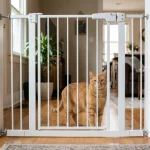
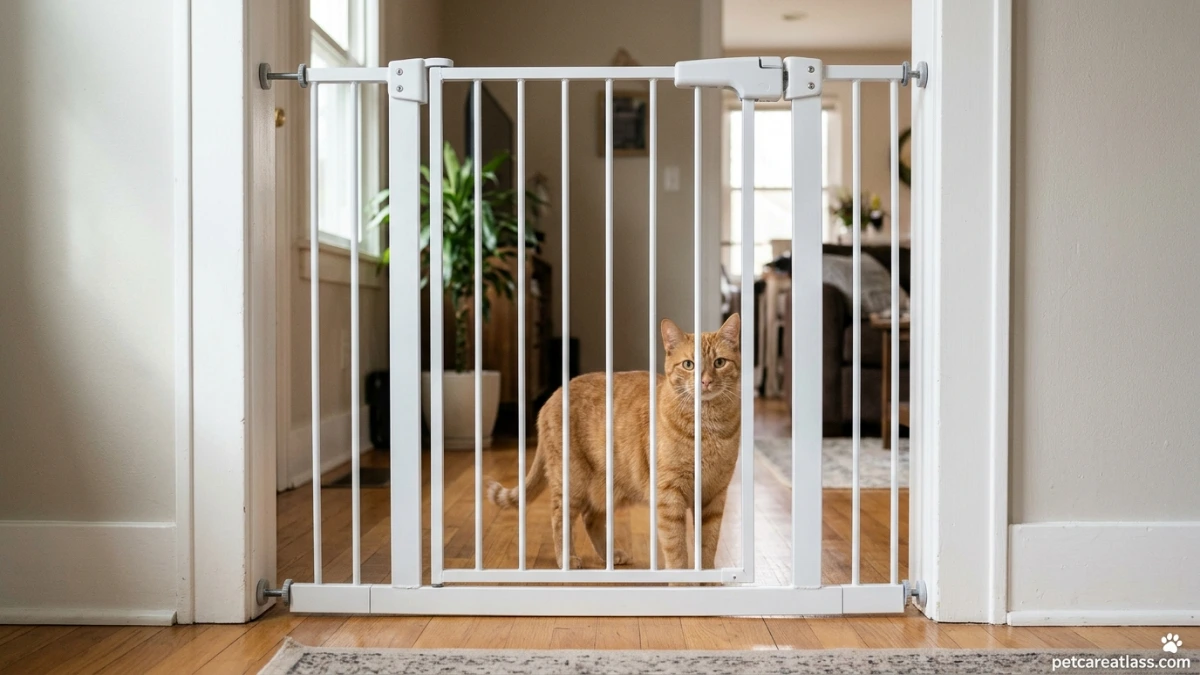
Pet gates for cats help restrict access to certain rooms, separate pets, and create safer boundaries inside your home. The best gate depends on your cat’s jumping and climbing abilities, body size, and the layout of your home. Look for appropriate height, secure mounting, safe bar spacing, and durable materials. For determined cats, a full-height barrier may be more reliable than a standard baby gate.
Cats are naturally curious, and keeping them out of certain rooms is not always as simple as closing a door. A standard baby gate may work for a small dog, but many cats can jump over it, climb its bars, or squeeze through the openings.
This makes choosing the right barrier especially important in homes with multiple pets, young kittens, or areas that need restricted access. Pet gates for cats come in different heights, materials, mounting styles, and designs, and each offers different advantages.
Some are suitable for temporary separation, while others provide a more secure boundary for everyday use. The right choice also depends on your cat’s age, size, activity level, and jumping ability.
Understanding these differences can help you avoid buying a gate that your cat can easily bypass. This guide compares common gate styles, explains important safety features, and offers practical advice for selecting a suitable barrier for your household.
Key Takeaways
- Standard baby gates may not prevent cats from jumping or climbing over them.
- Extra-tall and smooth-panel gates can be useful for certain cats.
- Bar spacing should prevent squeezing and reduce entrapment risks.
- Hardware-mounted gates generally provide a more secure attachment than pressure-mounted designs.
- Cats should always have access to food, water, litter boxes, resting areas, and enrichment.
Why Do Cats Need Pet Gates?
A pet gate provides a physical boundary between different areas of your home. It can help manage your cat’s movement without requiring you to keep every interior door closed.
Here are some common reasons cat owners use gates.
Separating Cats During Introductions
Introducing a new cat to a resident cat requires patience and controlled interactions. A gate can allow both animals to see and smell each other while preventing immediate physical contact.
This arrangement gives you more control over their first visual interactions. However, ordinary baby gates may not be tall enough for cats that can jump over them. American Humane Society recommends stacking two gates when additional height is needed.
Keeping Dogs and Cats Separate
A gate can help create separate spaces for dogs and cats, particularly during feeding, resting, and early introductions.
Some designs include a small pet door that allows a cat to pass through while restricting a larger dog. However, this only works when the cat can comfortably use the opening and the dog cannot follow.
If a dog chases or attacks a cat, use secure physical separation rather than relying on an ordinary gate.
Restricting Access to Certain Rooms
You may want to prevent your cat from entering particular areas, such as:
- Kitchens during food preparation.
- Laundry rooms containing cleaning products.
- Home offices with sensitive equipment.
- Guest rooms where visitors need a cat-free environment.
- Storage areas containing fragile objects or household supplies.
A gate can help manage access, but hazardous substances should always be stored securely.
Managing Separate Feeding Areas
In homes with multiple pets, gates can help create separate feeding spaces.
For example, a cat may need a quiet place to eat without a dog approaching its food. A barrier with a suitable cat-access opening can sometimes help, although separate rooms may be more effective when pets compete over food.
Types of Pet Gates for Cats
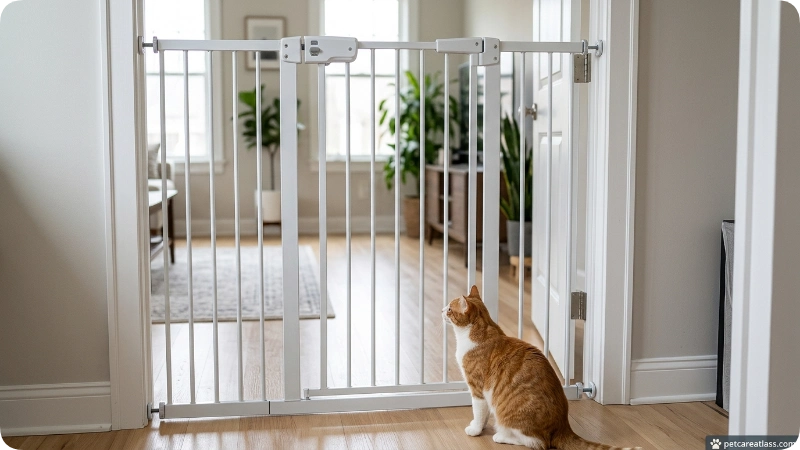
Different gate designs offer different levels of access control, convenience, and stability. Understanding their construction can help you choose a suitable option.
1. Extra-Tall Pet Gates
Extra-tall gates provide more vertical height than ordinary baby gates. They may discourage cats that can easily jump over shorter barriers.
However, height alone does not guarantee containment. Athletic cats may still jump over a tall gate, especially when nearby furniture provides a convenient launching point.
Best for: Cats that occasionally jump over standard gates but do not actively climb barriers.
What to check:
- Total installed height.
- Bar arrangement and available footholds.
- Distance between vertical bars.
- Stability of the mounting system.
- Nearby furniture that could help your cat reach the top.
2. Tall Gates With Solid or Smooth Panels
Solid-panel gates have fewer openings that cats can grip with their paws. Smooth acrylic or polycarbonate panels may therefore be harder to climb than conventional gates with horizontal bars.
Transparent panels also allow pets to see through the barrier, which can be useful during controlled introductions.
However, cats may still jump over the top or find another way around the barrier. Check the panel’s stability, edges, ventilation, and mounting system before purchasing.
Best for: Cats that regularly climb traditional bar-style gates.
What to check: Panel height, surface smoothness, secure installation, ventilation, and scratch resistance.
3. Pressure-Mounted Pet Gates
Pressure-mounted gates stay in position through tension between two walls or a doorway.
Many models are convenient for renters because they do not require permanent screw installation. They can also be useful for temporary room separation.
However, their stability depends on proper installation and compatible mounting surfaces. Repeated pushing, climbing, or incorrect adjustment can cause some models to shift.
Best for: Temporary separation in suitable doorways.
Limitations: Check the manufacturer’s installation requirements, inspect the gate regularly, and avoid using it in locations where a shifting barrier could create a serious fall hazard.
4. Hardware-Mounted Pet Gates
Hardware-mounted gates attach to walls or doorframes using screws and mounting brackets.
When correctly installed on suitable surfaces, they provide a more secure attachment than pressure-only barriers.
They are useful for frequently used openings and situations where a firmly attached gate is important.
Best for: Permanent room separation and locations requiring secure mounting.
Limitations: Installation may require drilling, and the gate must be compatible with the opening and mounting surface.
5. Retractable Mesh Gates
Retractable mesh gates use a flexible screen that extends across an opening and rolls back when not needed.
They are convenient for households that want to open a passageway without removing a rigid barrier.
However, some cats can climb the mesh, push against it, or damage it with their claws. Others may find openings around the sides.
Best for: Temporary access control when the cat does not regularly climb or challenge barriers.
Limitations: Check mesh strength, locking mechanisms, side gaps, and mounting security.
How to Choose the Right Pet Gate for Your Cat
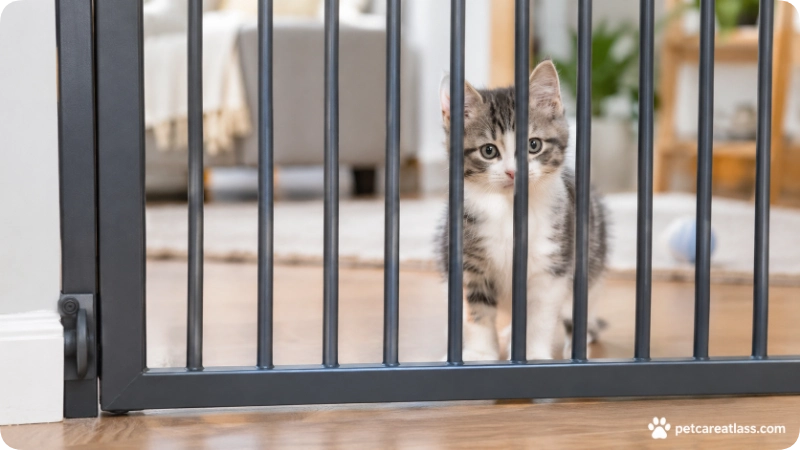
The best gate depends on your cat’s behavior and the physical layout of your home. Consider these features before purchasing.
1. Choose a Height That Matches Your Cat’s Abilities
Height is one of the first things to consider when comparing gates.
Some cats can jump over ordinary barriers, while others prefer climbing through gaps or using furniture to reach the top.
Observe your cat’s behavior around existing obstacles.
Ask yourself:
- Does your cat regularly jump over furniture?
- Does your cat climb vertical surfaces?
- Can your cat balance on narrow edges?
- Does your cat use chairs or shelves to reach higher places?
- Does your cat repeatedly attempt to escape enclosed areas?
A taller gate may reduce unwanted jumping, but there is no universal height that guarantees every cat will remain on one side.
For determined jumpers, consider a secure full-height barrier or an enclosed room instead of relying on gate height alone.
2. Check the Bar Spacing
The distance between bars affects both containment and safety.
If openings are too wide, a kitten or small cat may squeeze through. If the design contains unsuitable gaps, a cat could become caught while attempting to pass through.
Look for:
- Consistent spacing between vertical bars.
- No openings that allow your cat to squeeze through.
- Smooth edges and secure connections.
- No protruding screws or sharp hardware.
- No gaps that could trap the head, neck, or paws.
Do not assume that a gate designed for large dogs is automatically suitable for small cats.
Compare the actual openings with your cat’s size and follow the manufacturer’s safety specifications.
3. Consider the Material
Gate materials affect durability, weight, maintenance, and climbing opportunities.
| Material | Advantages | Potential Limitations |
|---|---|---|
| Steel | Strong and durable | Some designs provide climbing footholds |
| Aluminum | Lightweight and corrosion-resistant | Rigidity varies by design |
| Wood | Attractive and sturdy | Some designs have climbable surfaces |
| Acrylic | Smooth surface and good visibility | Can scratch or crack |
| Mesh | Lightweight and retractable | May be climbed or damaged |
| Plastic | Lightweight and easy to clean | May flex or break |
For cats that climb traditional gates, a tall, smooth-panel design may be worth considering.
Regardless of material, inspect the product for sharp edges, loose components, and places where claws could become caught.
4. Measure Your Doorway Before Buying
Measure the opening where you intend to install the gate.
Check the width at the top, middle, and bottom because doorframes and walls are not always perfectly even.
Also consider:
- Available mounting surfaces.
- Baseboards that may interfere with installation.
- Whether extension panels are necessary.
- The direction in which the walk-through door opens.
- Whether the gate obstructs nearby furniture or doors.
Compare your measurements with the manufacturer’s stated installation range.
A gate that is too narrow may leave gaps, while an incorrectly sized gate may not mount securely.
5. Look for a Secure Locking Mechanism
A reliable latch helps prevent accidental opening.
Look for a design that:
- Locks securely when closed.
- Does not open easily when pushed.
- Can be operated conveniently by adults.
- Closes completely after use.
- Does not leave large gaps around the walk-through section.
If your cat has learned to manipulate simple latches, consider a gate with a more secure locking mechanism.
6. Decide Whether You Need a Walk-Through Door
Walk-through gates allow people to pass without removing the entire barrier.
They are useful in busy households where a gate is opened several times daily.
However, the opening should not become a weak point. Check that the door closes completely and that the latch works properly.
Pay particular attention to gaps underneath the gate and around the door panel if your cat is small enough to squeeze through narrow spaces.
Which Pet Gate Is Best for Different Cat Behaviors?
Your cat’s behavior should influence your decision more than the gate’s appearance.
| Cat’s Behavior | Gate Style to Consider | Important Limitation |
|---|---|---|
| Jumps over barriers | Extra-tall gate | May still jump over it |
| Climbs metal bars | Smooth-panel gate | Does not prevent jumping |
| Squeezes through gaps | Closely spaced vertical bars | Check all edge gaps |
| Pushes against barriers | Hardware-mounted gate | Requires proper installation |
| Damages mesh | Rigid-panel or metal gate | Check for sharp edges |
| Is a small kitten | Secure barrier with suitable openings | Reassess as the kitten grows |
There is no single best pet gate for every cat. A successful choice depends on the animal’s size, age, activity level, and ability to overcome barriers.
Can Cats Jump Over Regular Baby Gates?
Yes. Many cats can jump over ordinary baby gates, particularly when the barrier is relatively short or nearby objects make jumping easier.
Baby gates are primarily designed for child safety, not to contain athletic cats.
American Humane Society explains that an ordinary baby gate may not be high enough for cats and suggests stacking two gates when additional height is needed.
If your cat regularly clears a standard gate, consider these alternatives:
- Choose a taller gate with a suitable design.
- Remove nearby furniture that provides jumping access.
- Consider a smooth-panel barrier.
- Install a secure screen door or full-height enclosure.
- Keep the room door closed when reliable separation is essential.
Do not assume that increasing the gate height alone will solve every escape problem.
Are Pet Gates Safe for Cats?
Pet gates can help manage access when properly selected and installed. However, an unsuitable design can create hazards.
Check the following safety considerations before using one.
Entrapment Risks
Cats may attempt to squeeze through openings that are too small for their bodies.
A paw, leg, head, or neck could become trapped in an unsuitable design. Inspect the gate carefully, particularly if you have a kitten or a small cat.
Falling or Tipping
A poorly secured gate may shift or fall when a cat jumps against it or climbs on it.
This is especially concerning near stairs, elevated landings, and other locations where a fall could cause injury.
Claw and Paw Injuries
Loose mesh, damaged panels, protruding screws, and sharp metal edges can catch claws or injure paws.
Inspect the gate regularly and stop using it if any part becomes damaged.
Restricted Access to Essential Resources
A gate should not prevent a cat from reaching essential resources.
Make sure your cat has reliable access to:
- Fresh drinking water.
- Appropriate food.
- A clean litter box.
- Comfortable resting areas.
- Hiding places and enrichment.
- Safe movement and exercise.
When separating multiple pets, ensure each animal has its own necessary resources.
Stairway Hazards
Gates near stairs require additional attention.
Use a barrier specifically suitable for the location, follow the manufacturer’s installation instructions, and avoid arrangements that could cause people or animals to trip.
Hardware-mounted gates are generally preferable when a more secure attachment is needed. Follow the specific product’s stairway installation requirements rather than assuming every gate is suitable.
How to Use a Pet Gate When Introducing Cats
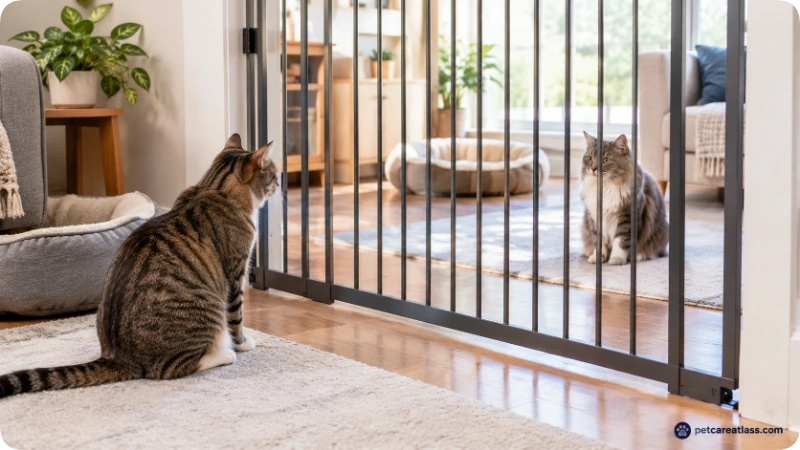
A gate can be a helpful part of introducing a new cat to a resident cat.
It allows controlled visual contact while preventing immediate physical interaction. The process should progress according to both cats’ comfort levels.
Step 1: Prepare Separate Living Areas
Give each cat a comfortable area with its own food, water, litter box, resting place, and enrichment.
Start with physical separation so both cats have time to adjust.
Step 2: Exchange Scents
Allow the cats to become familiar with each other’s scent.
You can exchange bedding or gently collect facial scent with a soft cloth and place it in the other cat’s environment.
Let each cat investigate voluntarily.
Step 3: Introduce a Visual Barrier
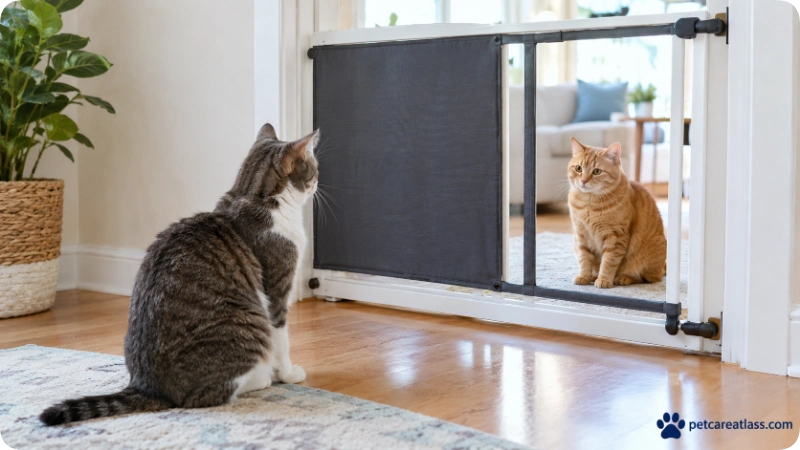
Once both cats are comfortable with the initial separation, introduce a secure visual barrier.
A tall gate, screen door, or another suitable barrier can allow them to see each other without direct access.
Make sure the barrier prevents either cat from jumping over or squeezing through it.
Step 4: Create Positive Associations
Offer meals, treats, or play on opposite sides of the barrier.
Start at a distance where both cats remain comfortable. Avoid placing them so close that either becomes tense or refuses food.
Gradually adjust the distance according to their reactions.
Step 5: Monitor Their Behavior
Watch for signs that either cat is uncomfortable, including:
- Persistent growling or hissing.
- Repeated attempts to attack the barrier.
- Stiff body posture.
- Prolonged staring.
- Hiding or avoiding the area.
- Refusing food during interactions.
If these behaviors occur, increase the distance or return to an earlier introduction stage.
Step 6: Progress to Supervised Meetings
When both cats remain relaxed during barrier interactions, gradually introduce short, supervised meetings.
Provide escape routes, hiding places, and elevated resting areas. Never force either cat to approach the other.
Keep them separated when you cannot supervise until their interactions are consistently safe.
Common Mistakes to Avoid When Buying Pet Gates for Cats
Even a well-made gate may fail if it is poorly selected or installed.
Avoid these common mistakes:
- Buying a standard baby gate without checking its height: Your cat may jump straight over it.
- Ignoring bar spacing: Small cats and kittens may squeeze through openings.
- Choosing a climbable design: Horizontal bars and cross-patterns can provide convenient footholds.
- Ignoring installation instructions: Incorrect mounting can make a gate unstable.
- Leaving furniture beside the gate: Chairs, tables, and shelves can create jumping platforms.
- Using a damaged gate: Broken latches, loose screws, and torn mesh can create hazards.
- Using a gate as permanent confinement: Cats still need space, enrichment, movement, and access to essential resources.
A little preparation can help prevent unnecessary problems and make your gate more effective.
Frequently Asked Questions
What is the best type of pet gate for cats?
A tall gate with a smooth, difficult-to-climb surface is worth considering for cats that regularly jump or climb. For cats that squeeze through openings, choose a design with appropriately narrow, consistent spacing. The best option depends on your cat’s behavior and the layout of your home.
How tall should a pet gate be for cats?
There is no universal height that will contain every cat. Some cats can jump over tall barriers, while others struggle with much shorter gates. Consider your cat’s jumping ability, climbing habits, and nearby furniture before selecting a height.
Can I use a dog gate for my cat?
Yes, some dog gates can also work for cats. However, check the height, bar spacing, construction, and openings before purchasing. A gate designed for large dogs may have gaps that allow a small cat or kitten to pass through.
Are pressure-mounted gates suitable for cats?
Pressure-mounted gates can work for temporary separation in suitable doorways. However, cats that climb or push against barriers may cause an improperly secured gate to shift. Check the installation regularly and consider hardware mounting when greater stability is needed.
Can I use two baby gates to keep my cat from jumping over?
Yes, two securely stacked gates can provide additional height. American Humane Society recommends this approach when an ordinary baby gate is insufficient. Make sure the arrangement is stable, properly secured, and free from dangerous gaps.
Do cats need a special gate when living with dogs?
Not necessarily, but the gate should suit both animals. Some households benefit from a barrier with a small cat-access opening that prevents a larger dog from following. If the dog displays chasing or aggressive behavior, use secure physical separation rather than relying on an ordinary gate.
Can I leave my cat behind a pet gate overnight?
It depends on the arrangement. Your cat needs comfortable space, fresh water, appropriate litter access, resting areas, and enrichment. A gate should not create unsafe confinement or prevent your cat from reaching essential resources.
Conclusion
The right pet gate can make managing your home easier while helping you create safer spaces for your cat and other pets. Focus on height, bar spacing, material, mounting style, and your cat’s individual behavior rather than choosing a gate based on appearance alone.
For determined jumpers and climbers, a secure full-height barrier or separate room may be more dependable than an ordinary pet gate. Always prioritize stability, comfortable access, and your cat’s safety.

Dr. Emily Carter is a pet-care writer with a focus on animal health, nutrition, and everyday pet wellness. She creates practical, easy-to-understand guides that help pet owners make informed and responsible care decisions.