Quick Answer:
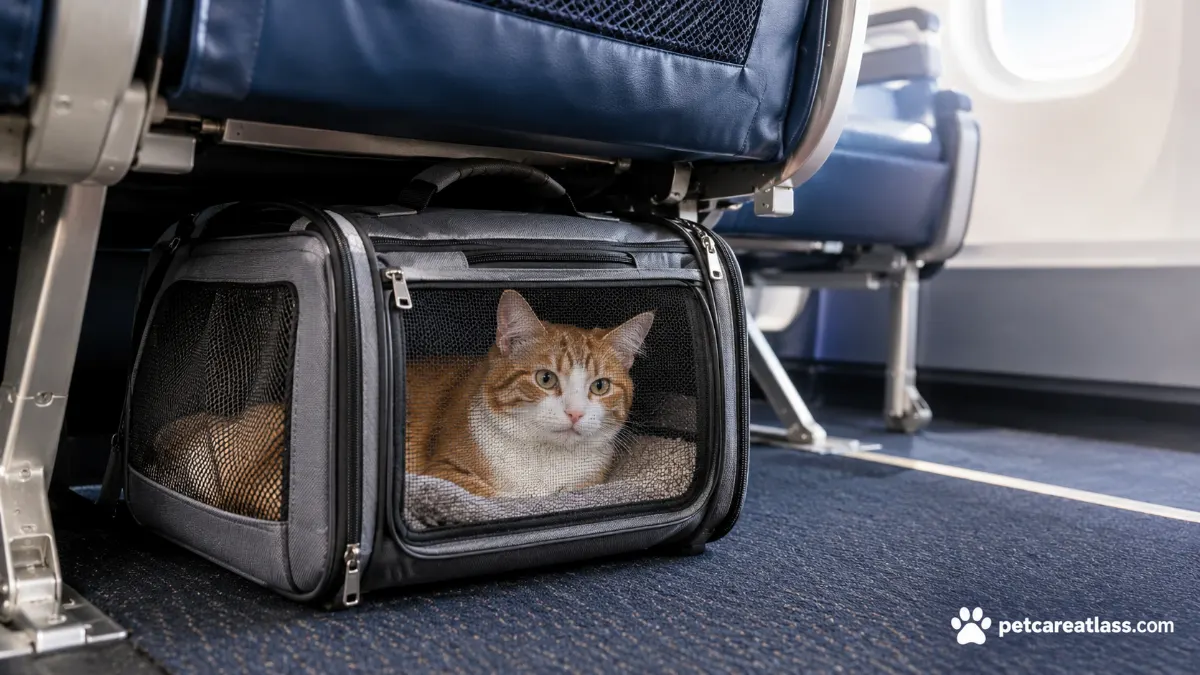
Airline-approved pet carriers in-cabin are designed to keep small pets safely contained while fitting under an airplane seat. The right carrier should meet your airline’s specific size requirements, provide adequate ventilation, have a secure closure, and give your pet enough room to stand, turn around, and lie down comfortably. Always check your airline’s current pet travel policy before purchasing a carrier because dimensions and requirements vary.
Choosing the right airline approved pet carriers in-cabin can make flying with your dog or cat safer, more comfortable, and less stressful. However, not every pet carrier advertised as airline-approved will meet your airline’s requirements.
Airlines have different rules for carrier dimensions, ventilation, closures, and under-seat storage, so selecting the wrong one could create problems at check-in or boarding.
The best in-cabin pet carrier should fit beneath the seat in front of you while giving your pet enough space to move comfortably. It should also provide secure zippers, breathable mesh panels, a stable base, and convenient access during travel.
Whether you are flying with a small dog or cat, understanding these features will help you choose a practical carrier that suits both your pet’s needs and your airline’s policies.
Key Takeaways
- Airline approval depends on the specific airline, aircraft, and flight.
- Soft-sided carriers are often easier to fit beneath airplane seats.
- Your pet needs enough room to stand, turn around, and lie down naturally.
- Ventilation, secure closures, and a leak-resistant bottom are essential.
- Reserve your pet’s cabin space before arriving at the airport.
What Makes a Pet Carrier Approved for In-Cabin Air Travel?
An in-cabin pet carrier is a travel container designed to keep a small animal safely enclosed while fitting beneath the passenger seat. Airlines generally require the carrier to remain closed and properly stored during the flight.
There is no single universal airline approval certificate for ordinary pet carriers. The airline operating your flight decides whether a particular carrier and pet meet its requirements.
A suitable carrier should have:
- Correct dimensions: It must fit beneath the seat on your specific aircraft.
- Good ventilation: Mesh panels or ventilation openings should allow sufficient airflow.
- Secure closures: Zippers, fasteners, and doors must prevent accidental escapes.
- Leak-resistant construction: The bottom should contain small accidents without leaking.
- Adequate interior space: Your pet should be able to stand, turn around, and lie down naturally.
- Comfortable padding: A removable, washable base can make cleaning easier and provide a comfortable resting surface.
The carrier must also remain secure when lifted, carried, and placed beneath the seat.
Airline Pet Carrier Size Requirements for Major U.S. Airlines
Before purchasing a carrier, compare its external measurements with the airline’s published requirements. Different airlines have different maximum dimensions, and some provide recommended measurements rather than universal limits.
The following table provides commonly published in-cabin carrier dimensions for major U.S. airlines. Measurements are length × width × height.
| Airline | Carrier Dimensions | Important Details |
|---|---|---|
| American Airlines | 18 × 11 × 11 in | Soft-sided carriers recommended |
| Delta Air Lines | 18 × 11 × 11 in (recommended) | Space depends on aircraft |
| United Airlines | 18 × 11 × 11 in (soft-sided guidance) | Must fit under the seat |
| Southwest Airlines | 18 × 10.5 × 10 in | Soft-sided carriers recommended |
| JetBlue | 17 × 12.5 × 8.5 in | Accepts hard- and soft-sided carriers |
| Alaska Airlines | Check aircraft-specific requirements | Must fit under the seat |
| Frontier Airlines | 18 × 14 × 11 in | Soft-sided carriers recommended |
Important: These figures should be treated as airline-specific guidance, not a guarantee of acceptance on every aircraft. Airline policies and aircraft configurations can change, so confirm the current requirements before purchasing a carrier.
Why Aircraft Type Matters
An airline’s published measurements do not always represent the available space beneath every seat.
Under-seat storage can vary because of:
- Aircraft model and configuration.
- Seat supports and structural equipment.
- The passenger’s assigned seat.
- Bulkhead and emergency exit-row restrictions.
- Available floor space in different cabin sections.
The Federal Aviation Administration requires in-cabin pet containers to be properly secured beneath the seat without obstructing the aisle. Airlines also enforce their own pet acceptance and storage requirements.
For this reason, check the aircraft assigned to each flight segment, particularly when your journey includes connecting flights.
Best Types of Airline Approved Pet Carriers in-Cabin
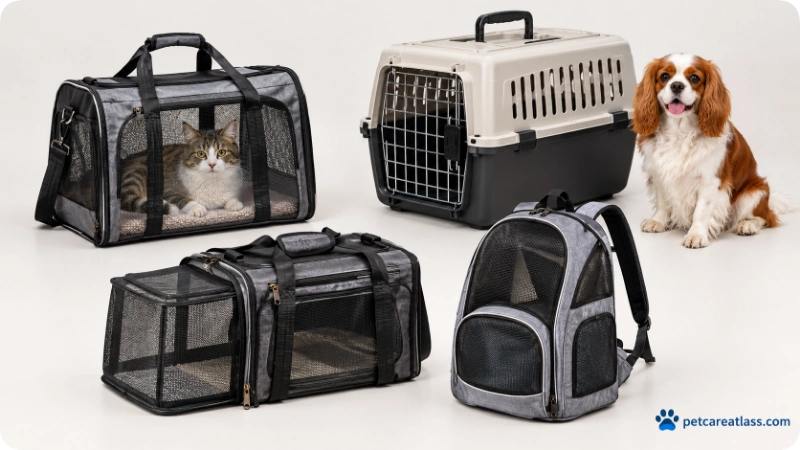
Different carrier designs offer different advantages. Your choice should depend on your pet’s size, behavior, comfort, and the airline’s requirements.
1. Soft-Sided Pet Carriers
Soft-sided carriers are often the most practical option for cabin travel. They usually feature flexible fabric walls, mesh ventilation panels, and secure zippered openings.
Their flexible construction can make it easier to fit beneath an airplane seat, provided the carrier does not need to be excessively compressed.
Best for: Small cats and dogs traveling on airlines that accept soft-sided carriers.
2. Hard-Sided Pet Carriers
Hard-sided carriers provide a rigid structure and are generally easier to wipe clean. Their firm construction can also help protect the enclosed space from external pressure.
However, their fixed shape can make under-seat placement difficult when available space is limited.
Best for: Pets that need a firm enclosure, provided the airline accepts the carrier and its dimensions fit.
3. Expandable Pet Carriers
Expandable carriers have additional mesh sections that can open to provide more resting space when permitted.
They can be useful in airport waiting areas, but an expanded section may not be allowed to remain open during the flight.
Best for: Travelers who want additional space during permitted waiting periods.
4. Pet Carrier Backpacks
Pet carrier backpacks distribute weight across your shoulders and can make walking through busy terminals easier.
Some designs, however, are too tall or bulky for airplane under-seat storage. Check the complete external measurements before choosing one.
Best for: Airport transportation when the particular backpack also meets the airline’s under-seat requirements.
For most travelers, a well-constructed soft-sided carrier is a sensible starting point because it offers flexibility without requiring the rigid dimensions of a hard plastic kennel.
Pet Carrier Models Worth Comparing for Air Travel
If you are shopping for a carrier, several established manufacturers offer designs specifically marketed for pet transportation. These examples are worth comparing, but they should not be considered independently tested or universally airline-approved recommendations.
Sleepypod Air
The Sleepypod Air is a flexible pet travel carrier with a compressible design. It features mesh ventilation, removable bedding, and luggage attachment features.
Its published exterior dimensions are approximately 16–22 × 10.5 × 10.5 inches. Its adjustable length means you must check the actual configuration against your airline’s requirements.
Features to consider:
- Flexible construction.
- Mesh ventilation.
- Removable bedding.
- Adjustable length.
- Luggage attachment capability.
SturdiBag Pro 3.0
The SturdiBag Pro 3.0 is a soft-sided carrier with a flexible-height design, mesh panels, multiple entry points, and a removable comfort pad.
Its small size measures approximately 18 × 10 × 9.25 inches. Although its flexible construction may help with under-seat placement, its published measurements exceed some airlines’ limits.
Features to consider:
- Flexible structure.
- Breathable mesh panels.
- Multiple entry points.
- Removable padding.
- Lightweight construction.
How to compare these models: Look beyond the manufacturer’s airline-travel claims. Compare external dimensions, interior measurements, ventilation, zipper security, cleaning requirements, and your pet’s ability to move comfortably.
A carrier that has worked for another traveler may not fit your aircraft or your pet.
How to Choose the Correct Carrier Size for Your Pet
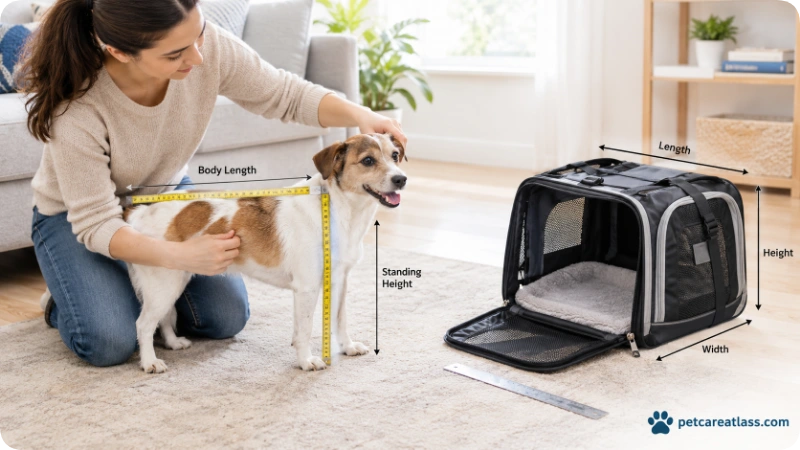
Choosing the right carrier involves two separate measurements: your pet’s body size and the carrier’s external dimensions.
A lightweight carrier is not necessarily suitable if its interior is too small. Similarly, a spacious carrier is not useful if it cannot fit beneath the airplane seat.
1. Measure Your Pet Before Shopping
Use a flexible measuring tape to measure your pet while standing naturally.
- Body length: Measure from the base of the neck to the base of the tail.
- Standing height: Measure from the floor to the top of the head or ears, whichever is higher.
- Body width: Consider your pet’s natural body width when choosing the interior space.
Compare these measurements with the manufacturer’s interior dimensions and sizing instructions.
Your pet should have enough room to stand, turn around, and lie down comfortably without being forced into an unnatural position.
2. Measure the Carrier’s Exterior
Airlines generally evaluate the outside dimensions rather than the usable interior space.
Measure the carrier with its handles, pockets, frame, and other permanent parts included. Check its length, width, and height in its normal travel configuration.
For a flexible carrier, determine how much it compresses without compromising your pet’s comfort or ventilation.
3. Consider Your Pet’s Weight
Check the manufacturer’s recommended pet weight range, but do not use weight as your only sizing measurement.
Two pets weighing 12 pounds may have very different body shapes. A long-bodied cat may need a larger carrier than a compact dog of the same weight.
The carrier itself should also be light enough for you to carry comfortably through the airport.
4. Check the Interior Structure
Look for a firm, supportive floor that prevents your pet from sinking into the bottom when the carrier is lifted.
Avoid designs that collapse inward around your pet or reduce the available breathing space when placed beneath an airplane seat.
Essential Features to Look for Before Buying
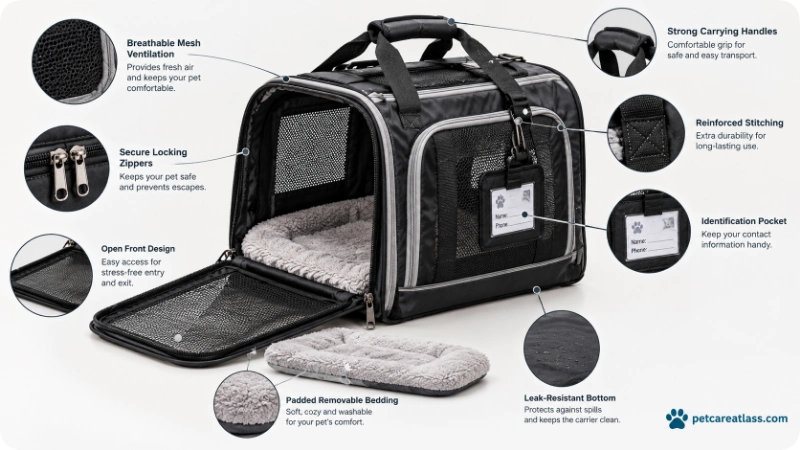
A good in-cabin carrier should combine airline compatibility with practical safety and comfort features.
| Feature | Why It Matters |
|---|---|
| Mesh ventilation | Provides airflow and visibility |
| Secure zippers | Helps prevent escapes |
| Leak-resistant bottom | Contains minor accidents |
| Supportive base | Provides a stable resting surface |
| Washable padding | Makes cleaning easier |
| Strong handles | Improves carrying security |
| Safety tether | Adds an attachment point when used appropriately |
| Identification pocket | Stores travel contact details |
A safety tether should not replace a properly secured carrier closure or be used in a way that restricts your pet’s movement.
Avoid carriers with weak stitching, damaged mesh, exposed sharp edges, unreliable zippers, or insufficient ventilation.
How to Prepare Your Pet for In-Cabin Air Travel
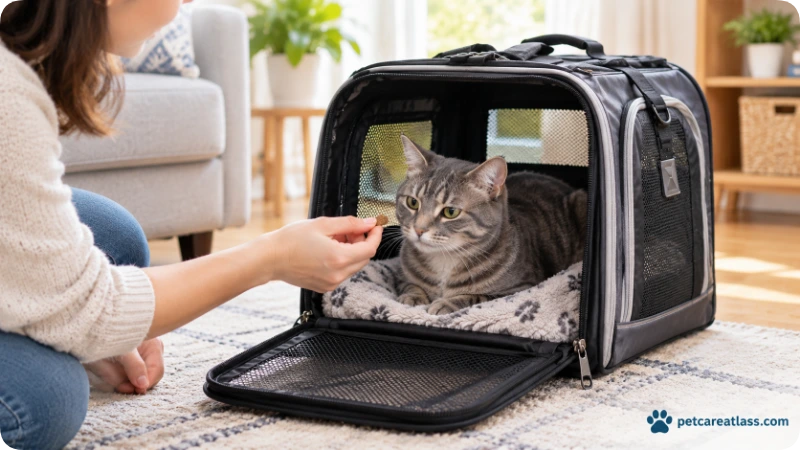
Even a correctly sized carrier may not be comfortable for an animal that has never used one. Introduce it gradually before your departure.
Step 1: Introduce the Carrier at Home
Place the carrier in a familiar, quiet area and leave its entrance open. Allow your pet to investigate it voluntarily.
You can place a familiar-smelling blanket or a favorite toy inside, provided it does not interfere with ventilation or take up too much space.
Avoid forcing your pet inside or immediately closing the door.
Step 2: Practice Short Carrier Sessions
Once your pet starts entering the carrier willingly, gradually practice closing the entrance for short periods.
Increase the duration slowly as your pet becomes more comfortable. Reward calm behavior with treats or gentle encouragement.
If your pet becomes distressed, shorten the session and return to an easier stage.
Step 3: Practice Carrying the Carrier
After your pet is comfortable inside, practice lifting and carrying it around your home.
For dogs, you can also practice short car journeys if appropriate. This helps introduce the movement and sounds associated with transportation.
Step 4: Prepare for Airport Security
At airport security, you may be asked to remove your pet from the carrier while the carrier passes through the X-ray machine.
Keep a secure harness and leash on your dog or cat before removing it. Follow the security officer’s instructions and never send your pet through the X-ray machine.
Ask airport security staff about alternative screening arrangements if your pet cannot safely be carried through the screening area.
Step 5: Keep Your Pet Secure During the Flight
Your pet should remain inside the closed carrier according to airline requirements.
Place the carrier beneath the seat in front of you during taxiing, takeoff, and landing, and whenever required by the airline or flight crew.
Never open the carrier in the aisle or allow your pet to roam around the cabin.
What to Pack When Flying With Your Pet
Preparing a small travel kit can make airport delays and unexpected situations easier to manage.
Consider packing:
- A few absorbent puppy pads or carrier liners.
- Waste bags and pet wipes.
- A small supply of your pet’s regular food.
- A collapsible water bowl.
- Familiar, lightweight bedding.
- A secure harness and leash.
- Identification tags and microchip information.
- Copies of relevant vaccination and travel documents.
- Any prescribed medication, with veterinary instructions.
Avoid packing too many items inside the carrier. Your pet needs sufficient space to move comfortably.
For longer journeys, ask your veterinarian about feeding, hydration, toilet breaks, and any special preparation your pet may need.
Airline Pet Travel Rules Beyond Carrier Dimensions
Buying an appropriate carrier does not automatically qualify your pet for cabin travel. Airlines also regulate which animals can travel, how many pets are permitted, and how reservations must be arranged.
Reserve Your Pet’s Space in Advance
Most airlines limit the number of animals permitted in the cabin on each flight.
Even if your carrier meets the size requirements, your pet may not be accepted if the flight has reached its pet limit.
Contact the airline or use its approved booking process to add your pet to your reservation. Confirm that the pet is accepted on every flight segment, including connections.
Check Seat Restrictions
Passengers traveling with pets may not be permitted to sit in certain locations.
Common restrictions include:
- Emergency exit rows.
- Bulkhead seats.
- Seats without sufficient under-seat storage.
- Selected premium cabin seats.
Choose your seat only after checking the airline’s pet seating policy.
Understand Pet Fees
In-cabin pet transportation usually requires a separate fee. The amount depends on the airline, destination, and journey.
Do not assume the pet fee is included in your passenger ticket or that paying it guarantees acceptance regardless of carrier size.
Check Health and Travel Documents
Documentation requirements depend on the destination and route.
Domestic travel, international travel, and travel to destinations with special animal-entry rules may involve different requirements.
For international journeys, check the destination country’s official animal import requirements and applicable U.S. animal-health documentation rules.
If your pet is traveling internationally, begin checking requirements well before your departure date.
Are Soft-Sided or Hard-Sided Carriers Better for Airplanes?
Both designs can work for in-cabin travel when the airline accepts them and they meet the required measurements.
However, soft-sided carriers are often more convenient because they can adapt slightly to different under-seat spaces.
| Feature | Soft-Sided Carrier | Hard-Sided Carrier |
|---|---|---|
| Flexibility | More flexible | Fixed structure |
| Under-seat fit | Often easier | Depends on seat clearance |
| Cleaning | Fabric needs more care | Easier to wipe |
| Weight | Often lighter | Can be heavier |
| Protection | Less rigid exterior | More rigid exterior |
| Storage | Often folds for storage | Takes up more space |
Which should you choose?
For most small cats and dogs traveling in the cabin, a well-structured soft-sided carrier is a practical choice. However, a hard-sided carrier may be appropriate if your airline accepts it and your pet can fit comfortably inside.
The most important factors are secure construction, sufficient ventilation, adequate interior space, and compatibility with your aircraft.
Common Mistakes to Avoid When Buying an Airline Pet Carrier
A few purchasing mistakes can create unnecessary problems during check-in or boarding.
- Buying based on the airline-approved label: A manufacturer’s marketing description does not guarantee acceptance by your airline.
- Ignoring the aircraft: Under-seat measurements can vary between aircraft and seats.
- Choosing a carrier that is too small: Your pet needs enough room to move naturally.
- Ignoring external measurements: Handles, pockets, and frames can affect the carrier’s overall dimensions.
- Buying an expandable carrier without checking its rules: Airlines may have restrictions on expanded sections.
- Waiting until departure to introduce the carrier: Pets need time to become familiar with their travel space.
- Forgetting to reserve the pet: A compliant carrier cannot replace a confirmed pet reservation.
- Ignoring connecting-airline requirements: A carrier accepted by one airline may not meet another airline’s requirements.
Avoid choosing a carrier based only on its appearance, price, or advertised weight capacity. Comfort and actual airline compatibility should come first.
Safety Considerations Before Flying With Your Pet
Air travel can be stressful for some animals, particularly those with existing medical conditions, respiratory difficulties, or significant anxiety.
Speak with your veterinarian before booking if your pet has a health condition or a history of difficulty during transportation.
Short-nosed breeds, including Pugs, Bulldogs, and Persian cats, may have an increased risk of breathing difficulties during travel. Your veterinarian can help assess whether flying is appropriate and discuss precautions.
Do not give your pet sedatives or tranquilizers simply to make the flight easier. These medications can affect breathing and cardiovascular function at altitude. Consult your veterinarian about travel safety and follow the airline’s medication policy.
If your pet shows signs of severe breathing difficulty, collapse, or another medical emergency before departure, seek urgent veterinary care rather than attempting to continue the journey.
Frequently Asked Questions
What size pet carrier is airline approved for in-cabin travel?
There is no universal size. Many major U.S. airlines publish soft-sided carrier limits around 18 × 11 × 11 inches, but some have smaller requirements. Always check your airline’s current policy and the under-seat dimensions of your specific aircraft.
Can I use the same pet carrier on different airlines?
Sometimes. A carrier that meets one airline’s requirements may also fit another airline’s limits, but acceptance is never automatic. Compare the carrier’s external dimensions against every airline operating your itinerary, including connecting flights.
Are expandable pet carriers allowed on airplanes?
Expandable carriers may be accepted if their closed travel configuration meets airline requirements. However, an expanded section may need to remain closed during the flight. Confirm the rules with your airline before traveling.
Can my cat or dog sit on my lap during the flight?
Generally, ordinary in-cabin pets must remain inside their secured carrier. Some airlines have additional arrangements for extra purchased seats, but those do not automatically allow pets to travel outside their carriers. Follow the operating airline’s instructions.
Can two pets travel in one airline carrier?
It depends on the airline and the animals. Some airlines allow limited exceptions for compatible young pets or certain litters, while others require one animal per carrier. Never assume two pets can share a carrier simply because they fit physically.
Do airline approved pet carriers need ventilation on all sides?
Not necessarily. Ventilation requirements differ between airlines and routes. Some airlines require ventilation on three or four sides, depending on the journey and carrier type. Check the applicable airline requirements before buying.
Can I take an ordinary pet backpack on a plane?
Yes, if the airline accepts its design and it meets the applicable carrier requirements. Many pet backpacks are too tall or bulky for under-seat storage, so measure the backpack rather than relying on its advertised travel suitability.
Conclusion
Choosing airline approved pet carriers in-cabin requires more than finding a bag with the right label. The carrier must satisfy your airline’s size, ventilation, security, and under-seat storage requirements while giving your pet enough room to move comfortably.
Soft-sided carriers are often a practical option, but the best choice depends on your pet and your aircraft. Measure carefully, reserve your pet’s space early, and confirm the current airline policy before departure.

Dr. Emily Carter is a pet-care writer with a focus on animal health, nutrition, and everyday pet wellness. She creates practical, easy-to-understand guides that help pet owners make informed and responsible care decisions.