Quick Answer:
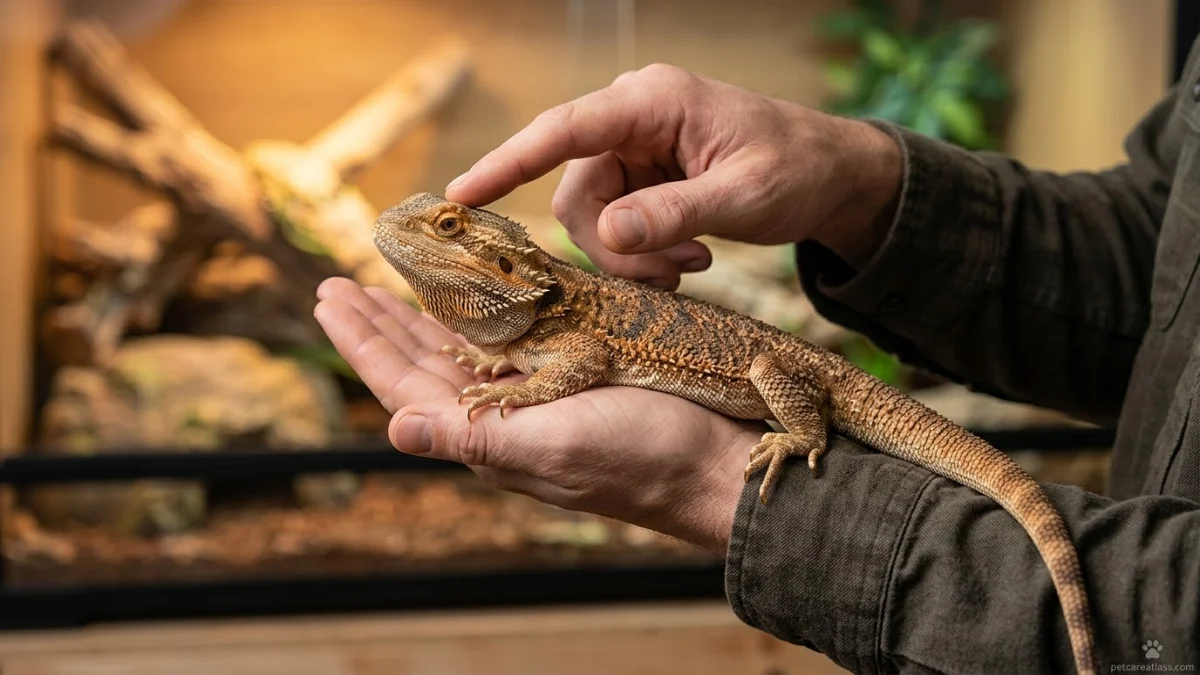
Bearded dragons can enjoy gentle petting, but their preferences vary depending on their personality, past handling experiences, and comfort level. Some become relaxed when gently stroked, while others prefer limited physical contact. Paying attention to their body language, approaching them calmly, and respecting signs of stress can help make handling a more positive experience.
Bearded dragons are popular pet reptiles known for their calm personalities and curious behavior. Many owners enjoy interacting with them and wonder whether these fascinating lizards actually like being petted.
The answer depends on the individual bearded dragon. Some become comfortable with gentle human touch, while others tolerate handling without necessarily enjoying it.
Their reactions can also change depending on their environment, health, mood, and previous experiences. Understanding how bearded dragons respond to physical contact helps owners recognize when their pets feel comfortable and when they need space.
From identifying their preferred touch areas to recognizing signs of stress, learning their body language can help you build trust and create a more positive relationship with your bearded dragon.
Do Bearded Dragons Enjoy Human Interaction?
Bearded dragons can become accustomed to human interaction, particularly when they receive gentle, consistent, and positive experiences from an early age. Some will calmly sit on their owner’s hand, rest on their lap, or allow gentle strokes along their back.
However, it is important to understand the difference between tolerating contact and actively enjoying it.
Bearded dragons do not show affection in exactly the same way as dogs or cats. Their responses to people are influenced by familiarity, individual temperament, previous handling experiences, and their surroundings.
For example:
- A comfortable bearded dragon may remain relaxed while sitting on your hand.
- Another may willingly climb onto your arm but dislike being stroked.
- A nervous dragon may move away whenever someone reaches toward it.
- A familiar dragon may calmly approach the enclosure when it sees its owner.
These behaviors can indicate different levels of comfort with human presence.
Does this mean bearded dragons recognize their owners?
Bearded dragons can become familiar with their owners, their appearance, movements, and daily routines. They may respond differently to familiar people than to unfamiliar visitors. However, this should not automatically be interpreted as human-like affection.
The most important thing is to understand your individual dragon rather than assuming that every bearded dragon enjoys the same type of interaction.
Where Do Bearded Dragons Like to Be Pet?
If your bearded dragon is comfortable with handling, some areas may be better starting points for gentle contact than others.
Many owners begin with the head, chin, or back, but there is no universal petting preference. Always observe your dragon’s response rather than assuming that a particular spot is enjoyable.
Top of the Head
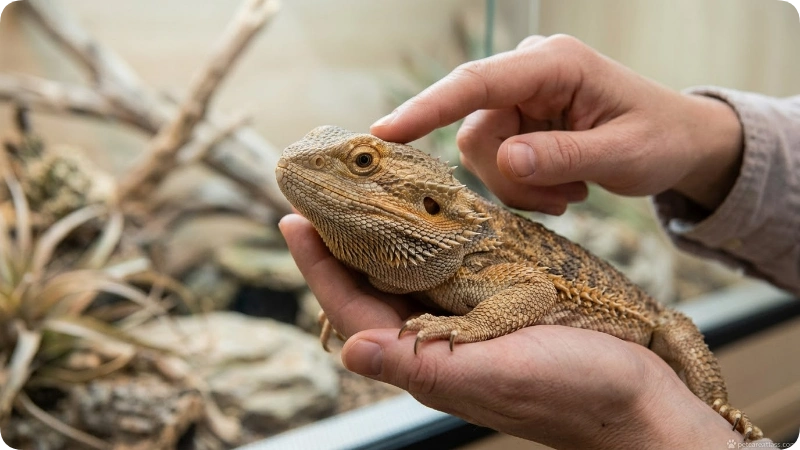
<PRIVATE_PERSON> Some bearded dragons tolerate gentle contact on the top of their heads when they are already comfortable with their owners.
If you try this area:
- Approach slowly from the front or side.
- Keep your movements gentle.
- Avoid touching the eyes.
- Never press down on the head.
- Stop if your dragon pulls away or becomes tense.
Avoid reaching suddenly from above because a shadow or movement overhead may resemble a potential threat.
Under the Chin
The chin can be another area to try when your dragon is relaxed and familiar with handling.
Use a light touch and avoid lifting or pushing the head upward. If your bearded dragon moves away, closes its mouth tightly, or shows other signs of discomfort, stop.
Along the Back
Some bearded dragons tolerate gentle strokes along their back.
If your dragon accepts this contact, use one or two fingers and apply very little pressure. Avoid pressing on the spine, ribs, or tail.
Remember that a calm response does not prove that your dragon actively enjoys being stroked.
Sides of the Body
The sides of a bearded dragon’s body are sensitive areas that require extra care.
Rather than starting with petting around the sides, focus on supporting the body properly when handling it. Avoid squeezing the abdomen or restricting its movement.
Important: Never force your bearded dragon to accept petting. Allow it to move away whenever possible.
Where Should You Avoid Touching a Bearded Dragon?
Although some bearded dragons become comfortable with gentle contact, certain areas should be handled carefully or avoided during casual petting.
| Body area | Why extra care is needed | Better approach |
| Eyes | Sensitive structures that can be injured | Avoid direct contact |
| Nose and mouth | Sensitive facial areas | Do not poke or press |
| Belly | Can feel vulnerable when touched or restrained | Support the body without squeezing |
| Tail | Can be injured by pulling or excessive pressure | Never grab or pull |
| Legs and toes | Small joints and delicate digits | Avoid squeezing or bending |
| Beard | Can expand during defensive displays | Do not pull or manipulate it |
A bearded dragon’s body should always be supported during handling. Never pick it up by its tail, legs, or beard.
How to Tell If Your Bearded Dragon Likes Being Pet
Your bearded dragon cannot tell you verbally whether it enjoys petting, so you need to pay attention to its overall body language.
Some signs suggest that your dragon is comfortable with your presence and gentle contact. However, no single behavior proves that it enjoys being petted.
Signs Your Bearded Dragon May Be Comfortable
Look for a combination of relaxed behaviors, such as:
- Relaxed body posture: Its body appears loose rather than stiff or tense.
- Calm breathing: It breathes normally without repeatedly opening its mouth in a stressful context.
- Voluntary approach: It moves toward your hand instead of repeatedly escaping.
- Settling comfortably: It rests calmly on your hand or arm when properly supported.
- No defensive displays: It does not repeatedly puff up, hiss, or attempt to bite.
These behaviors suggest that your dragon is comfortable with the situation.
However, remaining still is not enough to determine whether it likes being touched. Some reptiles freeze when frightened.
Signs Your Bearded Dragon Does Not Want to Be Pet
Your bearded dragon may be uncomfortable if it:
- Moves away from your hand.
- Tries to escape repeatedly.
- Hisses or opens its mouth defensively.
- Inflates its beard.
- Turns its body away from contact.
- Becomes unusually stiff or tense.
- Shows repeated attempts to hide.
If you notice these behaviors, stop petting and give your dragon space.
Why Does Your Bearded Dragon Not Like Being Pet?
Not every bearded dragon enjoys physical contact. Some are naturally more cautious, while others may become uncomfortable because of their environment, previous experiences, or the way someone approaches them.
Here are some common reasons your bearded dragon may avoid petting.
It Is Not Used to Human Touch
A bearded dragon that has recently arrived in a new home may need time to become familiar with people.
New surroundings, unfamiliar smells, and frequent handling can make it feel unsettled.
Give your dragon time to adjust. Begin by sitting near its enclosure and allowing it to observe you without trying to touch it.
It Has Had Unpleasant Handling Experiences
If a bearded dragon has previously been grabbed, restrained, or handled roughly, it may become cautious around human hands.
For example, a dragon that repeatedly moves away when someone reaches into its enclosure may have learned to associate hands with an uncomfortable experience.
Build positive associations through calm interactions and gentle handling.
It Is Feeling Stressed
Environmental changes, excessive handling, loud noises, and insufficient hiding spaces can contribute to stress.
A bearded dragon may become defensive when it does not feel secure.
Check whether its enclosure provides:
- Appropriate temperature zones.
- Suitable UVB lighting.
- Hiding areas.
- Enough space to move around.
- A predictable day-and-night cycle.
Good husbandry is essential for your dragon’s overall comfort.
It Is Shedding
Bearded dragons periodically shed their skin as they grow and replace old skin.
During shedding, some dragons become more sensitive to touch, particularly around areas where the skin is loosening.
You may notice dull or pale patches of skin, changes in appetite, or increased hiding.
Avoid pulling loose skin or trying to speed up shedding. Let the process happen naturally, and maintain appropriate enclosure conditions.
It Has an Individual Preference for Limited Contact
Just like other animals, bearded dragons have individual temperaments.
Some become comfortable with regular handling, while others prefer to spend most of their time exploring, basking, or resting independently.
Your dragon does not need to enjoy petting to have a good relationship with you.
Respecting its preferences is part of responsible reptile ownership.
How to Pet a Bearded Dragon Safely
If your bearded dragon is comfortable around you, gentle interaction can help it become more familiar with human contact.
The key is to avoid rushing the process.
Follow these steps to introduce petting gradually.
Step 1: Let Your Bearded Dragon Get Used to Your Presence
Start by spending a few quiet minutes near the enclosure.
Avoid tapping on the glass, making sudden movements, or reaching inside immediately.
Allow your dragon to observe you and become familiar with your presence.
Step 2: Approach Slowly
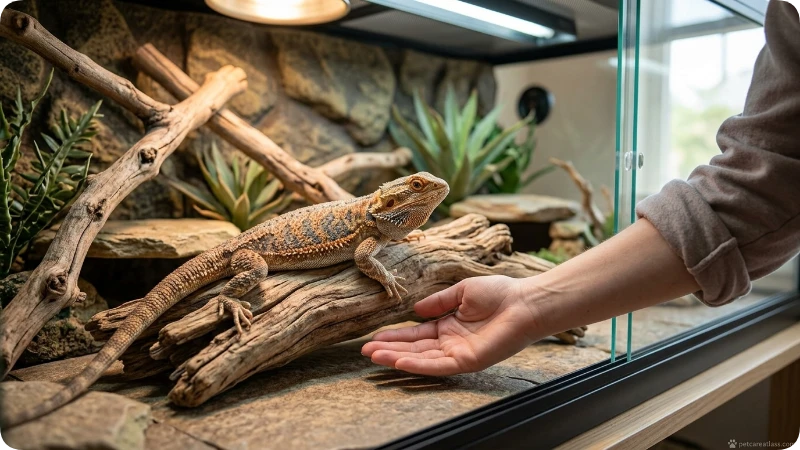
When your dragon appears relaxed, slowly bring your hand into its enclosure.
Approach from the front or side rather than suddenly reaching down from above.
Keep your hand visible and avoid blocking its escape route.
Step 3: Allow It to Investigate Your Hand
Give your bearded dragon an opportunity to approach your hand voluntarily.
It may look at your fingers, move closer, or simply remain where it is.
Do not chase it around the enclosure or force it to interact.
Step 4: Try Gentle Contact
If your dragon remains relaxed, you can try a very gentle touch on the top of its head or along its back.
Use a light touch without pressing or restraining its body.
Start with a brief interaction rather than repeatedly stroking the same area.
Step 5: Watch Its Body Language
Pay attention to how your bearded dragon responds.
If it remains relaxed and does not try to escape, it may be comfortable with the interaction.
If it becomes stiff, moves away, hisses, or displays defensive behavior, stop.
Step 6: Keep Interactions Short
There is no need to pet your dragon for a long time.
Short, calm interactions are a better starting point than prolonged handling, especially for a new or nervous pet.
Over time, you can adjust the length and frequency of interactions according to its response.
How to Hold a Bearded Dragon Without Making It Uncomfortable
Petting and handling are not exactly the same. Even a bearded dragon that tolerates gentle strokes may not enjoy being picked up.
When you need to handle your dragon, proper body support is important.
Follow these basic guidelines:
- Approach calmly and make sure your dragon can see your hand.
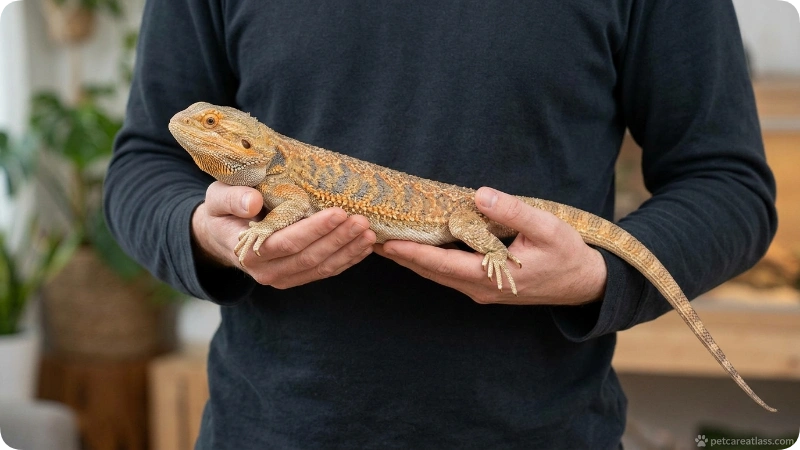
- Gently slide one hand underneath its chest and front legs.
- Use your other hand to support its abdomen, hindquarters, and back legs.
- Keep its entire body supported rather than allowing it to dangle.
- Hold it close to your body without squeezing.
- Return it to its enclosure if it struggles or becomes distressed.
Never lift a bearded dragon by its tail. Unlike some lizards, bearded dragons cannot safely drop and regrow their tails as a normal defense mechanism.
Also, avoid holding it high above the ground. A sudden movement or fall can cause injury.
| Handling practice | Recommended approach | What to avoid |
| Picking up | Support the chest and entire body | Grabbing the tail |
| Holding | Keep the dragon close to your body | Allowing it to dangle |
| Petting | Use a gentle, light touch | Pressing or squeezing |
| Interaction | Allow voluntary movement | Chasing or forcing contact |
| Returning it | Place it gently on a stable surface | Dropping it into the enclosure |
Why Does My Bearded Dragon Close Its Eyes When I Pet It?
Closing its eyes during petting can be a sign of discomfort rather than enjoyment.
Some owners assume that a bearded dragon closing its eyes means it is relaxing, similar to a cat enjoying a gentle stroke. However, this interpretation is not always correct.
A bearded dragon may close one or both eyes when something approaches or touches its face because it is trying to protect its eyes or avoid an uncomfortable stimulus.
Consider the surrounding behavior:
- If it repeatedly closes its eyes when you touch its head, stop touching that area.
- If it moves away, respect its attempt to avoid contact.
- If it keeps one eye closed even when nobody is touching it, check for possible eye irritation or injury.
Persistent eye closure, swelling, discharge, or other unusual eye changes warrant veterinary attention.
Important: Do not interpret closed eyes as proof that your bearded dragon is enjoying petting.
What Does It Mean When a Bearded Dragon Puffs Up Its Beard?
A bearded dragon’s beard is an important part of its communication and defensive behavior.
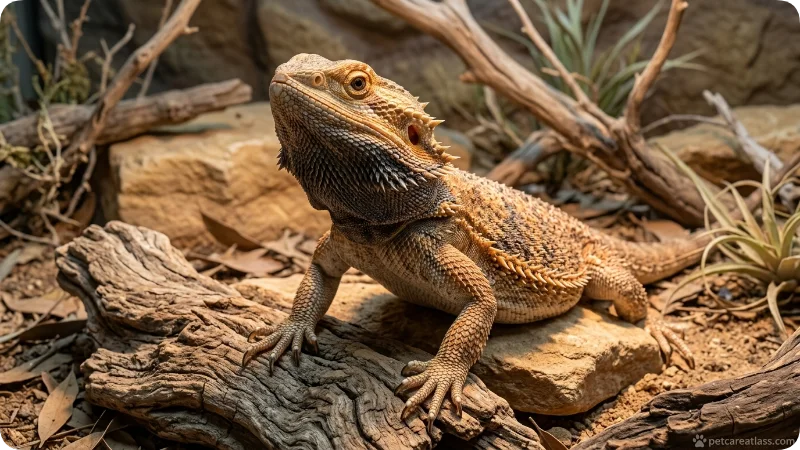
When it puffs up its beard, the animal may be responding to a perceived threat, feeling stressed, or displaying another behavioral response.
The beard may also become darker, particularly during certain displays.
Common reasons include:
- Feeling threatened by unfamiliar people or animals.
- Responding to another bearded dragon.
- Feeling defensive when approached.
- Experiencing stress from its surroundings.
A puffed beard does not automatically mean that your dragon is angry. Context matters.
If your dragon puffs up when you try to pet it, stop and give it space. Avoid touching or trying to flatten its beard.
Do Bearded Dragons Like Being Held More Than Being Pet?
Some bearded dragons tolerate being held but dislike repeated stroking. Others may accept gentle petting while preferring not to be picked up.
These are different types of physical interaction, and your dragon may have a preference for one over the other.
| Interaction | What it involves | Possible response |
| Being held | Supported contact with your hands | May tolerate or resist depending on temperament |
| Being petted | Gentle contact on the head or back | May accept limited touch or move away |
| Sitting on your arm | Resting on a supported arm | May remain calm if comfortable |
| Exploring your hand | Voluntarily investigating your fingers | May help build familiarity |
| Sitting near you | Being close without physical contact | May be comfortable for some dragons |
Do not assume that a bearded dragon wants to be cuddled simply because it sits on your arm.
Some may prefer warmth, a stable resting place, or an opportunity to explore rather than physical affection.
How Often Should You Pet Your Bearded Dragon?
There is no fixed number of times a bearded dragon should be petted each day.
Its comfort level, age, temperament, health, and previous handling experiences all influence how much interaction it can tolerate.
For a newly adopted dragon, begin with brief, low-pressure interactions and allow it to adjust to its new home.
For an established pet that is comfortable with handling, occasional gentle contact may be appropriate.
Keep these points in mind:
- Do not wake your dragon just to pet it.
- Avoid unnecessary handling during shedding if it appears uncomfortable.
- Give it time to bask, eat, explore, and rest without interruption.
- Reduce handling if it repeatedly tries to escape.
- Avoid handling when it appears unwell or injured unless necessary for care.
The goal is not to create a petting routine that your dragon must follow. It is to develop a relationship that respects its natural behavior.
Can You Bond With a Bearded Dragon Without Petting It?
Absolutely. Physical contact is not the only way to help a bearded dragon become familiar with you.
In fact, some dragons may become more comfortable when owners focus on predictable, non-invasive interactions.
Here are a few ways to build familiarity without constantly touching your pet.
Spend Time Near Its Enclosure
Sit near the enclosure and allow your dragon to become familiar with your appearance and movements.
Avoid tapping on the glass or repeatedly trying to get its attention.
Follow a Consistent Care Routine
Feed your dragon, maintain its enclosure, and provide appropriate lighting and temperatures on a consistent schedule.
Predictable care can help reduce unnecessary disturbances.
Allow Voluntary Interaction
When appropriate, let your dragon approach your hand rather than reaching toward it every time you open the enclosure.
Voluntary interaction gives it more control over the experience.
Provide a Comfortable Environment
A suitable enclosure, appropriate heating, UVB lighting, hiding areas, and enrichment are essential for good welfare.
A healthy, comfortable environment provides a better foundation for positive interactions.
Learn Its Individual Behavior
Spend time observing how your dragon behaves when you approach, feed it, clean its enclosure, or offer gentle handling.
Over time, you may recognize which situations make it comfortable and which cause it to withdraw.
Remember, a bearded dragon can become familiar with you without enjoying frequent physical contact.
Common Mistakes to Avoid When Petting a Bearded Dragon
Even well-meaning owners can accidentally make their bearded dragons uncomfortable.
Avoid these common mistakes:
1. Reaching suddenly from above: A quick movement overhead can frighten your dragon. Approach slowly from the front or side.
2. Assuming stillness means happiness: A frightened reptile may freeze instead of moving away. Look at its overall body posture and behavior.
3. Touching sensitive areas repeatedly: Avoid unnecessary contact with the eyes, mouth, belly, and tail.
4. Forcing interaction: Never chase your dragon around its enclosure to make it accept petting.
5. Holding it incorrectly: Always support its entire body, including its hindquarters and legs.
6. Ignoring defensive signals: Hissing, repeated attempts to escape, and defensive beard displays mean you should stop and reassess the interaction.
7. Handling too frequently: Excessive handling can interfere with normal activities and increase stress in some individuals.
8. Forgetting hygiene: Wash your hands before and after handling your bearded dragon, especially after touching its enclosure, food, or waste. Reptiles can carry Salmonella even when they look healthy.
When Should You Stop Petting Your Bearded Dragon?
Stop petting immediately if your dragon displays signs of distress or attempts to avoid contact.
Some behaviors may simply indicate that it wants to be left alone, while others can be associated with health or environmental problems.
Pay attention to unusual changes such as:
- Repeated defensive behavior.
- Persistent lethargy or weakness.
- Unusual difficulty moving.
- Loss of appetite that continues or occurs alongside other concerning symptoms.
- Swelling, wounds, or visible injuries.
- Abnormal breathing or persistent open-mouth breathing outside normal basking behavior.
A bearded dragon may sometimes open its mouth while basking to help regulate body temperature. However, persistent open-mouth breathing outside this context, especially with wheezing, mucus, or unusual breathing effort, requires veterinary assessment.
If your dragon suddenly stops tolerating handling when it previously did, consider whether something in its environment or health has changed.
A veterinarian experienced in reptile care can assess persistent behavioral changes and possible medical problems.
Frequently Asked Questions :
Do bearded dragons get attached to their owners?
Bearded dragons can become familiar with their owners and recognize familiar routines, appearances, and interactions. Some may approach their owners or remain calm during handling. However, this does not necessarily mean they form emotional attachments in the same way as dogs or cats.
Do bearded dragons like belly rubs?
Not necessarily. The belly is a vulnerable area, and many bearded dragons may feel uncomfortable when someone touches or restrains it. Avoid rubbing or pressing their abdomen. Always support the body gently when handling them.
Can you pet a bearded dragon every day?
Some bearded dragons tolerate brief daily interactions, but daily petting is not necessary. Consider your dragon’s temperament, health, and response to handling. If it becomes uncomfortable or tries to escape, give it a break.
Why does my bearded dragon flatten its body when I approach?
Flattening can occur for several reasons, including defensive behavior, thermoregulation, or responding to something in its environment. Look at the surrounding circumstances and other body language before deciding what it means.
Do baby bearded dragons like being pet?
Baby bearded dragons may be more cautious around people because they are still becoming familiar with their surroundings. Introduce handling gradually, use gentle movements, and keep interactions brief. Never force a baby dragon to accept petting.
Can bearded dragons bite when you try to pet them?
Yes. A bearded dragon may bite if it feels threatened, frightened, or uncomfortable. Some bites may also happen when a dragon mistakes fingers for food. Avoid sudden movements, respect defensive signals, and never force physical contact.
How do I know if my bearded dragon trusts me?
A bearded dragon may show comfort around familiar people by remaining relaxed, approaching voluntarily, or calmly accepting necessary handling. These behaviors suggest familiarity and tolerance, although they do not prove human-like trust or affection.
Conclusion
So, do bearded dragons like to be pet? Some do, while others prefer limited physical contact. Their preferences depend on individual temperament, familiarity with people, previous experiences, and overall comfort.
If you want your bearded dragon to become comfortable around you, start with calm interactions and allow it to approach your hand voluntarily. Gentle contact around the head or back may be tolerated by some individuals, but always watch for signs of discomfort.
Most importantly, remember that petting is not necessary for a healthy relationship with your reptile. Providing suitable housing, proper nutrition, appropriate lighting, and respectful handling matters much more than how often you touch it.
A comfortable bearded dragon should have the freedom to interact when it feels ready and move away when it needs space. Respecting those preferences is one of the best ways to support its well-being.

Daniel Brooks is a pet care and animal behavior writer at petcareatlass.com focused on helping owners better understand their pets’ behavior and everyday needs. He creates practical, easy-to-follow content on pet communication, training, welfare, and responsible care.