Quick Answer:
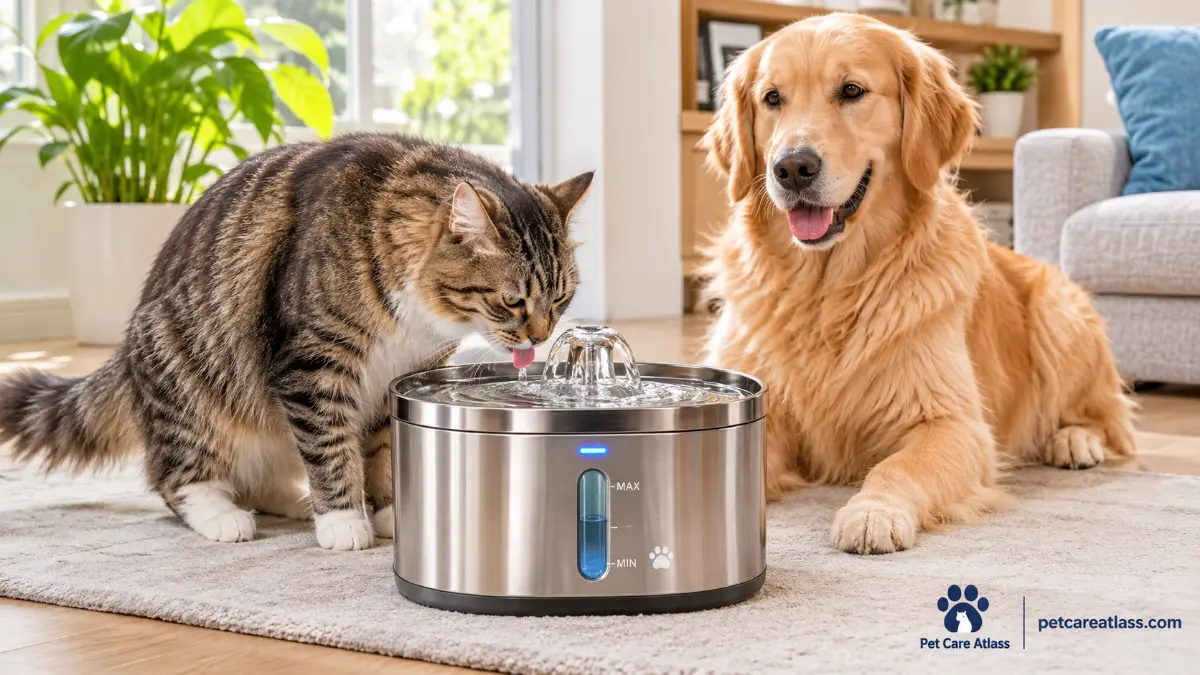
A smart pet water fountain provides circulating drinking water with additional features such as app connectivity, water-level alerts, filter reminders, and drinking activity monitoring. The best model combines reliable circulation, easy cleaning, safe materials, and suitable capacity. Choose a fountain your pet feels comfortable using rather than paying extra for technology you may never need.
Managing your pet’s drinking water involves more than filling a bowl. Hair, dust, food particles, and everyday use can affect water cleanliness, while busy owners may occasionally forget to check water levels or replace filters.
A smart pet water fountain combines automatic water circulation with technology designed to simplify these tasks.
Depending on the model, you may be able to receive smartphone notifications, monitor water levels, check filter status, or review your pet’s drinking activity.
However, these features are not equally useful for every household. Understanding how smart fountains work, what their technology actually offers, and how to maintain them can help you choose a practical option for your cat or dog.
What Is a Smart Pet Water Fountain?
A smart pet water fountain is an automatic drinking-water system that circulates water through a pump and filtration system. Unlike a conventional water bowl, some models also connect to smartphone applications and use sensors to monitor selected operating conditions.
Depending on the design, owners may receive notifications when the water level becomes low, view filter replacement reminders, or monitor recorded drinking activity.
Most smart pet water fountains contain several basic components:
- Water reservoir: Stores the drinking water.
- Electric pump: Moves water through the circulation system.
- Filter: Helps capture hair, debris, and certain impurities.
- Drinking tray: Provides an accessible surface for pets.
- Sensors: Monitor selected conditions, such as water levels.
- Smart connectivity: Allows compatible devices to communicate with an application.
Not every fountain includes all these features. Some offer basic automatic circulation, while advanced models provide additional monitoring and remote notifications.
How Does a Smart Pet Water Fountain Work?
A smart pet water fountain uses an electric pump to move water from its reservoir through a circulation system. Water passes through the filtration arrangement and reaches the drinking surface before returning to the reservoir.
The pump keeps water moving while the filtration system helps capture certain particles.
Smart technology adds another layer of functionality. For example, a water-level sensor may detect when the reservoir becomes low and send an alert to a connected smartphone.
Some models also record drinking frequency or session duration. These measurements can help owners observe changes in their pets’ routines, although they do not necessarily represent the exact amount of water consumed.
The basic operation is relatively simple:
- Fill the reservoir with fresh drinking water.
- Connect the fountain to its recommended power source.
- The pump circulates water through the system.
- The filter helps capture selected particles.
- Sensors monitor supported operating conditions.
- The connected application displays available information.
Smart Features Worth Looking For
Smart technology can make fountain maintenance more convenient, but some features provide considerably more practical value than others.
Real-Time Water Level Monitoring
Water-level monitoring helps owners know when a fountain needs refilling.
Basic models may include a transparent reservoir, while advanced versions use sensors to display water-level information through an application.
This feature can be particularly useful when:
- Several pets share the same fountain.
- You have a busy daily schedule.
- You want to check water levels remotely.
- You prefer receiving notifications instead of relying entirely on manual checks.
However, electronic sensors are not infallible. Always inspect the actual water level because a delayed notification or inaccurate reading could leave your pet without sufficient drinking water.
Smartphone App Connectivity
A connected application allows owners to access selected fountain information from a smartphone.
Depending on the manufacturer, available features may include:
- Device operating status.
- Water-level notifications.
- Filter replacement reminders.
- Battery information.
- Adjustable operating modes.
- Drinking activity records.
Before purchasing, check whether the device uses Wi-Fi, Bluetooth, or an additional hub.
Also check smartphone compatibility and whether certain functions require a subscription. Some applications provide basic monitoring for free but charge for advanced features.
Low-Water and Filter Replacement Alerts
Low-water alerts notify owners when the reservoir needs attention. Filter reminders help establish a regular maintenance routine.
These notifications are useful, but they do not guarantee that the water or filter is clean.
A filter can become dirty before its scheduled replacement date, particularly in homes with multiple pets or heavy-shedding animals.
Follow the manufacturer’s maintenance instructions and inspect the fountain regularly.
Drinking Habit Monitoring
Some advanced models record how frequently a pet visits the fountain and how long it spends drinking.
These records can help owners notice changes in everyday behavior.
For example, a noticeable change in drinking frequency may be worth discussing with a veterinarian, especially when accompanied by changes in appetite, urination, or energy.
However, drinking frequency and session duration do not necessarily reveal the precise volume consumed. Spilled water, splashing, and multiple pets sharing the fountain can affect measurements.
Use this technology as an observation aid rather than a medical monitoring or diagnostic tool.
Automatic Pump Protection
Automatic pump protection helps prevent the pump from operating when the water level becomes insufficient.
This is particularly useful because running without enough water can damage certain pump designs.
Look for:
- Automatic low-water shutoff.
- Clear minimum water-level indicators.
- Accessible pump components.
- Easy-to-follow restarting instructions.
- Reliable sensor operation.
This feature can protect the device, but it should never replace regular water-level checks.
Benefits of Using a Smart Pet Water Fountain
A smart fountain can make everyday water management more convenient, particularly for households with several pets.
| Benefit | How It Helps |
|---|---|
| Water-level monitoring | Makes refilling easier |
| Filter reminders | Helps track maintenance |
| Circulating water | Offers an alternative to still water |
| Drinking activity records | Tracks changes in drinking habits |
| Pump protection | Helps prevent dry-running damage |
| Larger reservoirs | Reduces frequent refilling |
| Smartphone connectivity | Provides convenient access to information |
Can a Smart Fountain Encourage Pets to Drink More Water?
A smart fountain may encourage some pets to investigate and use a different drinking arrangement, but it does not guarantee increased water consumption.
Cats have individual preferences. Some may approach moving water, while others prefer a quiet, stationary bowl.
Scientific research does not support the claim that fountains consistently increase water intake in all cats.
A 2010 study involving healthy cats found that a fountain did not substantially improve hydration based on urine measurements, despite differences in recorded water intake. A separate 2019 study also found no significant overall difference in water consumption between still, circulating, and free-falling water systems. Individual preferences nevertheless occurred.
The practical takeaway is to provide choices. Keep a clean conventional bowl available while introducing the fountain and observe which option your pet prefers.
Smart Pet Water Fountain vs. Traditional Pet Water Bowl
Both options can provide drinking water, but they differ in convenience, maintenance, and technology.
| Feature | Smart Fountain | Water Bowl |
|---|---|---|
| Water movement | Circulating | Still |
| App connectivity | Selected models | Not available |
| Water-level alerts | Selected models | Manual checks |
| Filtration | Usually included | Usually not needed |
| Electricity | Required for powered models | Not required |
| Cleaning | Pump and filter care | Usually simpler |
| Initial cost | Generally higher | Generally lower |
| Setup | Assembly and possible app setup | Minimal |
| Portability | Depends on power design | Easy to move |
A traditional bowl may be preferable for pets that dislike pump noise, unfamiliar equipment, or moving water.
A smart fountain may be more convenient for owners who appreciate automated notifications and digital monitoring.
Neither option is universally better. Cleanliness, accessibility, and your pet’s drinking preferences should guide the decision.
How to Choose the Best Smart Pet Water Fountain
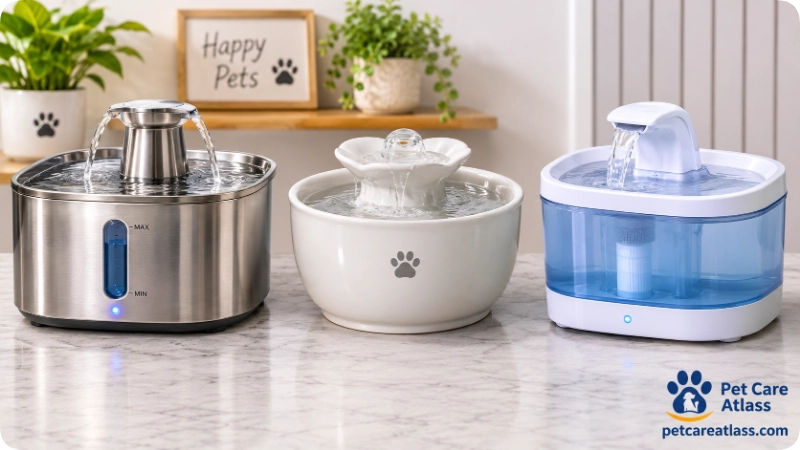
Choosing a fountain involves more than comparing smartphone features. The construction, capacity, cleaning requirements, and ongoing expenses are equally important.
Choose Safe and Easy-to-Clean Materials
The drinking surface should be smooth, durable, and easy to wash.
Common materials include:
- Stainless steel: Durable, nonporous, and generally straightforward to clean.
- Ceramic: Smooth and stable when the surface remains intact.
- Plastic: Lightweight and often affordable, although scratches can make thorough cleaning more difficult.
Stainless steel and smooth ceramic are practical choices when hygiene and cleaning convenience are priorities.
Remember that the drinking tray is only one part of the system. Check the material used for the reservoir, pump housing, and other water-contact components.
Select an Appropriate Water Capacity
The right reservoir capacity depends on the number of pets using the fountain and their drinking habits.
A smaller model may work for one cat, while a household with several cats or dogs may need a larger reservoir.
Consider:
- Number of pets sharing the fountain.
- Approximate daily water consumption.
- Available installation space.
- Refilling frequency.
- Minimum operating water level.
A larger reservoir does not mean the water can remain untouched for several days. Regular inspection, water replacement, and cleaning are still necessary.
Check Filtration Quality
Different fountains use different filtration arrangements.
| Filter Type | Main Purpose |
|---|---|
| Activated carbon | Reduces certain odors and tastes |
| Foam filter | Traps hair and larger debris |
| Mesh filter | Keeps large particles away from the pump |
| Multi-layer filter | Combines multiple filtration functions |
Filtration does not eliminate the need for cleaning or guarantee that contaminated water becomes safe.
Check replacement filter availability, costs, and manufacturer recommendations before purchasing.
Consider Noise Levels
Pump noise can influence whether a pet feels comfortable drinking.
A quieter fountain may be preferable for nervous animals or households where the drinking station is near sleeping areas.
Look for feedback about:
- Pump humming.
- Water splashing.
- Vibrations against hard floors.
- Increased noise when water levels become low.
A stable base and properly positioned pump can also help reduce unnecessary noise.
Check Power and Connectivity Requirements
Smart fountains use different power arrangements.
| Power Type | What to Consider |
|---|---|
| Plug-in | Continuous power; needs an outlet |
| Rechargeable battery | Flexible placement; needs charging |
| Cordless design | Fewer exposed cables; battery maintenance required |
| USB-powered | Needs a compatible power source |
For connected features, check the supported Wi-Fi frequency, Bluetooth requirements, smartphone compatibility, and whether remote monitoring requires an additional hub.
Do not assume Bluetooth connectivity allows monitoring from anywhere. Some models require your phone to remain within Bluetooth range.
Evaluate Cleaning and Replacement Costs
A fountain that is difficult to disassemble can become frustrating to maintain.
Before purchasing, check:
- Whether the pump can be removed.
- Whether internal pump parts can be cleaned.
- Whether the drinking tray is dishwasher-safe.
- How frequently filters need replacing.
- Whether replacement parts are available.
- Whether the application requires a subscription.
The initial purchase price is only one part of the long-term cost.
Which Smart Pet Water Fountain Features Matter Most?
If you are comparing several models, prioritize reliable operation and practical maintenance over unnecessary technology.
| Feature | Priority | What to Look For |
|---|---|---|
| Easy cleaning | Essential | Removable parts and accessible pump |
| Reliable circulation | Essential | Consistent pump operation |
| Low-water protection | High | Automatic pump shutoff |
| Suitable filtration | High | Available, replaceable filters |
| Durable surface | High | Smooth stainless steel or ceramic |
| App notifications | Optional | Reliable alerts |
| Drinking tracking | Optional | Clear measurement limitations |
| Voice control | Low | Only if useful |
| Advanced automation | Depends | Simple, reliable controls |
For most households, easy maintenance and dependable operation provide more value than complicated app features.
How to Clean and Maintain a Smart Pet Water Fountain
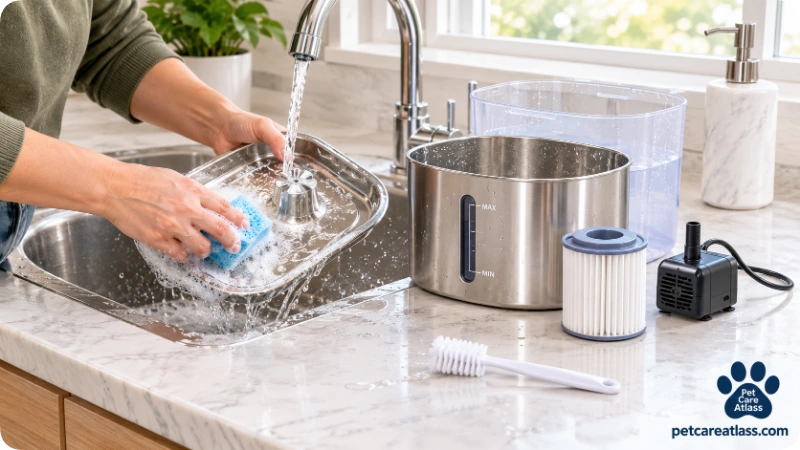
Regular cleaning is essential because hair, food particles, saliva, and mineral deposits can accumulate inside the fountain.
The CDC recommends cleaning pet water bowls daily. Fountain owners should also follow the manufacturer’s additional instructions for cleaning pumps, filters, and reservoirs.
Step-by-Step Cleaning Process
- Disconnect the power: Unplug the fountain before disassembling or cleaning its components.
- Empty the reservoir: Remove the remaining water instead of simply topping it up.
- Remove the filter: Follow the manufacturer’s instructions for rinsing or replacing it.
- Disassemble removable components: Separate the tray, reservoir, filter housing, and pump where the design allows.
- Wash the components: Use warm water and mild dish soap to remove visible dirt and residue.
- Clean the pump: Use an appropriate small brush to remove accumulated hair and debris from accessible parts.
- Rinse thoroughly: Remove all soap residue before reassembly.
- Refill and restart: Add fresh drinking water to the recommended level and check that circulation works properly.
Never assume disposable filters can be washed with soap. Follow the specific filter instructions.
How Often Should You Clean a Smart Fountain?
Cleaning frequency depends on the fountain design, number of pets, water quality, and manufacturer recommendations.
| Maintenance Task | Recommended Routine |
|---|---|
| Check water and water level | Daily |
| Remove hair and debris | Daily or as needed |
| Clean water-contact surfaces | Daily, as directed |
| Deep-clean reservoir and parts | Follow manufacturer instructions |
| Clean the pump | Follow manufacturer instructions |
| Replace filters | Follow the recommended interval |
The CDC’s general recommendation is to clean water bowls daily. This is a useful baseline for fountain drinking surfaces, while the pump and internal components need model-specific care.
Do not immerse electrical adapters, exposed electrical connections, or components that the manufacturer identifies as non-washable.
How to Introduce Your Pet to a Smart Water Fountain
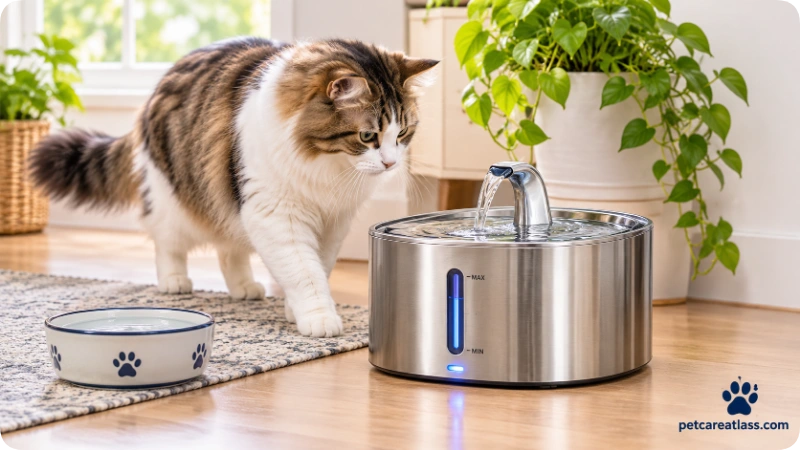
Some pets investigate a new fountain immediately, while others need time to become comfortable with its sound, movement, and unfamiliar appearance.
A gradual introduction can make the transition easier.
Place It Near the Existing Drinking Area
Choose a quiet location where your pet already feels comfortable drinking.
Avoid busy walkways, noisy appliances, and areas where another animal might block access.
Let Your Pet Investigate
Allow your pet to approach and investigate the fountain without pressure.
Do not force its face toward the water or hold it in place to encourage drinking.
Keep the Original Water Bowl Available
Continue offering fresh water in the familiar bowl while your pet becomes accustomed to the fountain.
This ensures that your pet always has an alternative drinking source.
Introduce the Circulating Water
Switch on the fountain according to its instructions once your pet is comfortable around the device.
Some animals may investigate the moving water, while others may initially avoid the sound.
Observe Your Pet’s Response
Look for relaxed body language and voluntary drinking.
If your pet repeatedly avoids the fountain or appears frightened, provide the familiar bowl and reconsider whether the fountain is suitable.
Patience is more useful than forcing a transition.
Common Smart Pet Water Fountain Problems and Solutions
Even connected fountains can experience mechanical, electrical, or connectivity problems.
| Problem | Possible Cause | Practical Solution |
|---|---|---|
| Water stops flowing | Low water or blocked pump | Refill and clean the pump |
| Pump makes noise | Debris, trapped air, or low water | Inspect pump and refill |
| Incorrect app status | Sensor or connection issue | Check water level and reconnect |
| Early filter reminder | Scheduled replacement alert | Inspect filter and follow instructions |
| Bad water smell | Dirty reservoir or poor maintenance | Empty and clean the fountain |
| Pet avoids fountain | Noise or unfamiliar movement | Offer quiet water and introduce gradually |
| Pump keeps stopping | Low water or blockage | Check reservoir, intake, and pump |
Why Is My Smart Pet Water Fountain Not Working?
Start by checking the water level, power connection, and pump.
If circulation has stopped, unplug the fountain before inspecting or cleaning its components. Remove accumulated hair and debris from the pump and check whether the filter is correctly positioned.
For application-related problems, check the internet connection, Bluetooth range, device permissions, and smartphone compatibility.
If the pump overheats, wiring becomes damaged, or the fountain repeatedly malfunctions, stop using it and contact the manufacturer rather than attempting unsafe electrical repairs.
Are Smart Pet Water Fountains Safe for Cats and Dogs?
Generally, a properly designed and maintained fountain can provide a convenient drinking-water source for cats and dogs.
However, safety depends on the materials, electrical design, water quality, and condition of the device.
Follow these precautions:
- Choose durable, easy-to-clean materials.
- Keep electrical connections away from water spills.
- Position the device on a stable, level surface.
- Replace damaged cables and components.
- Prevent pets from chewing exposed wires.
- Maintain the recommended water level.
- Clean the pump and drinking surfaces regularly.
- Always provide another accessible drinking-water source.
Do not assume that UV sterilization, carbon filtration, or other advertised purification technologies make a fountain maintenance-free.
Can a Smart Fountain Replace Veterinary Hydration Advice?
No. A fountain is a drinking-water accessory, not a treatment for dehydration or an underlying medical condition.
If your pet suddenly drinks much more or less than usual, contact a veterinarian. Changes in thirst can sometimes accompany medical conditions, including kidney disease, diabetes, and urinary problems.
Seek prompt veterinary advice if your pet shows signs such as unusual lethargy, weakness, reduced appetite, or other concerning changes.
For cats with diagnosed urinary or kidney conditions, do not rely on a smart fountain alone to manage hydration. Diet, medical treatment, and an individualized veterinary plan may also be important.
Is a Smart Pet Water Fountain Worth Buying?
A smart fountain can be worthwhile if you want convenient water monitoring, maintenance reminders, or additional information about your pet’s drinking routine.
It may be a good investment if:
- You have multiple pets sharing a drinking station.
- You frequently forget filter replacement dates.
- You prefer low-water notifications.
- Your pet comfortably drinks from circulating water.
- You want to observe changes in drinking habits.
A traditional fountain or water bowl may be sufficient if:
- Your pet prefers stationary water.
- You do not need smartphone monitoring.
- You want a simpler cleaning routine.
- You prefer fewer electronic components.
- Your budget is limited.
Ultimately, choose a fountain based on reliable operation, hygienic construction, accessible replacement parts, and your pet’s preferences. Expensive technology should be an added convenience, not the deciding factor.
Frequently Asked Questions
Do Smart Pet Water Fountains Require Wi-Fi?
Not all smart fountains require Wi-Fi. Some models use Bluetooth, while basic automatic fountains operate without internet connectivity. Check the manufacturer’s specifications to determine whether app monitoring, remote alerts, or other functions require Wi-Fi, Bluetooth, or an additional hub.
How Long Can Water Stay in a Smart Pet Fountain?
There is no universal safe storage period for every fountain. Water quality depends on cleanliness, temperature, exposure to debris, and the manufacturer’s design. Inspect the water daily, replace it when dirty, and clean the reservoir regularly rather than relying on its capacity to determine freshness.
Are Stainless-Steel Smart Pet Water Fountains Better Than Plastic Ones?
Stainless-steel drinking surfaces are generally easier to clean and resist scratching better than many plastic surfaces. However, the complete fountain matters. Check the reservoir, pump housing, filter compartment, and other water-contact components before choosing.
Can Multiple Pets Use One Smart Pet Water Fountain?
Yes, multiple cats or dogs can share a fountain if its capacity and drinking area are suitable. However, some pets may guard shared resources or prevent others from drinking comfortably. Consider providing additional water stations in separate locations.
Do Smart Pet Water Fountains Track How Much My Pet Drinks?
Some models estimate drinking activity using sensors that record frequency or duration. However, these measurements are not necessarily equivalent to the exact volume consumed, especially when multiple pets share the device.
Do Smart Pet Water Fountains Need Replacement Filters?
Most filtered models require periodic filter replacement. The interval depends on the filter design, water quality, number of pets, and manufacturer instructions. Check replacement availability and ongoing costs before purchasing.
Can Dogs Use Smart Cat Water Fountains?
Many automatic fountains can accommodate both cats and smaller dogs, but suitability depends on drinking height, opening size, stability, and water capacity. Larger dogs may need a fountain with a wider drinking area and a larger reservoir.
Conclusion
A smart pet water fountain can simplify everyday water management through circulating water, digital notifications, and optional drinking activity monitoring. However, the best choice is not necessarily the model with the most advanced technology.
Prioritize easy cleaning, reliable pump protection, suitable capacity, safe materials, and affordable replacement filters. Most importantly, observe your pet’s preferences and always provide access to fresh drinking water, whether from a smart fountain or a traditional bowl.

Emily Carter is a pet-care writer with a focus on animal health, nutrition, and everyday pet wellness. She creates practical, easy-to-understand guides that help pet owners make informed and responsible care decisions.