Quick Answer:
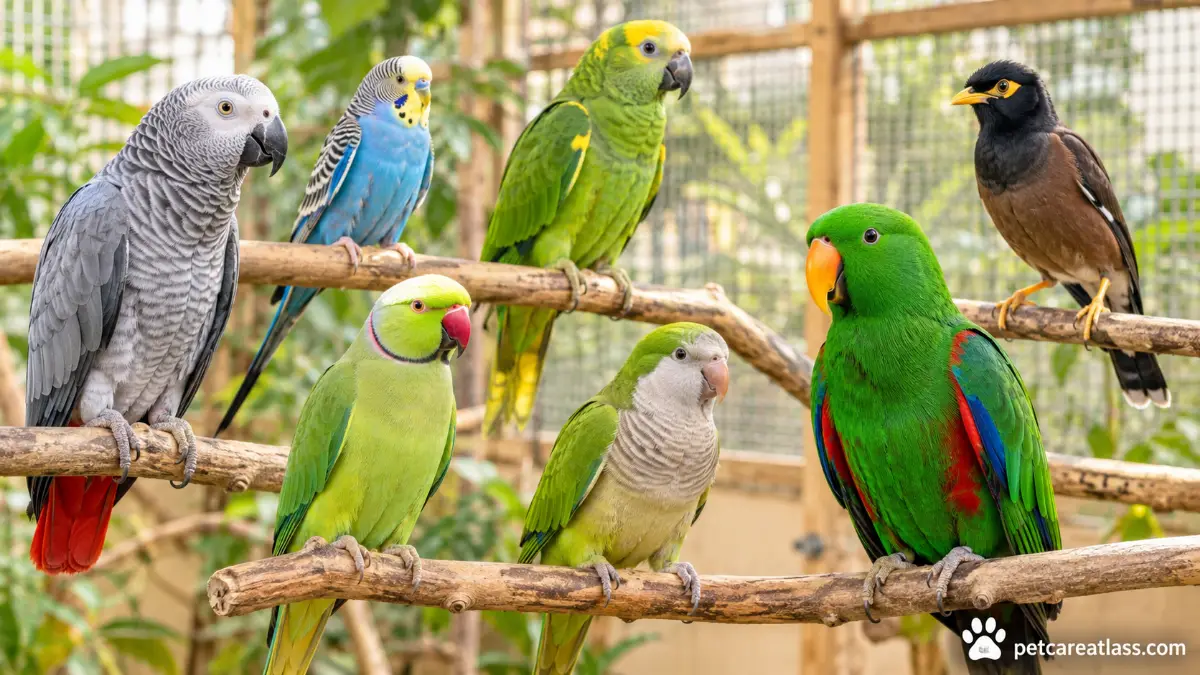
Pet birds that talk include African grey parrots, budgerigars (budgies), Amazon parrots, Indian ringneck parakeets, Quaker parrots, Eclectus parrots, and hill mynahs. Some can imitate human words and phrases remarkably well, while others develop smaller vocabularies. However, talking ability varies between individuals, and no bird species guarantees a talking companion.
Imagine greeting your pet bird in the morning and hearing it respond with a familiar word or phrase. Some companion birds can imitate human speech, repeat household sounds, and even reproduce familiar whistles and melodies.
However, not every talking bird has the same vocal abilities. African grey parrots are particularly well known for speech mimicry, while budgies can develop surprisingly large vocabularies despite their small size.
Mynahs are another interesting option because they are not parrots but can imitate human voices.This guide explores seven pet birds that talk, compares their vocal abilities, and explains what prospective owners should consider before choosing one.
Key Takeaways
- African grey parrots are particularly well known for extensive speech mimicry.
- Budgerigars can learn surprisingly large vocabularies despite their small size.
- Amazon parrots often combine talking, singing, and loud vocalizations.
- Indian ringnecks and Quaker parrots can learn recognizable words and phrases.
- Hill mynahs are non-parrot birds known for impressive human-voice imitation.
- Talking ability varies between individual birds, and responsible care matters more than vocabulary size.
7 Pet Birds That Talk and Mimic Human Speech
Several companion bird species can learn to reproduce human words, phrases, and everyday sounds. The following seven are worth considering, although their talking abilities and care requirements differ.
1. African Grey Parrot
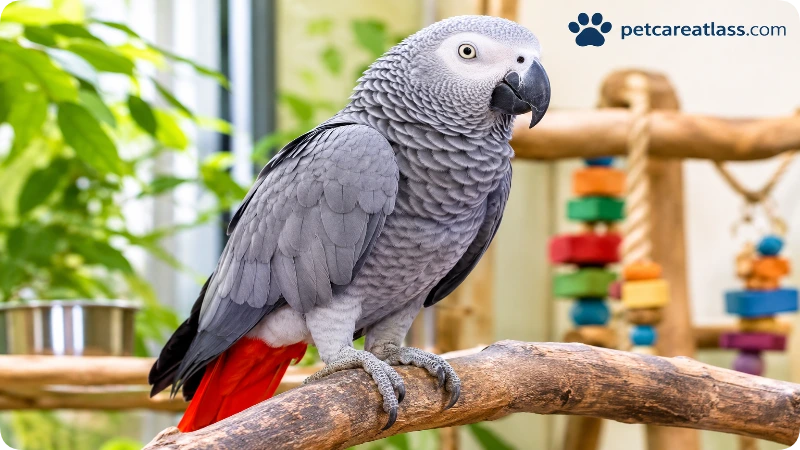
Scientific name: Psittacus erithacus
Talking ability: Exceptional vocal mimicry potential.
Why it stands out: Known for its extensive vocal repertoire and ability to imitate human speech and environmental sounds.
The African grey parrot is widely recognized as one of the most impressive talking companion birds. Its ability to reproduce human speech, household sounds, and familiar vocal patterns makes it particularly interesting to bird enthusiasts.
Some individuals develop extensive vocabularies and produce remarkably recognizable words and phrases. However, not every African grey becomes a strong talker, and some may prefer whistles or other sounds.
Personality and characteristics:
- Highly intelligent and observant.
- Often develops strong social relationships.
- Needs regular interaction and mental stimulation.
- Can become bored without appropriate enrichment.
- May be sensitive to changes in its surroundings.
Care requirements:
African greys need a spacious, safe enclosure, a balanced species-appropriate diet, daily enrichment, opportunities for exercise, and regular veterinary care.
They also require considerable social interaction. A bird that spends most of its time alone without meaningful stimulation may develop welfare and behavioral problems.
Their lifespan can extend for several decades, making this a substantial long-term commitment.
Best suited for: Experienced or well-prepared owners who can provide consistent attention, enrichment, and long-term care.
2. Budgerigar (Budgie)

Scientific name: Melopsittacus undulatus
Talking ability: Very good potential in some individuals.
Why it stands out: A small companion bird that can learn an impressive range of human words and sounds.
Budgerigars, commonly called budgies, are small Australian parrots with surprisingly strong vocal mimicry abilities.
Despite their size, some budgies learn numerous words and phrases. Their voices are generally higher-pitched and softer than those of larger parrots, which can make their speech less distinct to unfamiliar listeners.
Personality and characteristics:
- Small, active, and curious.
- Social and playful.
- Often enjoy whistles and sound imitation.
- Can learn familiar words and short phrases.
- Usually quieter than larger, louder parrot species.
Care requirements:
Budgies need a suitably sized enclosure, opportunities for safe exercise and flight, daily interaction, appropriate toys, and a balanced diet.
Their small size should not be mistaken for low-maintenance ownership. They still need social contact and environmental enrichment.
Some budgies enjoy living with another compatible budgie. However, owners should provide sufficient space and individual attention, regardless of whether they keep one bird or more.
Best suited for: Beginners interested in a smaller companion bird who understand that talking is possible but never guaranteed.
3. Amazon Parrot
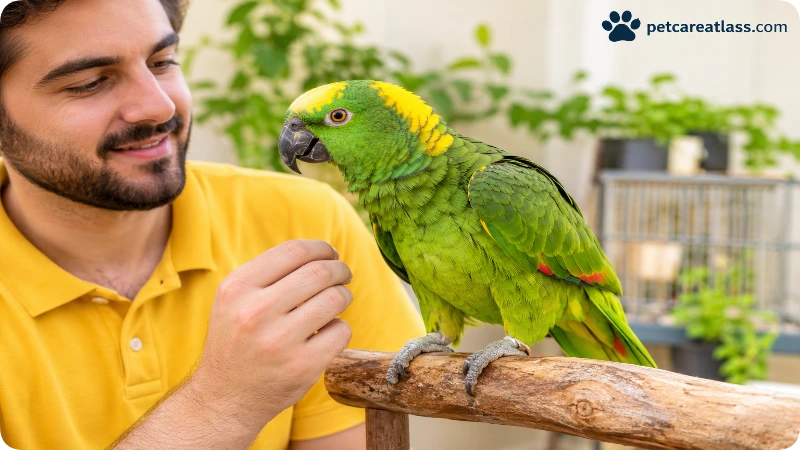
Scientific name: Amazona species
Talking ability: Excellent potential in many individuals.
Why it stands out: Often combines human-speech mimicry with whistling, singing, and expressive vocalizations.
Amazon parrots are popular talking birds known for their colorful feathers, energetic personalities, and impressive vocal abilities.
Many individuals learn familiar words, short phrases, songs, and household sounds. Their voices can be clear and recognizable, although abilities vary across Amazon species and individual birds.
Personality and characteristics:
- Intelligent and energetic.
- Often playful and socially interactive.
- Can imitate speech and music.
- May develop strong preferences for particular people.
- Can produce loud calls and vocalizations.
Care requirements:
Amazon parrots need daily interaction, safe opportunities for movement, foraging activities, and suitable chewing and enrichment materials.
Their noise levels deserve particular consideration. A bird that frequently calls or screams may not suit an apartment or a household with noise-sensitive neighbors.
Some Amazon parrots can live for several decades, making ownership a significant long-term responsibility.
Best suited for: Owners prepared for a larger, vocal, socially demanding companion bird.
4. Indian Ringneck Parakeet
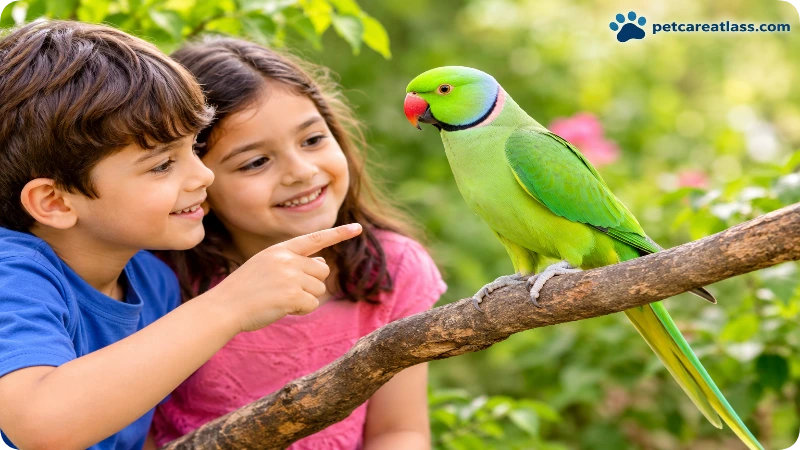
Scientific name: Psittacula krameri
Talking ability: Good to very good potential in some individuals.
Why it stands out: Known for recognizable speech mimicry and a distinctive neck ring in adult males.
The Indian ringneck parakeet, also called the rose-ringed parakeet, is a medium-sized bird recognized by its long tail, colorful plumage, and impressive vocal learning.
Some individuals learn clear words and phrases and can imitate familiar sounds around the home. Their talking abilities make them popular among people interested in interactive companion birds.
Personality and characteristics:
- Curious and intelligent.
- Active and playful.
- Can learn familiar words and sounds.
- May become independent or cautious.
- Benefits from patient, consistent socialization.
Care requirements:
Indian ringnecks need daily enrichment, appropriate toys, exercise, and positive interaction. They also benefit from training that encourages voluntary participation rather than forced handling.
Some individuals become less interested in physical interaction during particular developmental stages. Respecting their body language helps build trust.
Best suited for: Owners who enjoy patient training, interactive activities, and gradually developing a relationship with their bird.
5. Quaker Parrot (Monk Parakeet)
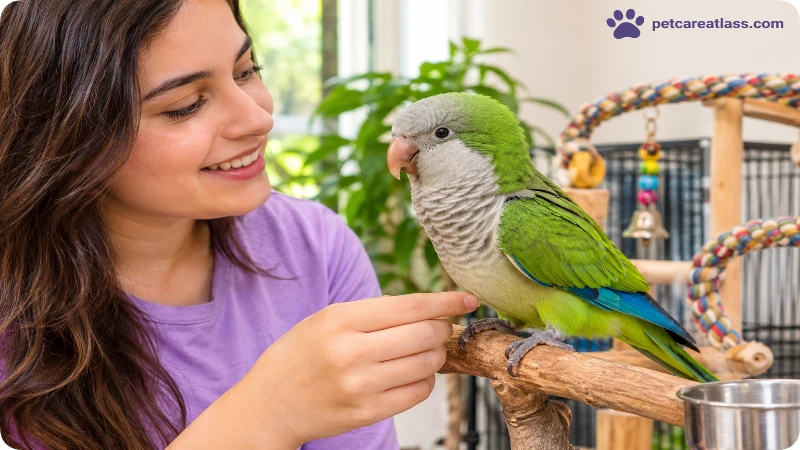
Scientific name: Myiopsitta monachus
Talking ability: Good potential in some individuals.
Why it stands out: A social, energetic parrot that can learn words, phrases, and everyday sounds.
Quaker parrots, also known as monk parakeets, are small-to-medium-sized parrots with distinctive gray facial and chest feathers.
They can learn recognizable human words, short phrases, whistles, and household sounds. Some individuals develop surprisingly expressive vocal repertoires.
Personality and characteristics:
- Curious and energetic.
- Social and playful.
- Often enjoys interactive activities.
- Can become attached to familiar people.
- May vocalize loudly and chew frequently.
Care requirements:
Quaker parrots need daily interaction, safe exercise opportunities, suitable chewing materials, and a stimulating environment.
Before acquiring one, check your current state and local wildlife regulations. Ownership restrictions and other requirements can apply in parts of the United States, and rules may change.
Best suited for: Owners who can provide consistent interaction and have confirmed that Quaker parrot ownership is legally permitted in their area.
6. Eclectus Parrot

Scientific name: Eclectus roratus
Talking ability: Variable, with good potential in some individuals.
Why it stands out: Its striking sexual dimorphism and ability to mimic human speech make it a distinctive companion bird.
Eclectus parrots are particularly recognizable because males and females have dramatically different feather colors.
Males are predominantly bright green, while females have striking red and purple-blue plumage.
They can learn human words and familiar sounds, although their speech abilities differ between individuals. Some develop recognizable vocabularies, while others vocalize less frequently.
Personality and characteristics:
- Intelligent and observant.
- Curious about their surroundings.
- Can learn familiar sounds and phrases.
- May be sensitive to environmental changes.
- Requires species-specific husbandry.
Care requirements:
Eclectus parrots need a carefully planned diet, suitable housing, regular enrichment, and opportunities for exercise.
Their nutritional needs should not be approached with a generic feeding plan designed for every parrot. Work with an avian veterinarian to establish an appropriate diet.
Best suited for: Owners who are prepared to understand and meet the species’ particular dietary, environmental, and social needs.
7. Hill Mynah

Scientific name: Gracula religiosa
Talking ability: Excellent mimicry potential.
Why it stands out: A non-parrot bird known for its ability to reproduce human voices with impressive clarity.
Hill mynahs are an interesting addition to the world of talking companion birds. Unlike parrots, they belong to the starling family, but they are well known for their ability to imitate human speech and other sounds.
Some can reproduce familiar words and phrases with a voice that sounds surprisingly similar to human speech.
Personality and characteristics:
- Intelligent and observant.
- Known for vocal mimicry.
- Can produce a variety of calls and sounds.
- May be noisy.
- Has different social and husbandry needs from parrots.
Care requirements:
Hill mynahs should not be cared for as if they were simply another type of parrot. Their nutritional requirements, housing, hygiene, and social needs differ.
They need an appropriate diet developed for mynahs, a suitable enclosure, regular cleaning, enrichment, and access to an avian veterinarian experienced with the species.
Before obtaining one, check applicable wildlife trade, importation, and state or local ownership requirements. Choose only a legally acquired captive-bred bird.
Best suited for: Experienced bird owners who have researched mynah-specific care and are prepared for their vocal and husbandry needs.
Which Talking Bird Is Best for Your Home?
The best talking bird depends on more than its ability to reproduce human words. Consider its size, noise level, lifespan, social needs, and the amount of daily care you can provide.
The following comparison offers a practical starting point.
| Bird | Speech Potential | Noise Level | Ownership Considerations |
|---|---|---|---|
| African grey | Exceptional | Moderate to high vocal needs | Experienced care preferred |
| Budgie | Very good | Usually relatively quiet | Small but socially active |
| Amazon parrot | Excellent | Often loud | Demanding long-term commitment |
| Indian ringneck | Good to very good | Can have piercing calls | Needs patient socialization |
| Quaker parrot | Good | Can be loud | Check local laws |
| Eclectus | Variable | Varies by individual | Specialized dietary needs |
| Hill mynah | Excellent mimicry | Can be loud | Different care requirements from parrots |
Speech potential and noise descriptions are general observations, not guaranteed characteristics of every individual. Lifespan also varies with health, genetics, and care.
Best Talking Birds for Different Owners
- For impressive speech mimicry: African grey parrots are a leading option.
- For a smaller talking companion: Budgerigars are worth considering.
- For speech and singing: Amazon parrots may be appealing.
- For interactive training: Indian ringnecks are worth researching.
- For a smaller energetic parrot: Quaker parrots may suit some households where legal.
- For a different type of talking bird: Hill mynahs are an interesting alternative, provided their specialized care needs can be met.
Remember that these are starting points for research, not guarantees of compatibility or talking ability.
Do All Pet Birds Learn to Talk?
No. Even birds from species famous for speech mimicry may never learn human words.
Talking ability varies because of several factors:
Species differences: Some birds have stronger vocal-learning abilities than others.
Individual personality: Birds within the same species can develop very different vocal repertoires.
Exposure to sounds: Birds may imitate words, whistles, and noises they regularly hear.
Social environment: Positive interaction provides opportunities for communication and learning.
Individual preferences: Some birds may prefer whistling, singing, or making natural calls instead of imitating speech.
A 2022 study published in Scientific Reports examined vocal mimicry in 877 companion parrots across 73 species. The researchers found significant differences between species, with grey parrots having the largest reported mimicry repertoires in their sample.
The study was based on owner-reported information, so its findings should not be interpreted as a guarantee of how any individual pet will perform.
How Do Pet Birds Learn to Talk?
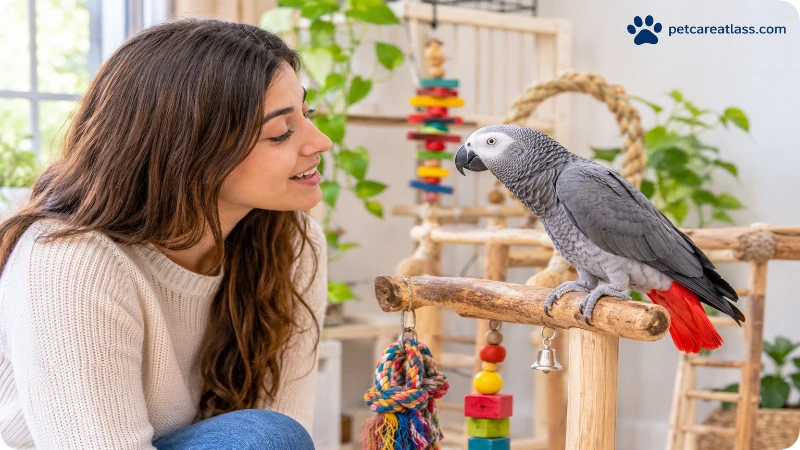
Parrots are vocal learners. They can hear sounds in their surroundings and learn to reproduce them through exposure, practice, and social interaction.
Human speech is one type of sound they may imitate.
For example, a bird that frequently hears someone saying “Good morning” may eventually reproduce a similar sound when that person approaches.
However, imitating human speech does not necessarily mean a bird understands language in the same way a person does. Some parrots use learned vocalizations in recognizable contexts, but the extent of their understanding varies.
How to Encourage Your Bird to Mimic Words
If your bird shows an interest in vocal imitation, you can encourage learning through positive interaction.
- Start with simple words: Choose short, familiar expressions such as “Hello” or “Good morning.”
- Repeat phrases naturally: Use the same words during familiar daily routines.
- Keep interactions positive: Practice briefly and stop when your bird loses interest.
- Reward participation: Use praise or an appropriate favorite reward when your bird makes an effort.
- Allow time: Some birds learn quickly, while others need longer or may never develop human speech.
Never frighten, punish, isolate, or deprive a bird of social interaction to encourage talking.
Remember: A bird does not need to speak to be a wonderful companion. Whistling, exploring, playing, and communicating through natural bird vocalizations are also valuable behaviors.
What to Consider Before Getting a Talking Bird
A bird’s ability to imitate human speech is only one part of responsible ownership. Before bringing one home, consider its long-term needs.
Lifespan and Long-Term Commitment
Some companion birds can live for several decades. African greys, Amazon parrots, and Eclectus parrots may require a commitment that extends through major changes in an owner’s life.
Consider future housing, financial responsibilities, veterinary expenses, and who could care for the bird if your circumstances change.
Noise and Living Environment
Talking birds also produce natural calls, whistles, squawks, and sometimes loud screams.
An Amazon parrot or Quaker parrot may be challenging in a noise-sensitive apartment. Even small birds such as budgies can vocalize frequently.
Consider your neighbors, household members, available space, and tolerance for everyday bird sounds.
Social Interaction and Mental Stimulation
Parrots are intelligent, social animals. They need more than food, water, and a cage.
Provide:
- Daily positive interaction.
- Safe opportunities for movement and exercise.
- Appropriate toys and chewing materials.
- Foraging activities that encourage natural behaviors.
- A predictable sleeping and resting environment.
- Regular checkups with an avian veterinarian.
Avoid keeping a bird isolated for long periods simply because it is expected to entertain you by talking.
Responsible Adoption or Purchase
Consider adopting from a reputable bird rescue or obtaining a bird from a responsible, legally operating breeder.
Before bringing a bird home:
- Ask about its health and background.
- Confirm that it was legally bred or acquired.
- Observe its behavior and living conditions.
- Request relevant veterinary records.
- Arrange an examination with an avian veterinarian.
Avoid wild-caught birds and sellers who cannot explain a bird’s origin.
Frequently Asked Questions
Which pet bird talks the most?
African grey parrots are particularly well known for their extensive human-speech mimicry. A 2022 study of companion parrots also found that grey parrots had the largest reported mimicry repertoires in its sample. However, individual abilities differ, and no bird is guaranteed to become a strong talker.
What is the easiest talking bird for beginners?
Budgerigars are worth considering because they are small, generally less noisy than larger parrots, and capable of learning human speech. However, they still need appropriate housing, daily interaction, exercise, enrichment, and veterinary care.
Are male or female birds better at talking?
There is no universal rule that male birds talk better than females. Vocal mimicry varies by species and individual. Research involving companion parrots found no overall effect of sex on mimicry repertoire size across the full study sample.
Can a pet bird learn to talk without training?
Yes. Some birds imitate familiar sounds simply by hearing them regularly in their environment. Positive interaction can provide additional opportunities for vocal learning, but formal training does not guarantee that a bird will develop human speech.
Do talking birds understand what they say?
Not necessarily. Reproducing a human word does not automatically mean a bird understands its full meaning. Some parrots use learned vocalizations in appropriate contexts, but their level of understanding varies.
How long does it take for a pet bird to start talking?
There is no fixed timeline. Some birds begin imitating sounds relatively early, while others may take much longer or never develop recognizable human speech. Age alone does not determine whether a bird will become a talker.
Can small birds like budgies really talk?
Yes. Some budgerigars can learn numerous recognizable words and phrases despite their small size. Their voices are often higher-pitched than those of larger parrots, but their vocal mimicry can still be impressive.
Conclusion
Pet birds that talk offer an interesting combination of vocal learning, intelligence, and social interaction. African grey parrots, budgerigars, Amazon parrots, Indian ringnecks, Quaker parrots, Eclectus parrots, and hill mynahs are all worth exploring if speech mimicry interests you.
However, the best companion bird is not necessarily the one that learns the most words. Choose a bird whose lifespan, personality, noise level, legal status, and daily care requirements fit your ability to provide a safe and enriching home.

Emily Carter is a pet-care writer with a focus on animal health, nutrition, and everyday pet wellness. She creates practical, easy-to-understand guides that help pet owners make informed and responsible care decisions.