Quick Answer:
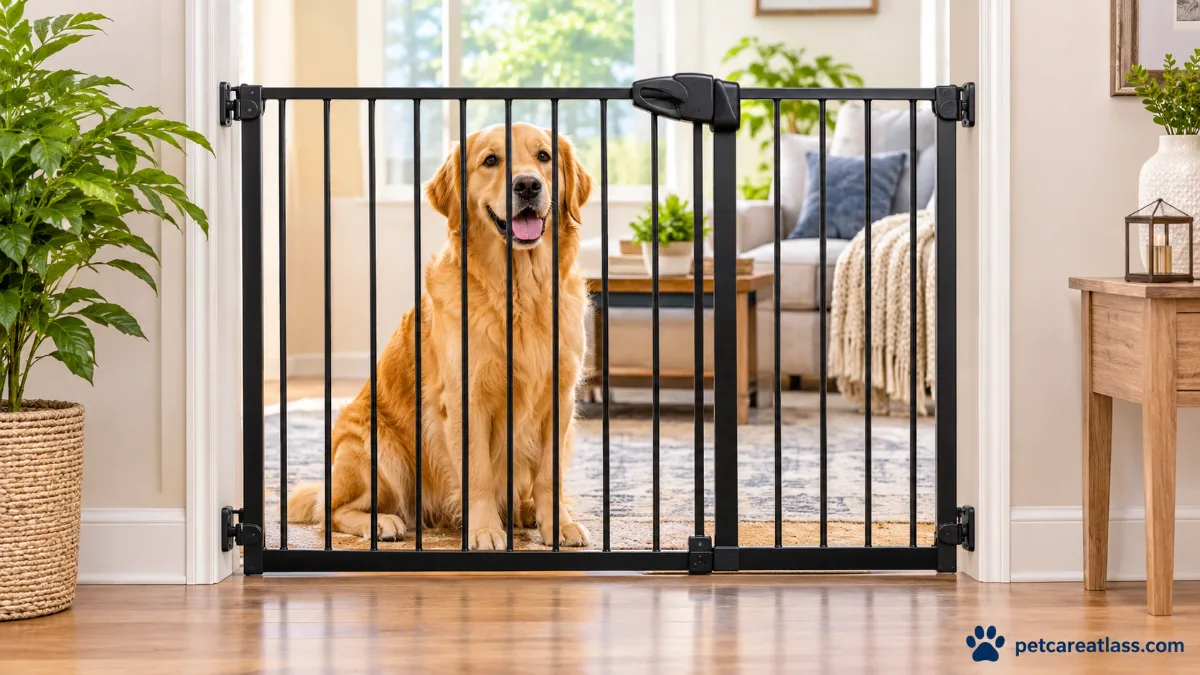
A pet gate for doorway helps create a barrier between rooms, limit access to certain areas, and keep pets away from spaces where they may get into trouble. The right choice depends on your doorway’s width, your pet’s size and behavior, and whether you need a pressure-mounted, hardware-mounted, or walk-through gate. Always choose a secure fit that suits the location.
Choosing the right pet gate for doorway spaces can make everyday life easier when you want to manage where your dog or cat can go inside your home.
Whether you’re keeping a curious puppy out of the kitchen, preventing a cat from entering a particular room, or creating a little separation between pets, the right gate provides a practical way to manage indoor access without closing doors throughout the day.
However, not every pet gate fits every doorway. Width, mounting style, gate height, material, and your pet’s ability to jump or squeeze through all matter when comparing options.
Some gates are designed for quick, tool-free installation, while others offer more secure mounting for frequently used areas.
This guide explains the different types of doorway pet gates, what to consider before buying, how to measure your space, and how to choose an option that works safely for your home and pet.
Why Do You Need a Pet Gate for a Doorway?
A doorway pet gate creates a physical boundary between rooms without requiring you to keep every door closed. It can help manage your pet’s movement while allowing you to maintain visibility and airflow between spaces.
Here are some common reasons pet owners use doorway gates:
- Restrict access to certain rooms: Keep pets away from kitchens, storage areas, bedrooms, or rooms containing fragile belongings.
- Manage puppies: Limit access while puppies learn household routines and boundaries.
- Separate multiple pets: Create temporary separation during feeding, introductions, or supervised interactions.
- Protect household items: Reduce access to furniture, electrical cords, and other objects that pets might chew or damage.
- Create designated spaces: Establish boundaries around areas where pets can relax or play.
- Manage interactions: Help control access between pets and young children while maintaining appropriate adult supervision.
A pet gate is a management tool, not a substitute for supervision or proper pet-proofing. Animals may jump over, climb, chew, or push through barriers that are not suitable for their abilities.
Types of Pet Gates for Doorways
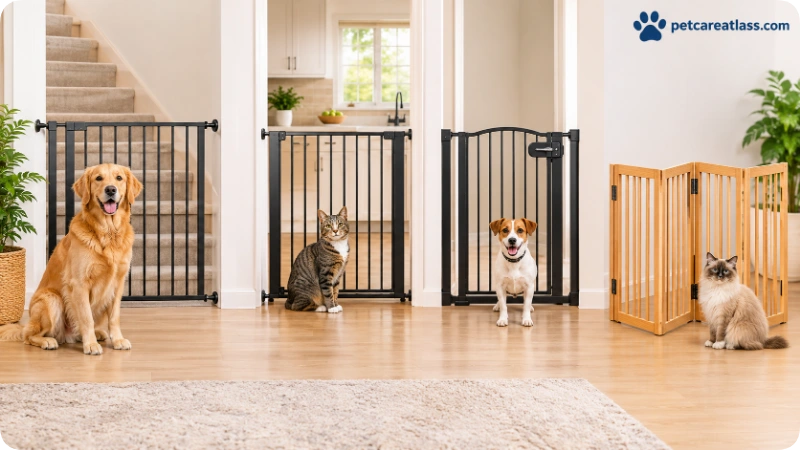
Pet gates are available in several designs, each offering different installation methods, materials, and access options. Understanding these differences can help you select a gate that fits your doorway and your pet’s behavior.
Pressure-Mounted Pet Gates
Pressure-mounted gates use adjustable tension to hold the frame between two supporting surfaces. They generally do not require screws or permanent hardware, making them convenient for many indoor doorways.
Advantages:
- Usually straightforward to install and remove.
- Available in adjustable widths.
- Suitable for many standard interior doorways.
- Convenient for renters who want to avoid drilling.
Limitations:
- Can shift if installed incorrectly.
- May not withstand a large dog pushing forcefully against it.
- Require suitable, stable mounting surfaces.
- Not automatically appropriate for stairways or fall-risk locations.
Follow the manufacturer’s installation instructions and check the gate regularly for movement.
Hardware-Mounted Pet Gates
Hardware-mounted gates attach to a wall or door frame using screws and mounting brackets. They offer a more permanent installation and can be a practical option when a stronger attachment is needed.
Advantages:
- Secure attachment when correctly installed.
- Suitable for many frequently used entrances.
- Available in designs for larger and stronger dogs.
- Some models are specifically designed for stairway openings.
Limitations:
- Require drilling or permanent mounting hardware.
- Take more time to install.
- May leave holes in walls or door frames.
- Require compatible mounting surfaces.
For stairways, use only a model specifically approved for that location and install it according to the manufacturer’s instructions.
Walk-Through Pet Gates
Walk-through gates include a small hinged door that allows people to pass without removing the entire barrier. They are particularly useful in entrances that family members use frequently.
Advantages:
- Convenient for everyday movement.
- Often feature a locking or latching mechanism.
- Available in different heights and widths.
- Reduce the need to step over the barrier.
Limitations:
- The small door creates another possible escape point.
- The latch must remain securely closed.
- Some models have a bottom threshold that can create a tripping hazard.
Check the opening direction and threshold design before purchasing.
Freestanding Pet Gates
Freestanding gates stand independently rather than relying on pressure fittings or permanent wall attachments. Some models feature folding panels that can be repositioned to create temporary boundaries.
Advantages:
- Easy to move around the home.
- Useful for temporary room separation.
- Usually do not require drilling.
- Available in adjustable and folding designs.
Limitations:
- May tip over if pushed.
- Can be unsuitable for strong or determined pets.
- May occupy additional floor space.
- Do not provide the same fixed attachment as a properly installed mounted gate.
Choose a freestanding design only when its stability and intended use are appropriate for your pet.
Retractable Pet Gates
Retractable gates use a flexible mesh barrier that rolls into a housing when not needed. They can be useful when a rigid gate would interfere with movement through the entrance.
Advantages:
- Can be rolled away when not in use.
- Often take up less space when retracted.
- Suitable for certain narrow or awkward openings.
- Provide a flexible alternative to rigid barriers.
Limitations:
- Mesh can be damaged by chewing or scratching.
- Installation and attachment strength vary.
- Some pets may push against or climb the material.
- The locking mechanism needs regular inspection.
Check the manufacturer’s intended use, maximum opening width, and installation requirements.
Pet Gate Materials: Which One Is Best?
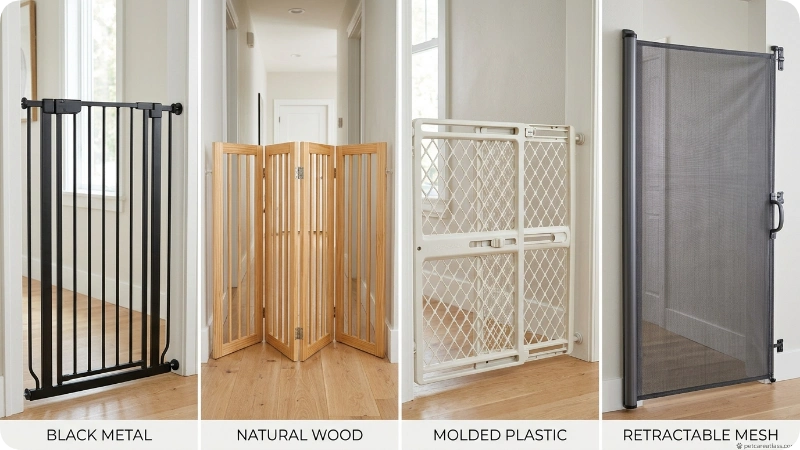
The material affects the gate’s weight, durability, appearance, and resistance to everyday wear. However, the quality of construction and installation also influence how well a gate performs.
Metal Pet Gates
Metal gates are often practical for households with medium or large dogs. Many designs feature vertical bars, adjustable frames, and secure locking mechanisms.
They are generally a good option when you need a rigid barrier, although the quality of the metal, joints, and mounting hardware varies between products.
Best suited for: Households that need a sturdy gate for dogs or other pets that may push against barriers.
Wooden Pet Gates
Wooden gates offer a traditional appearance that can complement furniture and interior décor. They are available in folding, freestanding, and other configurations.
However, wood may develop scratches, splinters, or chewing damage. Inspect the surface regularly.
Best suited for: Calm pets and households that prefer decorative indoor barriers.
Plastic Pet Gates
Plastic gates are generally lightweight and easy to reposition. Some models are designed for smaller pets or temporary separation.
Their strength depends on the material thickness and overall construction. Lightweight designs may not be suitable for pets that push or chew.
Best suited for: Smaller, calmer pets and temporary indoor arrangements.
Mesh and Fabric Pet Gates
Mesh and fabric gates use flexible material stretched across a supporting frame. Retractable versions can roll away when the entrance needs to remain open.
They offer convenience but require regular inspection for tears, loose stitching, and damage.
Best suited for: Households that need a flexible barrier and have pets unlikely to chew or push through the material.
Pet Gate Material Comparison
| Feature | Metal | Wood | Plastic | Mesh/Fabric |
|---|---|---|---|---|
| Durability | Generally high | Varies | Varies | Depends on quality |
| Weight | Moderate–heavy | Moderate–heavy | Usually light | Usually light |
| Chew Resistance | Often better | Can be chewed | Can be damaged | Easily chewed |
| Portability | Varies | Often heavy | Easy | Easy |
| Appearance | Modern | Traditional | Simple | Minimal |
| Maintenance | Check for rust and damage | Check for splinters | Check for cracks | Check for tears |
These are general material characteristics, not guarantees of individual product performance.
How to Choose the Right Pet Gate for Your Doorway
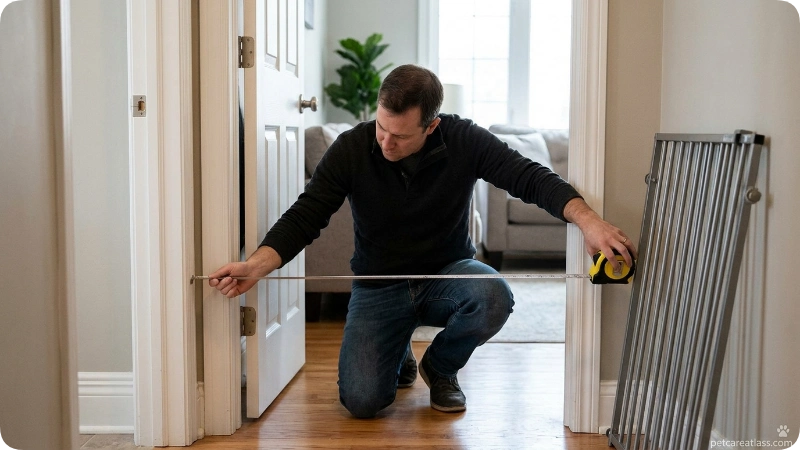
Choosing the right gate involves more than finding a model that fits the opening. You also need to consider your pet’s physical abilities, household layout, and how frequently people use the doorway.
1. Measure Your Doorway Correctly
Measure the opening between the two surfaces where the gate will be installed. Check the manufacturer’s measurement instructions because some models require measurements between the inside edges of a door frame, while others accommodate different mounting positions.
Before ordering, check:
- The minimum and maximum supported width.
- Whether the doorway has decorative trim or uneven surfaces.
- Whether compatible extension panels are available.
- Whether the gate can open without hitting nearby furniture.
- Whether the floor is level enough for the selected model.
Avoid exceeding the manufacturer’s recommended width, even if an extension appears to fit.
2. Select the Appropriate Gate Height
Gate height should reflect your pet’s jumping and climbing ability.
A short barrier might work for a small puppy that does not jump, but it may be ineffective for an athletic adult dog. Cats can also jump over many conventional doorway gates.
Consider your pet’s current abilities and whether they are likely to grow or become more active. Nearby furniture can also provide a convenient surface for climbing over a barrier.
3. Check Bar Spacing and Openings
The spaces between bars matter, especially when you have puppies, kittens, or small dogs.
Look for a design that prevents your pet from squeezing through or getting its head, paws, or body trapped. Also inspect the gap between the gate and the floor.
A solid-panel design may be more suitable for some smaller pets than a gate with widely spaced bars.
4. Examine the Locking Mechanism
A reliable locking system helps prevent accidental openings and makes daily use easier.
Consider these features:
- A secure latch that stays closed.
- A locking mechanism your pet cannot easily operate.
- Smooth opening and closing for adults.
- A door that remains properly aligned.
- No sharp edges or exposed components.
Test the latch after installation and check it periodically for wear.
5. Match the Gate to Your Pet’s Behavior
Your pet’s habits can influence which design is most appropriate.
| Pet Behavior | Gate Feature to Consider |
|---|---|
| Pushes against barriers | Secure mounting and sturdy construction |
| Jumps over low obstacles | Greater height or alternative separation |
| Chews household objects | Durable, chew-resistant materials |
| Squeezes through openings | Narrow spacing or solid panels |
| Scratches mesh | Rigid construction instead of fabric |
| Becomes easily frustrated | Gradual introduction and enrichment |
These are selection considerations, not guarantees that a particular gate will contain every animal.
Best Pet Gate Designs for Different Household Needs
Different homes have different doorway layouts and pet-management requirements. The following comparison can help narrow your choices.
| Household Need | Gate Design | What to Check |
|---|---|---|
| Frequently used doorway | Walk-through gate | Latch and opening direction |
| Rental property | Pressure-mounted gate | Mounting surface compatibility |
| Large or strong dog | Hardware-mounted gate | Frame and mounting strength |
| Wide doorway | Extra-wide adjustable gate | Extension range |
| Temporary room separation | Freestanding gate | Stability and tipping resistance |
| Small puppy or kitten | Narrow-bar or solid-panel gate | Safe opening size |
| Limited storage space | Retractable gate | Mesh strength and locking |
| Decorative separation | Wooden folding gate | Stability and chew damage |
The most suitable design depends on your pet, the doorway, and the manufacturer’s intended use.
How to Install a Pet Gate in a Doorway
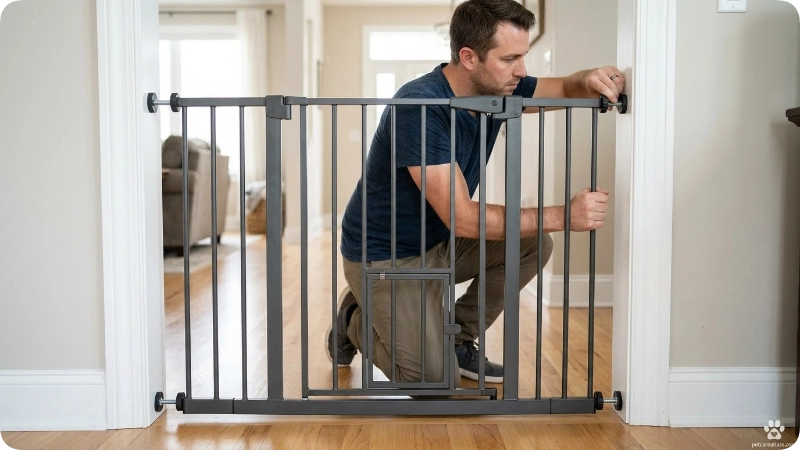
Correct installation is essential for maintaining a stable barrier. Always read the instructions supplied with your specific model because pressure-mounted, hardware-mounted, and retractable gates have different installation requirements.
Step 1: Prepare the Installation Area
Remove nearby furniture, rugs, and objects that could interfere with the gate.
Inspect both sides of the doorway for suitable mounting surfaces. Check that the floor is level and that the gate will not obstruct another door.
Step 2: Assemble the Gate
Follow the manufacturer’s instructions to attach the frame, extensions, hinges, brackets, and other supplied components.
Use only the recommended hardware. Do not substitute unrelated screws or mounting accessories.
Step 3: Position the Gate Correctly
Place the gate in its intended position.
For pressure-mounted models, adjust the tension evenly according to the manufacturer’s instructions. For hardware-mounted models, secure the brackets to the recommended supporting surfaces.
Do not improvise mounting arrangements or exceed the specified installation range.
Step 4: Test the Installation
Before allowing your pet near the gate:
- Check that the frame is correctly aligned.
- Confirm that mounting components are secure.
- Open and close the gate several times.
- Test the locking mechanism.
- Inspect gaps around the frame.
- Check for movement or instability.
Step 5: Inspect the Gate Regularly
Check the gate periodically for loose fittings, damaged bars, worn latches, tears, and other signs of deterioration.
Stop using a gate that becomes unstable or damaged until it has been properly repaired or replaced.
Pet Gate Safety: Common Mistakes to Avoid
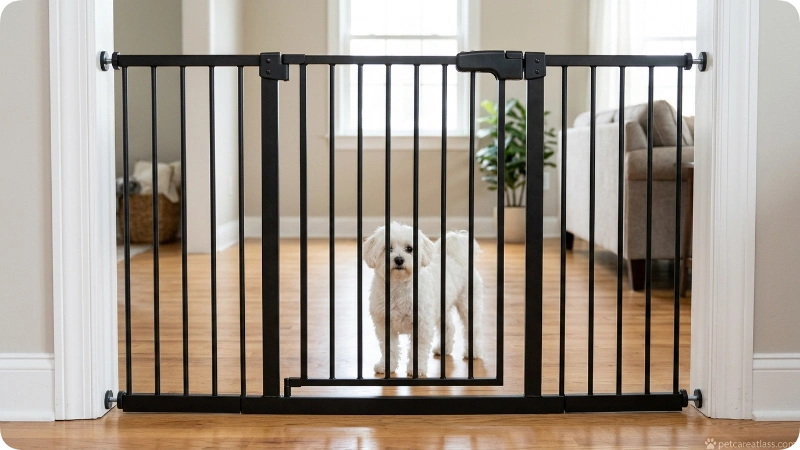
A doorway gate can help manage access, but an unsuitable or incorrectly installed model may create additional risks.
Choosing a Gate That Is Too Short
A short gate may not contain a pet that can easily jump over it. Consider your animal’s jumping ability and nearby furniture that could make climbing easier.
Ignoring Small Openings
Check the spaces between the gate, floor, and surrounding frame. Small pets may squeeze through gaps or become trapped in openings that are too narrow for their bodies.
Using a Damaged Gate
Broken bars, loose connections, damaged mesh, and malfunctioning locks can compromise the barrier.
Replace damaged components only with parts approved by the manufacturer.
Installing an Unsuitable Gate Near Stairs
Stairways require particular care because a displaced or unsuitable barrier can contribute to a fall.
Use a gate specifically approved for the intended stairway location. Follow its mounting instructions and do not assume that a pressure-mounted or freestanding model is appropriate for this purpose.
Treating a Pet Gate as Complete Home Protection
A gate cannot eliminate every household hazard. Keep medications, cleaning products, sharp objects, and other dangerous items inaccessible even when a barrier is installed.
How to Help Your Pet Get Comfortable With a New Gate
Some pets accept a new barrier quickly, while others may bark, scratch, push, or become frustrated when access is restricted.
Introduce the gate gradually rather than immediately leaving your pet alone behind it.
- Allow your pet to investigate the gate while you supervise.
- Reward calm behavior near the barrier.
- Close the gate briefly while remaining nearby.
- Gradually increase the time your pet spends behind it.
- Provide an appropriate resting area or activity.
- Avoid forcing your pet to approach or remain near the gate if it becomes distressed.
If your pet repeatedly attempts to escape, consider whether the barrier is blocking access to something important, such as water, a litter box, or a comfortable resting area.
Persistent distress may require a different separation arrangement or help from a qualified animal behavior professional.
Are Pet Gates Suitable for Cats?
Pet gates can help manage a cat’s access to certain rooms, but conventional doorway models do not necessarily provide reliable containment.
Many cats can jump over or climb gates, particularly designs with horizontal bars that provide footholds.
Consider these alternatives:
- Extra-tall barriers: May discourage some cats, depending on their jumping ability.
- Solid-panel gates: Reduce opportunities to climb between bars.
- Full-height room dividers: May provide more reliable separation when properly secured.
- Enclosed pet areas: Can be more suitable when a cat needs to remain in a designated space.
Consider your cat’s age, mobility, and physical abilities. Older cats or cats with limited mobility may need a different arrangement from young, athletic cats.
Never restrict access to essential resources such as food, water, litter boxes, and comfortable resting areas.
Pet Gate vs. Pet Barrier: What Is the Difference?
The terms pet gate and pet barrier are sometimes used interchangeably, but they can describe different types of household products.
| Feature | Pet Gate | Pet Barrier |
|---|---|---|
| Main Purpose | Blocks access through openings | Creates a physical boundary |
| Placement | Doorways and entrances | Doorways, hallways, open spaces |
| Design | Frame with a latch | Freestanding or panel-based |
| Access | May have a walk-through door | May need repositioning |
| Installation | Pressure or hardware mounted | Depends on design |
| Common Use | Controls access between rooms | Separates household areas |
A pet gate is generally a specific type of barrier. The most suitable option depends on your home’s layout and how you intend to manage your pet’s movement.
When Should You Replace Your Pet Gate?
A pet gate does not necessarily need replacement after a fixed period. Its physical condition and continued suitability are more important than its age.
Consider replacing it when:
- The frame becomes bent or unstable.
- The locking mechanism no longer works reliably.
- Bars become loose or broken.
- Mesh develops tears or holes.
- Mounting hardware becomes damaged.
- Your growing pet can jump over or squeeze through it.
- Your pet repeatedly dislodges the gate.
If the gate no longer provides reliable separation, stop using it until it has been properly repaired or replaced.
Frequently Asked Questions
What is the best pet gate for a doorway?
The best pet gate depends on your animal’s size, strength, behavior, and the doorway’s dimensions. A pressure-mounted gate may suit a calm, smaller dog in an appropriate interior doorway, while a sturdy hardware-mounted model may be more suitable for a stronger dog. Always check the manufacturer’s installation and suitability requirements.
Can I use a pressure-mounted pet gate without drilling?
Yes. Pressure-mounted gates generally use adjustable tension to remain in position without screws. They can be convenient for rental homes and temporary indoor arrangements. However, they must be installed on compatible surfaces and checked regularly. Do not assume every pressure-mounted model is suitable for stairways.
What height should a pet gate be?
There is no universal height that works for every pet. A small puppy may be contained by a shorter barrier, while a large or athletic dog may need a taller gate. Cats can jump over many conventional pet gates, so consider their climbing and jumping abilities before choosing a design.
Are wooden or metal pet gates better?
Metal gates are often a practical choice for stronger pets and animals that chew, while wooden gates may suit calmer pets and homeowners who prefer a traditional appearance. Neither material guarantees containment. Construction quality, mounting stability, bar spacing, and the locking mechanism are also important.
Can a pet gate fit a wide doorway?
Yes. Some models are designed for wider openings and accommodate additional extension panels. Measure your doorway carefully and check the manufacturer’s minimum and maximum width specifications. Avoid combining incompatible extensions or exceeding the recommended installation range.
Do pet gates work for cats?
Some pet gates can help restrict a cat’s movement, but many cats can jump over or climb conventional models. Taller barriers, solid-panel designs, or properly secured full-height dividers may provide more effective separation. Make sure your cat can still access essential resources.
Can I use a baby gate for my dog?
Some baby gates may work for smaller, calmer dogs, but they are not automatically suitable for pets. Consider construction, height, bar spacing, mounting stability, and resistance to pushing or chewing. Choose a model specifically designed for the intended use, and never assume a pet gate is approved for child safety.
Conclusion
Choosing the right pet gate for doorway use starts with measuring the opening and understanding your pet’s behavior. Pressure-mounted, hardware-mounted, walk-through, freestanding, and retractable designs each offer different advantages.
Compare material strength, height, bar spacing, installation requirements, and locking security before purchasing. A properly selected and maintained gate can make everyday pet management easier while helping establish safer boundaries throughout your home.

Emily Carter is a pet-care writer with a focus on animal health, nutrition, and everyday pet wellness. She creates practical, easy-to-understand guides that help pet owners make informed and responsible care decisions.