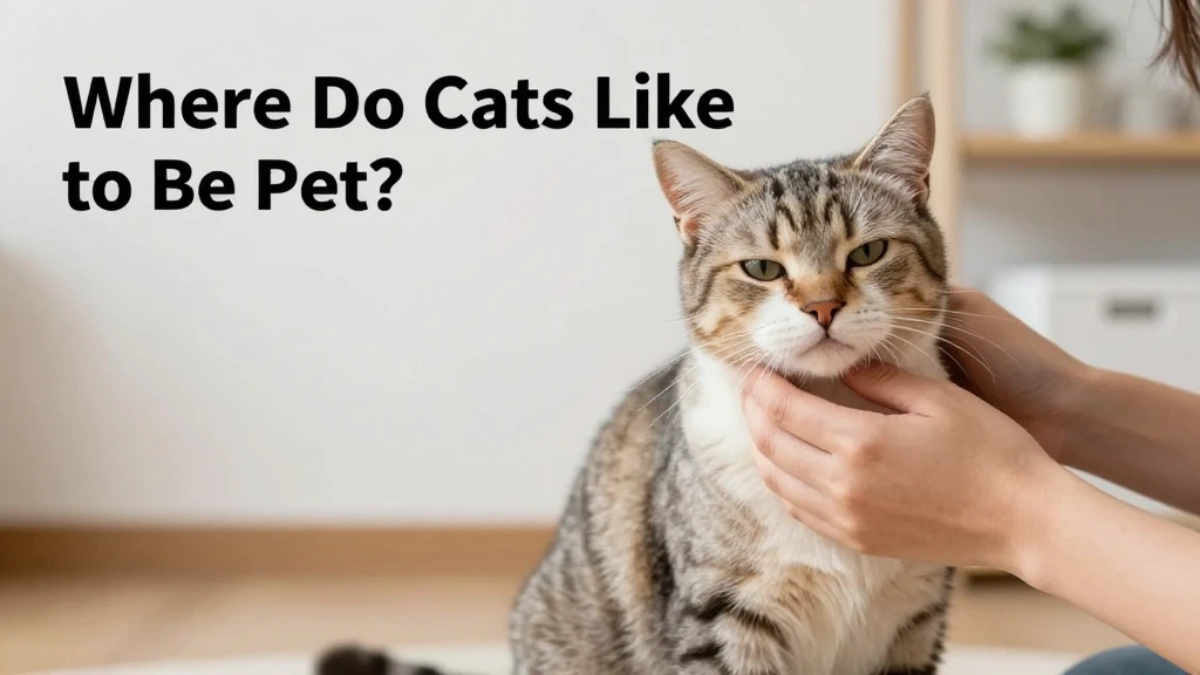
If you’re wondering where do cats like to be pet, most cats tend to enjoy gentle attention around the cheeks, chin, forehead, and other areas of the head. These spots often allow cats to enjoy social contact while still feeling comfortable and in control.
However, there is no single petting spot that every cat prefers. Some cats love gentle strokes along their back or neck, while others may become uncomfortable with too much handling. Learning to read your cat’s body language can help you understand where they like to be pet, where they prefer less contact, and when they have had enough.
Quick Answer
Most cats enjoy gentle petting around the cheeks, chin, forehead, and behind or around the ears. Some also enjoy light strokes along the neck and back. Start with areas your cat approaches with their head or body, use gentle pressure, and stop when they show signs of discomfort. A cat that walks away is telling you it has had enough.
Where Do Cats Like to Be Pet?
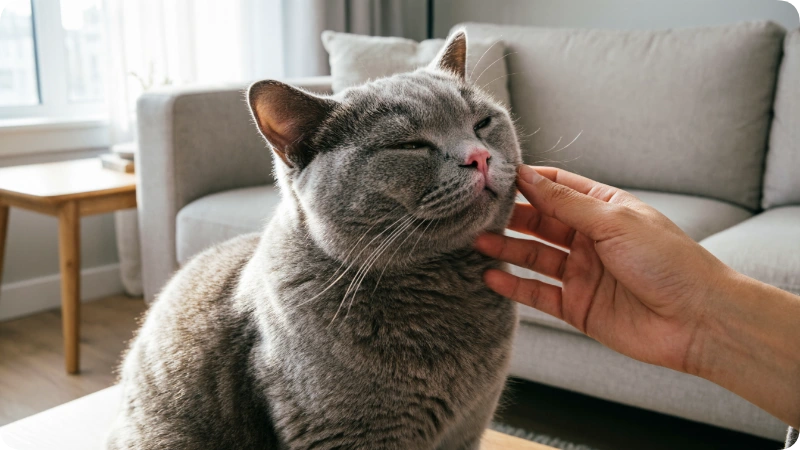
Cats do not all have the same preferences, but many are more comfortable with gentle contact around the head than with being touched everywhere.
Good places to try include:
| Area | How many cats may respond | How to approach it |
| Cheeks | Often well tolerated | Use gentle fingertips or slow strokes |
| Chin | Often well tolerated | Lightly scratch underneath the chin |
| Forehead | Often enjoyable | Stroke slowly from the forehead backward |
| Around the ears | Often enjoyable | Use very gentle pressure |
| Neck | Often tolerated | Try short, light scratches |
| Back | Individual preference | Use slow strokes and watch body language |
| Belly | Often sensitive | Do not assume an exposed belly is an invitation |
| Tail | Highly individual | Avoid grabbing or pulling the tail |
These are general tendencies, not rules. International Cat Care notes that some cats love being stroked and sitting on laps, while others prefer to sit nearby or have contact only when they initiate it.
1. Cheeks
The cheeks are one of the first areas worth trying when a friendly cat approaches you.
Cats have scent glands around the face, including the cheeks, chin, mouth area, and ears. When cats rub their faces against people or objects, they leave scent information behind. This behavior is commonly called bunting or head rubbing.
If your cat pushes its cheek against your hand, that can be a useful invitation to continue gentle contact.
Try:
- Holding your hand still first
- Letting your cat approach
- Gently rubbing the cheek
- Following the direction your cat seems to prefer
- Pausing occasionally to see whether your cat asks for more
2. Under the Chin
Many cats enjoy gentle scratching under the chin.
This is also a useful area for cats that are comfortable with people but do not enjoy long strokes over their whole body. VCA specifically recommends gently rubbing the cheeks or under the chin when a friendly cat chooses to approach a person’s hand.
Use your fingertips rather than applying strong pressure.
If your cat raises its chin toward your hand, stays relaxed, or moves closer, you can continue briefly.
3. Forehead and Top of the Head
The forehead can be another comfortable place to begin.
Some cats respond positively to slow strokes from the forehead toward the back of the head. However, don’t force the movement if your cat turns away.
A useful principle is:
Let the cat participate in the interaction rather than treating petting as something you automatically have permission to continue.
4. Around the Ears
The area around the ears can be pleasant for some cats, especially when touched gently.
However, avoid putting fingers inside the ear canal or pressing on the ear. If your cat suddenly reacts to touch around one ear, particularly if this is a new behavior, don’t keep testing the area.
Pain can make a cat react negatively to being touched, and veterinary evaluation may be appropriate when sensitivity is new or localized.
5. Neck
Some cats enjoy gentle scratching around the neck.
This can be particularly useful if your cat likes short, focused contact rather than long strokes.
Start with a few gentle scratches and pause. If the cat leans toward your hand, you can continue. If it moves away, respect the signal.
6. Back
Many cats enjoy being stroked along their back, but this is much more individual.
A cat might enjoy two or three slow strokes but become irritated if you continue for a long time. Other cats may actively seek repeated back strokes.
This is one reason there is no universal answer to where do cats like to be pet.
Your cat’s reaction matters more than a general list of favorite spots.
Why Do Cats Like Being Petted?
Petting can provide pleasant physical contact and social interaction, but the experience is not identical for every cat.
Cats also communicate through physical contact. Friendly cats may rub their heads or bodies against people and other cats, using scent and physical contact as part of their social communication.
For some cats, petting may also be part of a familiar social routine:
- Greeting their owner
- Seeking attention
- Relaxing beside a trusted person
- Initiating social contact
- Receiving gentle tactile stimulation
- Reinforcing a familiar human-cat relationship
But a cat being near you does not automatically mean it wants to be petted.
VCA notes that some cats enjoy being close to people for companionship or warmth but may not actually want to be stroked at that moment.
How Can You Tell If Your Cat Wants to Be Petted?
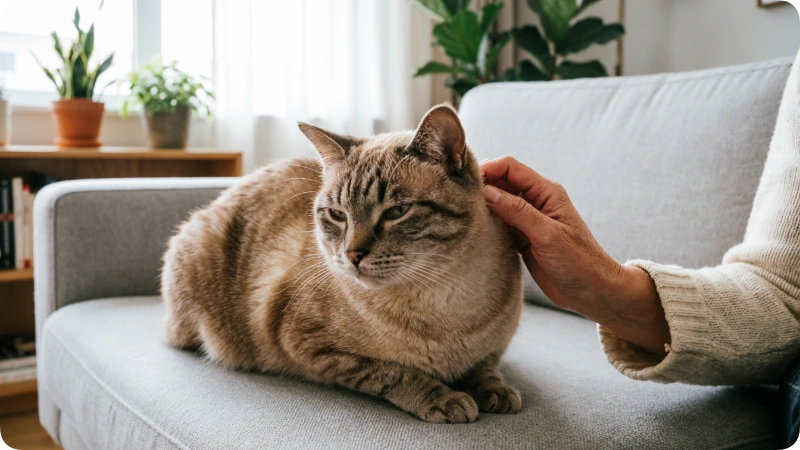
Instead of focusing only on where cats usually like petting, watch what your own cat does.
Signs Your Cat May Be Enjoying It
Your cat may:
- Lean toward your hand
- Push its cheek against you
- Move closer when you stop
- Keep a relaxed body posture
- Hold the ears in a neutral or forward position
- Remain beside you voluntarily
- Rub its head against your hand
- Seek contact again after you pause
A cat that initiates contact can give you particularly useful information about what it wants.
For example, imagine you are sitting on the sofa and your cat walks over, presses its cheek against your hand, and waits. You gently rub its cheek for a few seconds and stop. If the cat moves closer or presents its head again, it may be asking you to continue.
What Does a Cat Look Like When It Has Had Enough?
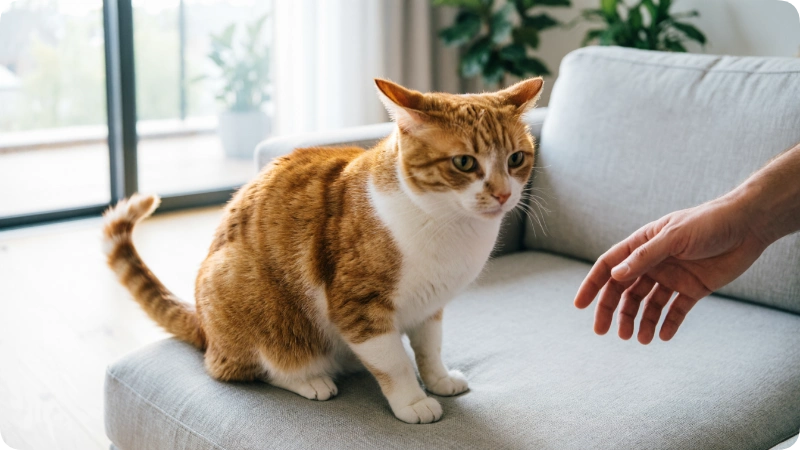
This is just as important as knowing where to pet.
Cats can tolerate or enjoy contact initially and then become overstimulated. ASPCA describes petting-induced aggression as a situation in which a cat may become irritated after repeated petting and then nip, bite, or leave.
Watch for:
- Tail flicking or rapidly moving
- Ears moving backward or sideways
- Body becoming tense
- Skin twitching
- Turning the head toward your hand
- Moving away
- Suddenly becoming restless
- Growling or hissing
- Swatting or biting
VCA similarly advises watching for changes such as pulled-back ears, body tension, and tail flicking while petting.
The Best Response
Stop petting when your cat says “enough.”
Don’t wait for a bite.
This is especially important because a cat may give subtle warning signals before escalating to a stronger response.
Why Does My Cat Bite Me When I Pet It?
A bite does not necessarily mean your cat dislikes you.
Several possibilities can explain this behavior.
Overstimulation
Repeated stroking can eventually become irritating for some cats. What feels pleasant initially may become unpleasant when the same contact continues for too long.
Your Cat Does Not Like That Area
Your cat may enjoy cheek scratches but dislike being touched somewhere else.
For example:
Your cat may happily accept chin scratches but become uncomfortable when you stroke its lower back.
That does not mean the cat is being inconsistent. It means the cat has individual preferences.
Your Cat Wants Something Different
A cat approaching you may want food, play, attention, or simply companionship rather than petting.
VCA notes that a cat may approach its owner or sit nearby without actually wanting to be stroked.
Pain or Sensitivity
If your cat suddenly starts objecting to touch, especially when you touch one particular area, consider a veterinary examination.
Pain can cause a cat to react defensively when an area is handled.
Do Cats Like Their Bellies Rubbed?
Usually, you should not assume that an exposed belly means “please pet me.”
Cats may expose their abdomen while relaxing, stretching, rolling, or communicating in other ways. It does not automatically mean they want a person’s hand on their stomach.
Some individual cats may enjoy belly contact, but others may respond by grabbing, scratching, or biting.
If you don’t already know your cat enjoys belly rubs, stick with areas such as the cheeks, chin, forehead, and neck first.
Do Cats Like Their Tails Being Petted?
The tail is not a good place to start.
A cat’s tail is sensitive and important for communication and movement. Avoid grabbing, pulling, squeezing, or repeatedly stroking the tail.
If your cat moves its tail away from your hand or begins flicking it during petting, treat that as a reason to pause.
A moving tail does not always mean the same thing, so consider the whole body, not just the tail.
How Should You Pet a Cat for the First Time?
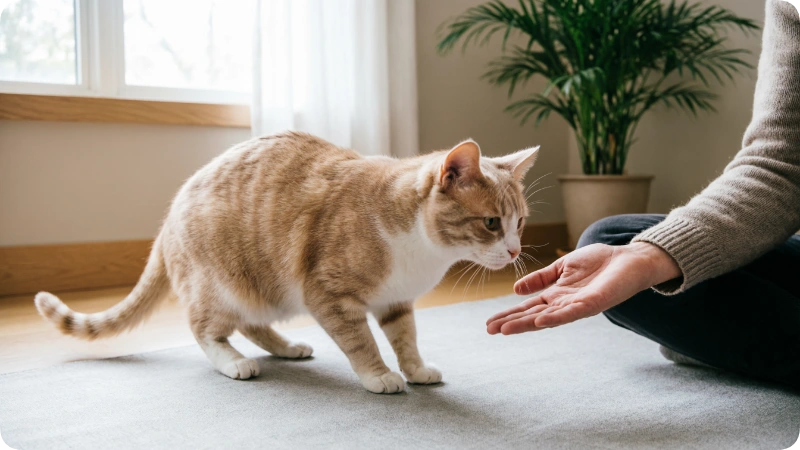
If you are meeting an unfamiliar cat, don’t immediately reach over its head.
Instead, give the cat an opportunity to approach you.
A simple approach
1. Stay calm.
Sit or stand quietly and avoid sudden movements.
2. Offer your hand.
Allow the cat to investigate rather than chasing it with your hand.
3. Let the cat choose.
If the cat approaches or rubs against your hand, you have more information that it is comfortable with interaction.
4. Start around the cheeks or chin.
Use gentle, short movements.
5. Pause.
After a few seconds, stop and see what the cat does.
6. Respect the answer.
If the cat walks away, let it go.
VCA recommends allowing a friendly cat to approach and gently rubbing its cheeks or under the chin; if the cat does not approach or walks away, it should not be pursued.
Cat Petting Preferences Can Change
Your cat’s preferred petting spots may not remain exactly the same throughout its life.
Preferences can be influenced by:
- Age
- Previous experiences
- Personality
- Socialization
- Environment
- Stress
- Current physical comfort
- The person doing the petting
- The situation or time of day
International Cat Care emphasizes that cats differ in how comfortable they are with human contact and that some prefer to initiate interactions themselves.
For example, a confident cat may happily approach visitors, while a shy cat may prefer to interact only with its familiar owner.
How to Find Your Cat’s Favorite Petting Spots
Rather than testing every part of your cat’s body at once, use a simple pause-and-observe method.
| Step | What to do | What you’re looking for |
| 1 | Let your cat approach | Voluntary interaction |
| 2 | Offer your hand | Sniffing or rubbing |
| 3 | Start at the cheek or chin | Relaxed response |
| 4 | Pet briefly | Body remains loose |
| 5 | Stop | Cat chooses what happens next |
| 6 | Repeat only if invited | Continued voluntary contact |
Keep track of what your cat consistently enjoys.
You might discover:
“My cat likes cheek scratches but dislikes long back strokes.”
That is more useful than trying to make your cat fit a general list of “favorite” areas.
What Are Common Cat-Petting Mistakes?
Mistake 1: Petting for too long
Even a cat that enjoys petting can become overstimulated.
Better approach: Use short sessions and pause frequently.
Mistake 2: Assuming purring always means “keep going”
Purring commonly occurs during positive interactions, but you should consider it alongside the cat’s entire body language.
Better approach: Look at posture, ears, tail, facial expression, and whether the cat stays voluntarily.
Mistake 3: Touching the belly because it is exposed
An exposed belly is not necessarily an invitation.
Better approach: Start with the head and cheeks unless your cat clearly enjoys other types of contact.
Mistake 4: Ignoring warning signs
A cat may communicate discomfort before biting.
Better approach: Stop when you see tension, tail flicking, ears moving back, or attempts to move away.
Mistake 5: Forcing a shy cat
Chasing a cat with your hand can make interactions more stressful.
Better approach: Allow the cat to control the pace.
Should You Stop Petting a Cat When It Walks Away?
Yes.
Walking away is a clear reason to end the interaction.
Don’t follow the cat and continue petting it. Giving your cat control over when contact starts and ends can make interactions more predictable and respectful.
Some cats prefer to sit beside their owners without being touched. That is still social interaction.
International Cat Care specifically notes that some cats prefer being nearby rather than being stroked, while others prefer contact only when they initiate it.
When Should You Be Concerned About a Change in Petting Behavior?
A sudden change deserves more attention than a long-standing preference.
Contact your veterinarian if your cat that normally enjoys being touched suddenly:
- Avoids touch
- Reacts painfully to a specific area
- Bites when a particular body area is touched
- Becomes unusually aggressive
- Hides more than usual
- Shows other noticeable behavior changes
Pain is one possible reason for a sudden change in tolerance for handling. VCA recommends veterinary assessment when unexpected aggression or touch sensitivity occurs.
This does not mean every change in petting preference indicates illness. It simply means a sudden or persistent change is worth taking seriously.
Cat Petting Spots: A Simple Comparison
| Body area | Generally a good starting point? | Important consideration |
| Cheeks | Yes | Follow the cat’s response |
| Chin | Yes | Use gentle pressure |
| Forehead | Yes | Keep movements slow |
| Around ears | Often | Don’t press into the ear |
| Neck | Often | Short gentle scratches |
| Back | Sometimes | Individual preference varies |
| Belly | Not usually | Exposure does not equal invitation |
| Paws | Usually not a first choice | Many cats are sensitive about feet |
| Tail | No | Avoid grabbing or pulling |
The word generally is important. Cats are individuals, so one cat’s favorite spot may be another cat’s “please stop” area.
7 FAQs About Where Cats Like to Be Pet
1. Where do cats like to be petted the most?
Many cats enjoy gentle contact around the cheeks, chin, forehead, and head. Some also enjoy the neck or back. However, preferences vary, so your cat’s body language should guide you.
2. Do cats like being petted behind their ears?
Many cats tolerate or enjoy gentle contact around the ears, but individual preferences differ. Use light pressure and avoid putting anything into the ear canal.
3. Do cats like belly rubs?
Some cats do, but many do not. A cat exposing its belly does not automatically mean it wants a belly rub. Start with areas such as the cheeks or chin instead.
4. Why does my cat bite me when I pet her?
Your cat may be overstimulated, dislike the area being touched, want a different type of interaction, or be experiencing discomfort. Stop when you notice early warning signs such as tail flicking or body tension.
5. How can I tell if my cat wants to be petted?
A cat may approach you, rub against your hand, lean into contact, remain relaxed, or return when you pause. A cat that walks away should be allowed to leave.
6. Why does my cat push its face against my hand?
Face rubbing, or bunting, involves scent glands around areas such as the cheeks, chin, and forehead. It can be part of feline scent communication and social interaction.
7. Should I pet my cat if it is purring?
Purring alone should not determine whether you continue. Look at the entire body. If your cat remains relaxed and voluntarily stays close, gentle petting may be welcome; if it becomes tense or tries to leave, stop.
Conclusion
So, where do cats like to be pet? For many cats, the cheeks, chin, forehead, and head are good places to begin. Some enjoy gentle neck or back strokes, while others prefer very little physical contact.
The most important lesson is not memorizing a list of body parts. It is learning your individual cat’s preferences.
Let your cat approach, start gently, pause often, and pay attention to what happens next. If your cat leans closer or asks for more, you can continue. If it becomes tense, flicks its tail, pulls its ears back, or walks away, give it space.
Respecting those signals makes petting more comfortable and helps build trust between you and your cat.

Daniel Brooks is a pet care and animal behavior writer at petcareatlass.com focused on helping owners better understand their pets’ behavior and everyday needs. He creates practical, easy-to-follow content on pet communication, training, welfare, and responsible care.